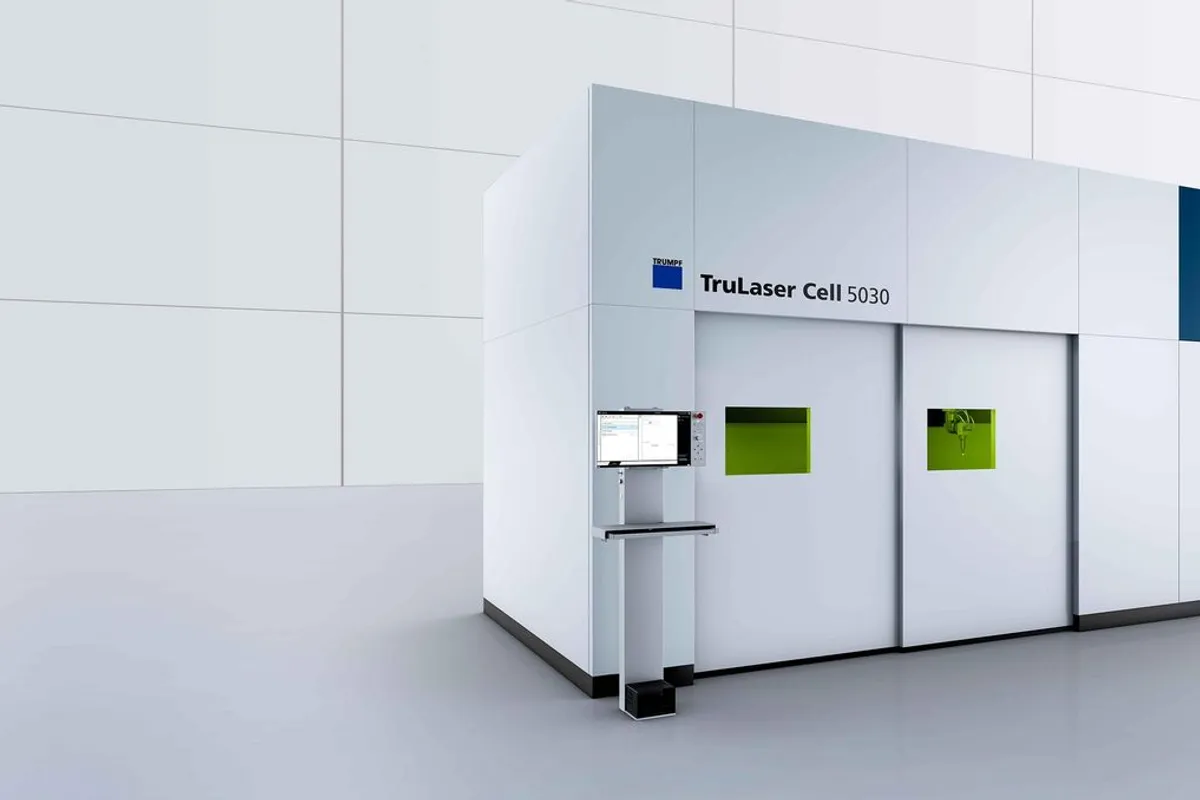
Trumpf TruLaser Cell 5030
Key Specifications
X Travel
Y Travel
Z Travel
Accuracy
working range x
working range y
How much does the Trumpf TruLaser Cell 5030 cost?
Price estimate
We do not have a price for the Trumpf TruLaser Cell 5030 that we can stand behind, so we show no number. Configuration, options and installation move the final price a long way: a quote is the reliable figure.
Overview
The Trumpf TruLaser Cell 5030 is a 5-axis laser cutting cell for formed, three-dimensional sheet metal parts. X, Y and Z travel is 3,000 × 1,500 × 700 mm (118 × 59 × 27.6 in), the B axis swivels ±135° and the C axis rotates without a stop (n × 360°). The beam source is a TruFiber laser of 3,000 to 4,000 W.
The largest workpiece Trumpf lists is 2,540 x 1,040 x 470 mm (100 x 41 x 18.5 in), clearly smaller than the axis travel. The difference is the room the head needs to come around the part: with the optics tilted on B, the nozzle has to reach flanges and side walls from the side, and that takes travel beyond the part itself. Size the cell by the workpiece figure, fixture included, and not by the travel.
Each linear axis moves at up to 60 m/min (2,362 ipm) and accelerates at 8 m/s², or 13.8 m/s² when the axes move simultaneously. The rotary axes turn at 60 rpm. A maximum positioning speed of 104 m/min is listed as well. That is more than any single axis reaches, which fits a move with all three linear axes running together. On a trimmed 3D contour the head changes direction and orientation constantly, so the acceleration figures say more about cycle time than the top speed does.
Positioning accuracy is ±0.08 mm on the linear axes and ±0.015° on the B axis. The table gives no maximum sheet thickness for the 3,000 to 4,000 W laser, so cutting data for your material and gauge has to come from Trumpf.
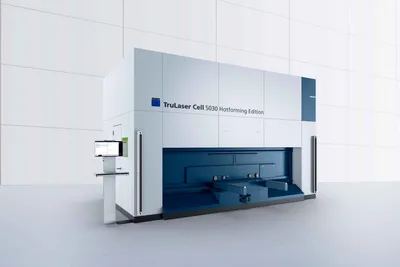
Two neighbours are worth knowing. The TruLaser Cell 8030 has the same 3,000 mm (118 in) of X but less Y and Z, 1,300 mm (51.2 in) and 600 mm (23.6 in), and rapids of 100 m/min. The TruLaser Cell 5030 Hotforming Edition stretches X to 3,300 mm (130 in) and gives up Z, at 600 mm (23.6 in).
Full Specifications
| Parameter | Value |
|---|---|
| Working Range X | 3,000 mm (118 in) |
| Working Range Y | 1,500 mm (59 in) |
| Working Range Z | 700 mm (27.6 in) |
| B Axis Range | ± 135 ° |
| C Axis Range | n × 360 ° |
| Axes | 5 (X, Y, Z, B, C) |
| Laser Power | 3,000 W - 4,000 W |
| Max Workpiece Size | 2,540 x 1,040 x 470 mm (100 x 41 x 18.5 in) |
| Max Linear Speed | 60 m/min (2,362 ipm) per axis |
| Linear Acceleration | 8 m/s2 |
| Simultaneous Acceleration | 13.8 m/s2 |
| Rotary Axis Speed | 60 RPM |
| Linear Positioning Accuracy | +/-0.08 mm |
| Rotary Positioning Accuracy | +/-0.015 degrees (B-axis) |
| X-Axis Travel | 3,000 mm (118 in) |
| Y-Axis Travel | 1,500 mm (59.1 in) |
| Z-Axis Travel | 700 mm (27.6 in) |
| Rapid Traverse X | 60 m/min |
| Max Positioning Speed | 104 m/min |
| Positioning Accuracy | 0.08 mm (0.00 in) |
| Laser Type | TruFiber |
Specifications sourced from trumpf.com — verified 2026-10-03
Strengths & Limitations
Strengths
- Five axes (X, Y, Z, B, C), with ±135° of B swivel and endless C rotation (n × 360°)
- Takes workpieces up to 2,540 x 1,040 x 470 mm (100 x 41 x 18.5 in)
- 700 mm (27.6 in) of Z travel, against 600 mm (23.6 in) on the TruLaser Cell 8030
- Positioning accuracy of ±0.08 mm on the linear axes and ±0.015° on the B axis
- 13.8 m/s² of simultaneous acceleration, with 60 m/min (2,362 ipm) on each linear axis
Limitations
- 60 m/min per axis is well short of the 100 m/min rapids of the TruLaser Cell 8030
- Laser power stops at 4,000 W, and the table gives no thickness limits for it
- The largest workpiece, 2,540 x 1,040 x 470 mm, is smaller than the 3,000 × 1,500 × 700 mm travel, so the travel figures overstate the usable envelope
- No rotary table appears in the table; the TruLaser Cell 5030 Hotforming Edition lists one with two stations and 260 kg per side
Best For
Frequently Asked Questions
01
Trumpf lists a maximum workpiece of 2,540 x 1,040 x 470 mm (100 x 41 x 18.5 in). The axis travel is larger, 3,000 mm (118 in) in X, 1,500 mm (59 in) in Y and 700 mm (27.6 in) in Z, because the cutting head needs room to move around the part. Use the workpiece figure, with the fixture included, when checking whether a part fits.
02
Five: X, Y and Z plus two rotary axes at the head. B swivels ±135° and C rotates without a stop (n × 360°). The rotary axis speed is 60 rpm and positioning accuracy on the B axis is listed as ±0.015°. Together the two rotary axes let the beam stay square to a surface that curves or steps in three dimensions.
03
A TruFiber laser of 3,000 W to 4,000 W. The table gives no maximum material thickness for either end of that range, so thickness capability in your material is something to request from Trumpf, ideally with sample cuts. The TruLaser Cell 8030 is listed with the same 3,000 W to 4,000 W.
04
Each linear axis runs at up to 60 m/min (2,362 ipm) with 8 m/s² of acceleration, rising to 13.8 m/s² with the axes moving simultaneously. A maximum positioning speed of 104 m/min is also listed. The TruLaser Cell 8030 is the quicker cell, with rapids of 100 m/min.
05
The TruLaser Cell 5030 Hotforming Edition has 3,300 mm (130 in) of X travel and 600 mm (23.6 in) of Z, and is listed with a two-station rotary table carrying 260 kg per side. The standard TruLaser Cell 5030 has 3,000 mm (118 in) of X and 700 mm (27.6 in) of Z, and its table of figures includes no rotary table.
Videos

TRUMPF Inc.
Mid Atlantic Machinery Group

Mid Atlantic Machinery Group
More from Trumpf
Other CNC Laser Cutting Machines
LVD Puma 6020
CHMER PL6880
Penta Laser WPB 6025 / 9025