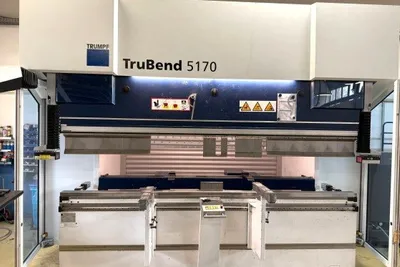
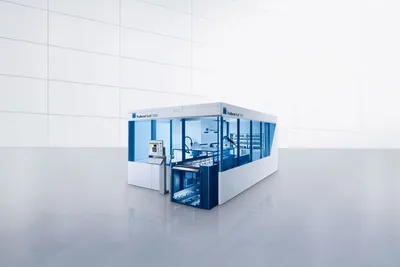
Trumpf TruBend Center 7000
Key Specifications
models
max bending length
min bending length
max box height
max part size 7020
max part size 7030
Overview
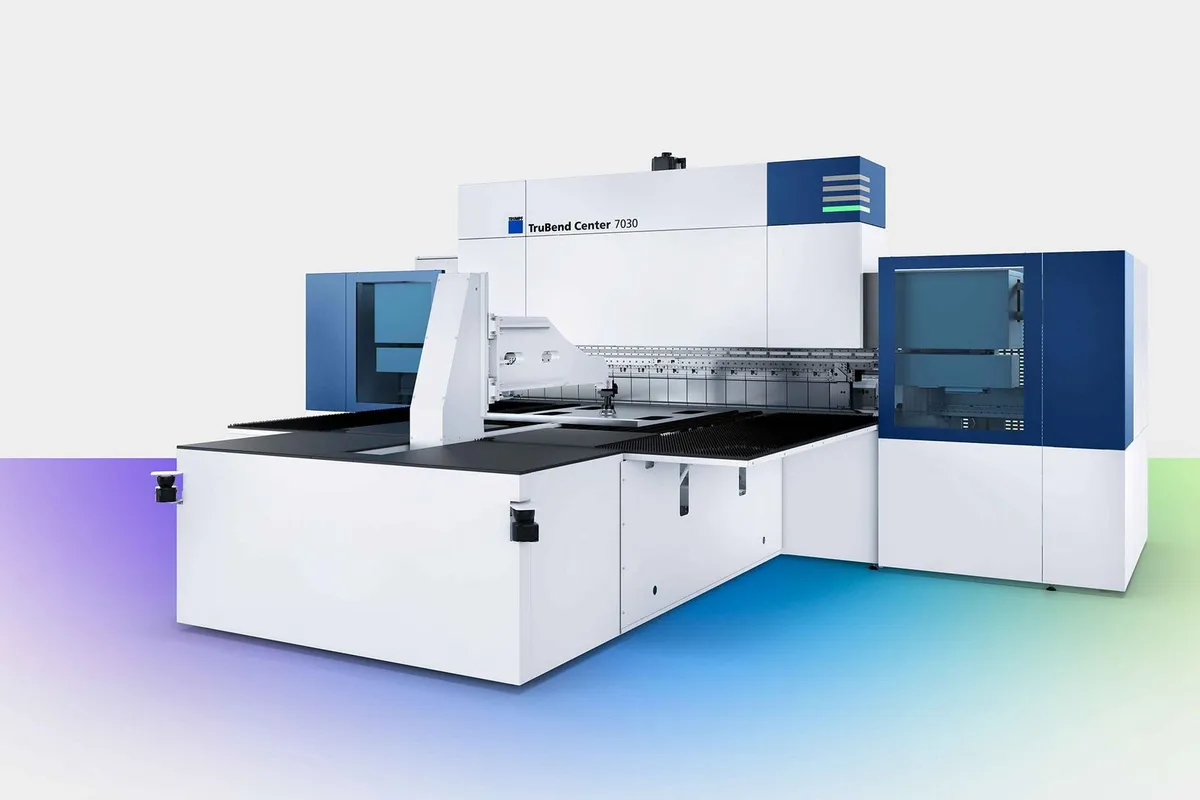
The Trumpf TruBend Center Series 7000 is a fully automated panel bender -- a fundamentally different machine from a conventional press brake. Where a standard press brake uses a ram-and-die setup that requires an operator to position and hold the workpiece, the TruBend Center grips the sheet, positions it automatically, and bends it using articulated bending blades from above and below. The result is a machine that produces complex multi-bend parts with zero operator handling during the bending cycle. For high-volume production of sheet metal panels, enclosures, and cabinets, this technology category delivers throughput and consistency that no manual press brake can match.
The series includes two models: the TruBend Center 7020 with a maximum bending length of 2,163 mm and the larger 7030 with 3,123 mm. Both handle minimum bending lengths down to 200 mm. The 7020 produces box parts up to 350 mm tall, while the 7030 reaches 220 mm box height. Material capacity covers mild steel up to 3 mm (400 MPa), stainless steel up to 2.2 mm (700 MPa), and aluminum up to 4 mm (265 MPa), with a minimum material thickness of 0.4 mm.
The bending process is fully automatic once the blank is loaded. The manipulator grips the sheet, positions it against the bending tools, and the upper and lower bending blades form each bend in sequence. The manipulator repositions the sheet between bends without operator intervention. This eliminates the operator skill variable that affects quality on conventional press brakes -- every part comes out the same regardless of who loaded the blank.
Angle accuracy is managed through the ACB Laser angle sensor, which measures the actual bend angle and corrects in real time. Mark-free bending capability is available for parts where surface cosmetics matter -- no die marks or pressure marks on visible surfaces. That's a significant advantage for architectural panels, consumer appliance enclosures, and any application where the bent surface is the finished visible surface.
The TruBend Center 7020 fits in a 5,200 x 4,855 mm footprint at 21,500 kg, while the 7030 needs 6,490 x 5,327 mm at 31,600 kg. Average power consumption is 10 kW for the 7020 and 15 kW for the 7030. The control runs on Windows Embedded Standard with Trumpf's panel bending software that handles flat-pattern import, bend sequence optimization, and collision simulation.
New TruBend Center 7000 machines typically run $500,000 to $900,000 depending on model and options. The 7020 sits at the lower end, while a fully configured 7030 with loading/unloading automation approaches the upper range. Panel benders are a different capital equipment category than press brakes -- they justify the investment through labor elimination, consistent quality, and throughput on the right part profiles.
Full Specifications
| Parameter | Value |
|---|---|
| Models | TruBend Center 7020, TruBend Center 7030 |
| Max Bending Length | 2,163 mm / 85.2 in (7020) | 3,123 mm / 122.9 in (7030) |
| Min Bending Length | 200 mm (7.9 in) |
| Max Box Height | 350 mm / 13.8 in (7020) | 220 mm / 8.7 in (7030) |
| Max Part Size 7020 | 2,160 x 1,500 mm (85.0 x 59.1 in) |
| Max Part Size 7030 | 3,120 x 1,500 mm (122.8 x 59.1 in) |
| Max Steel Thickness | 3 mm (0.118 in) at 400 MPa |
| Max Stainless Thickness | 2.2 mm (0.087 in) at 700 MPa |
| Max Aluminum Thickness | 4 mm (0.157 in) at 265 MPa |
| Min Material Thickness | 0.4 mm (0.016 in) |
| Angle Measurement | ACB Laser (automatic correction) |
| CNC Control | Windows Embedded Standard with Trumpf panel bending software |
| Power Supply | 53.4 kVA (7020) | 80 kVA (7030) |
| Avg Power Consumption | 10 kW (7020) | 15 kW (7030) |
| Machine Dimensions 7020 | 5,200 x 4,855 x 3,326 mm (204.7 x 191.1 x 130.9 in) |
| Machine Dimensions 7030 | 6,490 x 5,327 x 3,345 mm (255.5 x 209.7 x 131.7 in) |
| Machine Weight | 21500 kg |
| Maximum Bending Length | 2163 mm |
| Minimum Bending Length | 200 mm |
| Maximum Box Height | 350 mm |
| Maximum Part Size | 2160 mm x 1500 mm |
| Maximum Part Diagonal | 2640 mm |
| Minimum Bending Depth | 145 mm |
| Min Biegetiefe | 30 mm |
| Max Materialdicke Stahl | 3 mm (400 MPa) |
| Maximum Material Thickness Stainless Steel | 2.2 mm (700 MPa)2 |
| Maximum Material Thickness Aluminum | 4 mm |
| Minimum Material Thickness | 0.4 mm |
| Anschlussleistung | 53.4 kVA |
| Durchschnittliche Leistungsaufnahme | 10 kW |
| Geruschpegel | 73.4 dB |
| Betriebssteuerung | Windows Embedded Standard 10 |
| Length | 5200 mm |
| Width | 4855 mm |
| Height | 3326 mm |
| Maschinenhhe | 3328 mm |
| Min Hall Height | 4260 mm |
| Automation Counts | Because automated material handling, flexible gripper systems and tool changers and a wide range of software enable networked, automated processes. |
| Cycle Times Counts | Because the fully automatic manipulation of the parts, and fast edge direction changes enable maximum efficiency and short cycle times. |
| User Friendliness Counts | Because intuitive operation and simple offline programming with the TRUMPF TecZone Bend software make even complex sheet metal parts accessible. |
| Precision Counts | Because the patented angle sensor ACB laser automatically corrects every bend, ensuring high part quality in the long term. |
| Service Counts | Because fast solutions count in everyday production, technical support, targeted training and high-quality TRUMPF bending tools ensure smooth processes. |
Specifications sourced from trumpf.com — verified 2026-03-28
Strengths & Limitations
Strengths
- Fully automated panel bending eliminates operator handling during the bending cycle -- the manipulator grips, positions, and repositions the sheet for every bend automatically
- Consistent part quality independent of operator skill -- every part comes out identical, eliminating the human variable that affects conventional press brake bending
- Mark-free bending capability produces pristine surfaces for architectural panels, appliance enclosures, and cosmetic applications where die marks are unacceptable
- ACB Laser angle measurement with automatic correction ensures angle accuracy across material batches without test bends or manual adjustment
- Low power consumption (10-15 kW average) keeps operating costs manageable despite the machine's size and capability
- Handles material from 0.4 mm to 4 mm aluminum, covering the full range of thin-to-medium gauge panel bending applications
Limitations
- Major capital investment at $500K-$900K for a machine that only makes sense with high-volume panel and enclosure production to justify the cost
- Limited to thin-to-medium gauge material -- 3 mm mild steel maximum means heavy plate work is completely outside this machine's capability
- Large footprint (5,200 x 4,855 mm for the 7020) requires significant dedicated floor space plus clearance for material handling
- Panel bender technology requires different programming skills and workflow than conventional press brakes -- existing press brake operators need retraining
- Box height limitations (350 mm on 7020, 220 mm on 7030) restrict the depth of enclosed parts the machine can produce
Best For
Frequently Asked Questions
01
New TruBend Center 7020 machines typically start around $500,000, while the larger 7030 ranges from $650,000 to $900,000 depending on automation options and tooling packages. Loading and unloading automation adds to the base price. These are specialized high-volume production machines -- the investment only makes sense with sufficient panel bending volume to justify the capital.
02
A press brake uses a ram and die with an operator holding and positioning the workpiece for each bend. A panel bender like the TruBend Center grips the sheet with a manipulator, positions it automatically, and bends it using articulated bending blades from above and below. The operator loads a flat blank and unloads a finished part -- everything in between is automatic. Panel benders excel at multi-bend panel-type parts; press brakes handle a wider range of part geometries and material thicknesses.
03
The 7030 handles longer parts (3,123 mm vs 2,163 mm max bending length) and larger blanks (3,120 x 1,500 mm vs 2,160 x 1,500 mm). The 7020 has a taller maximum box height (350 mm vs 220 mm), making it better for deeper enclosures. The 7030 is larger (31,600 kg vs 21,500 kg) and consumes more power. Material thickness capacity is identical for both models.
04
Mark-free bending forms the sheet without the pressure marks, die marks, or surface impressions that conventional press brake tooling leaves on the workpiece. This is critical for pre-painted or pre-finished materials, architectural panels, appliance enclosures, and any application where the bent surface is visible in the final product. The TruBend Center achieves this through its blade-style bending mechanism rather than a conventional punch-and-die setup.
05
For panel-type parts (flat blanks bent into boxes, channels, U-shapes, and enclosures) in thin-to-medium gauge, the TruBend Center is dramatically more productive than a press brake. But it cannot replace a press brake for thick plate, deep draws, complex 3D forms, or parts that don't fit the panel bending workflow. Most shops that invest in a TruBend Center keep their press brakes for the work that doesn't suit panel bending.
06
Salvagnini is the other major player in automated panel bending, with the P4 being their flagship. Salvagnini has a longer history in panel bending and a larger installed base. Trumpf brings its laser and sheet metal ecosystem integration advantage. Both produce excellent results on panel-type parts. The decision often comes down to service network proximity, software ecosystem preference, and which manufacturer's part handling approach better suits your specific part geometries.
Videos
TRUMPFtube
TRUMPFtube
TRUMPF Inc.
Icon Machine Tool, Inc.
TRUMPFtube
Community Discussions
Community discussion — Press brake talk Trumpf, Amada etc. - Practical Machinist
Pricing and buying discussion — Fabrication: CNC Laser, Waterjet, Plasma, Welding | Trumpf ...
Troubleshooting and problem-solving — Fabrication: CNC Laser, Waterjet, Plasma, Welding | Trumpf ...
Maintenance and service — Fabrication: CNC Laser, Waterjet, Plasma, Welding | TrumpF ...
Troubleshooting and problem-solving — Need Help! Trumpf Laser Cutting Troubleshooting.... - CNCzone
Troubleshooting and problem-solving — Need Help! Trumpf laser error codes? - cnczone.com
Troubleshooting and problem-solving — TRUMPF PLC Error code 07117000 - CNCzone
Troubleshooting and problem-solving — Trumpf press brake protective beam - CNCzone
Links to community discussions. Summaries are editorial — visit the original thread for full context.