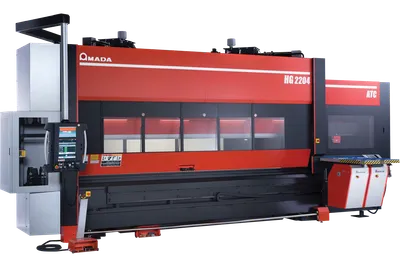
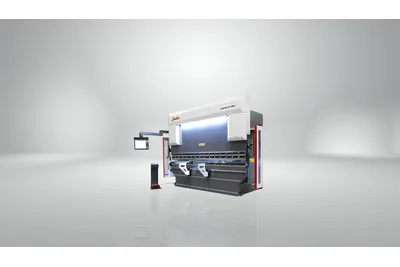
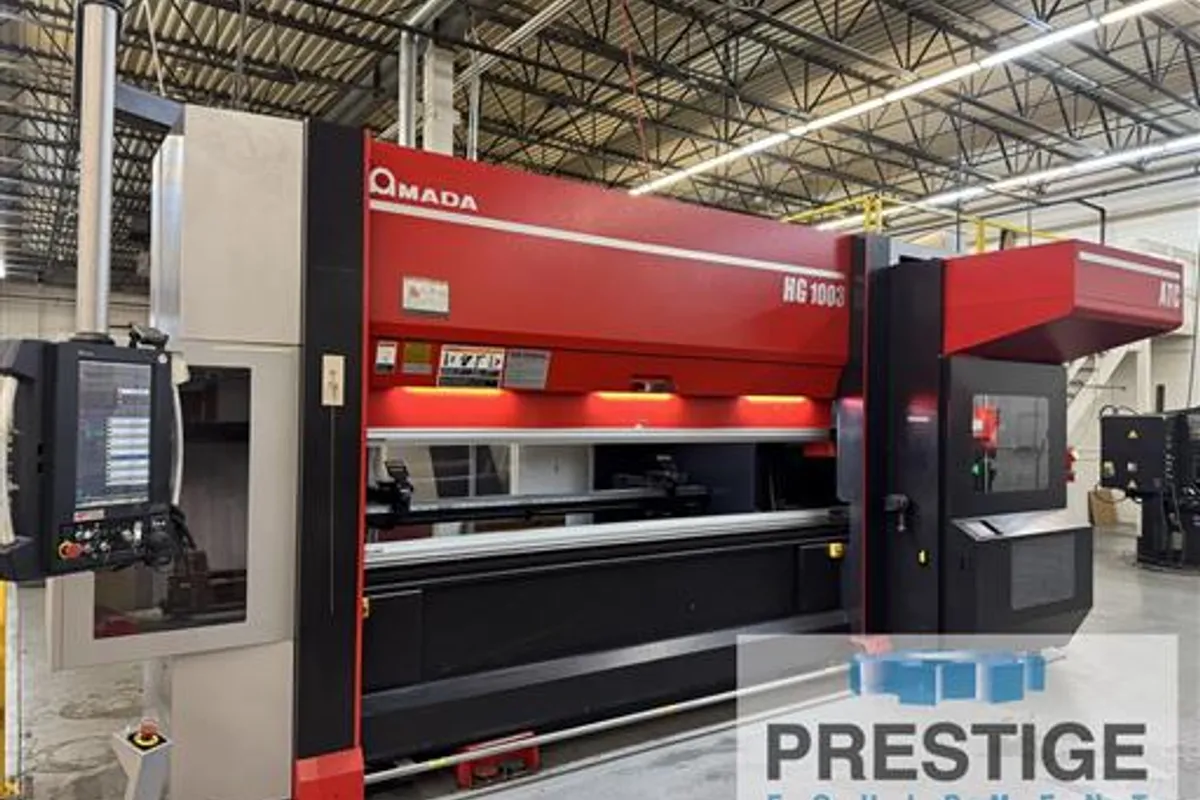
Amada HG-1003
This model was not found in Amada's current lineup when we checked on 2026-10-03 . It may be a superseded or older model; the specifications below are as we last recorded them.
Key Specifications
open height
pressing speed
ram repeatability
back gauge axes
drive system
power requirement
How much does the Amada HG-1003 cost?
Estimated price range
Our best estimate for a cnc press brake in this class — not a quote from Amada. Configuration moves it a long way.
Overview
The Amada HG-1003 is a CNC press brake with a Dual Servo Power (hybrid servo-hydraulic) drive, an 8-axis back gauge with L-shift and ATC tool storage holding 26.4 m (86 ft) of tooling. It is not in Amada's current lineup, so this page is mainly a reference for someone looking at a used machine, and the listed figures should be checked against the machine's own plate and manual before any decision.
The listed figures say more about precision and changeover than about part size. Ram repeatability is ±0.001 mm (±0.00004 in) and pressing speed is 20 mm/sec (47 ipm). Open height is 596 mm (23.5 in), which is the room available for the punch, the die and the flange that has to swing up between them. Press capacity, bending length and stroke are not listed. Those decide whether a part fits at all, so get them from the seller first.
Installation needs planning. With the ATC the machine is listed at 10,500 kg (23,149 lb), 7,062 mm (278 in) long, 3,156 mm (124.3 in) wide and 2,997 mm (118 in) high, and the power requirement is 200V, 22 kVA. That weight falls between the 7,200 kg listed for the HG 8025 and the 13,800 kg of the HG 1703, although neither of those two rows says whether a tool changer is included.
Full Specifications
| Parameter | Value |
|---|---|
| Open Height | 596 mm (23.5 in) |
| Pressing Speed | 20 mm/sec (47 ipm) |
| Ram Repeatability | ±0.001 mm (±0.00004 in) |
| Back Gauge Axes | 8-axis with L-shift |
| Drive System | Dual Servo Power (hybrid servo-hydraulic) |
| Power Requirement | 200V, 22 kVA |
| Machine Weight ATC | 10,500 kg (23,149 lb) |
| Machine Length | 7,062 mm (278 in) |
| Machine Width | 3,156 mm (124.3 in) |
| Machine Height | 2,997 mm (118 in) |
| ATC Tool Storage | 26.4 m (86 ft) of tooling |
Specifications compiled from manufacturer literature and industry references. Not independently verified against a published spec sheet — confirm with the manufacturer or an authorised dealer before making a purchasing decision.
Strengths & Limitations
Strengths
- Ram repeatability is listed at ±0.001 mm (±0.00004 in), which supports consistent angles from the first part of a batch to the last
- ATC tool storage of 26.4 m (86 ft) of tooling keeps a wide range of punches and dies on the machine between jobs
- 8-axis back gauge with L-shift, for parts that need more than a straight front-to-back stop
- Dual Servo Power (hybrid servo-hydraulic) drive, listed with a power requirement of 200V, 22 kVA
Limitations
- No press capacity, bending length or stroke appears in the listed figures, so the part range has to be confirmed with the seller
- Open height of 596 mm (23.5 in) limits the combined height of tooling and deep box or channel sections
- With the ATC the machine is listed at 10,500 kg (23,149 lb) and 7,062 mm (278 in) long, so floor loading, rigging and access need checking
- Only the pressing speed of 20 mm/sec (47 ipm) is listed; approach and return speeds are not, so cycle time cannot be worked out from the table
Best For
Frequently Asked Questions
01
Neither is in the listed figures, and nor is the stroke. What is listed for the working area is an open height of 596 mm (23.5 in). Ask the seller for the capacity plate and the manual of the machine on offer, and check your longest and thickest parts against them before going further.
02
ATC tool storage is listed as 26.4 m (86 ft) of tooling. The figure is a total length of tool segments, not a count of tools, so compare it with the summed length of the punches and dies your regular jobs call for. The split between punches and dies is not listed.
03
The drive is listed as Dual Servo Power (hybrid servo-hydraulic) and the back gauge as 8-axis with L-shift. Ram repeatability is ±0.001 mm (±0.00004 in) and pressing speed is 20 mm/sec (47 ipm). The control is not named in the listed figures, so confirm which one is fitted to a used machine.
04
The listed figures are 7,062 mm (278 in) in length, 3,156 mm (124.3 in) in width and 2,997 mm (118 in) in height, with a weight of 10,500 kg (23,149 lb) including the ATC. The power requirement is 200V, 22 kVA. Check door and crane clearances against the height and length, and confirm the supply at the machine's intended position.
Videos

AMADA AMERICA, INC.
evsmetal

Elite Machinery Inc.

Estes Design & Manufacturing
Community Discussions
Links to community discussions. Summaries are editorial — visit the original thread for full context.