Industrial CNC Machine Directory

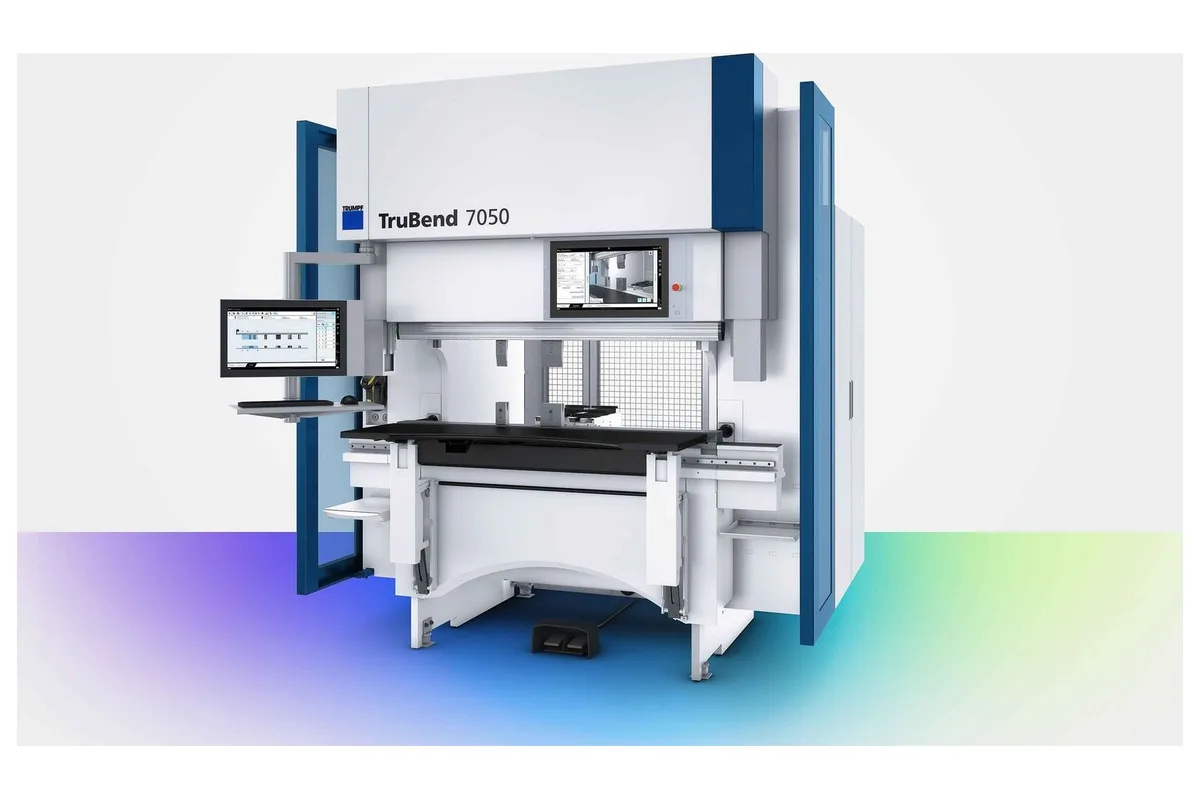
TRUMPF TruBend 7050

$140,000 - $200,000 (new, configuration dependent) Updated 2026-03-17
01

Key Specifications

press force

500 kN / 50 metric tons (55 US tons)

bending length

1,530 mm (60.2 in)

distance between uprights

1,422 mm (56 in)

usable mounting height

295 mm (11.6 in)

throat depth

150 mm (5.9 in)

y axis stroke

120 mm (4.7 in)

02

Overview

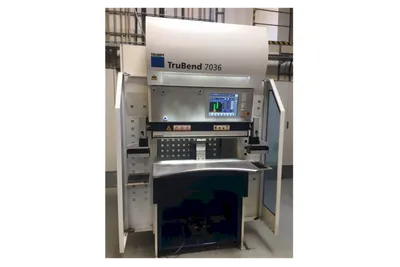
The TRUMPF TruBend 7050 is the larger sibling to the TruBend 7036 in TRUMPF's fully electric Series 7000 press brake line — marketed as the fastest bending platform in the world. With 500 kN (50 metric tons / 55 US tons) of press force and a 1,530 mm (60.2 in) bending length, the 7050 steps up from the 7036's 40-ton / 1,020 mm envelope to cover a broader range of small and medium parts without giving up any of the speed, precision, or ergonomic advantages that define the 7000 series.

The core technology is TRUMPF's gearless electric direct drive — no hydraulics, no oil, no warm-up period. The Y-axis rapid speed reaches 220 mm/s (8.7 in/s) with a maximum bending speed of 25 mm/s, delivering up to 80 strokes per minute at the 7050's tonnage. Because the drive is electric, performance is consistent from the first bend of the day; there's no thermal drift from hydraulic fluid heating up over a shift. Y-axis positional accuracy holds at +/- 0.002 mm (0.00008 in), and the X/R backgauge axes hold +/- 0.02 mm (0.0008 in).

The 6-axis CNC backgauge is constructed from carbon fiber, keeping repositioning mass low so the backgauge fingers move at 1,000 mm/s (2,362 ipm). That speed matters when you're running a high-mix schedule: minimal dwell time between bends keeps actual cycle time close to theoretical cycle time. The Touchpoint TruBend touchscreen control (TASC 6000 on older machines) handles programming with 2D simulation, tool selection guidance, and collision avoidance before the first stroke.

ACB Wireless angle measurement — TRUMPF's tracer-disc system built into the upper tooling — reads actual bend angles in real time and corrects springback on the fly. On the 7050, this capability is especially valuable when bending medium-thickness stainless or high-tensile steel, where springback is material-lot-dependent. The first bend on a new batch comes out right without trial bends and scrap.

Ergonomics carry over from the 7036: the 7050 ships with an adjustable sit/stand support, individually adjustable armrest, footrests, and front/rear LED lighting. The BendGuard light-field safety system replaces a traditional light curtain, keeping the working envelope open while maintaining compliance. For operators running an 8-hour shift bending hundreds of parts per day, these features matter for fatigue and long-term injury risk.

Footprint is 2,300 x 1,340 mm (90.6 x 52.8 in), roughly 400 mm longer than the 7036 but still compact enough for most production cells. Machine weight is approximately 3,600 kg (7,937 lb). Power consumption is just 9 kW — a fraction of what a comparable hydraulic press brake draws.

New TruBend 7050 machines typically run $140,000–$200,000 depending on tooling packages and options. Used machines from 2012–2019 trade between $55,000 and $100,000. The 7050 is appropriate when you need the 7036's electric drive advantages but regularly work with parts between 1,020 mm and 1,530 mm in length, or bend 4–6 mm mild steel that would stress the 7036 at full length. For parts under 1,020 mm, the 7036 is faster and more compact. For parts over 1,530 mm, step up to the TruBend 5000 series. Specs are sourced from TRUMPF published technical data, dealer listings, and equipment resellers.

03

Full Specifications

Parameter Value
Press Force 500 kN / 50 metric tons (55 US tons)
Bending Length 1,530 mm (60.2 in)
Distance Between Uprights 1,422 mm (56 in)
Usable Mounting Height 295 mm (11.6 in)
Throat Depth 150 mm (5.9 in)
Y Axis Stroke 120 mm (4.7 in)
Y Axis Working Speed 25 mm/s (59 ipm)
Y Axis Rapid Speed 220 mm/s (520 ipm)
X Z Backgauge Speed 1,000 mm/s (2,362 ipm)
R Axis Speed 330 mm/s (780 ipm)
Y Axis Accuracy +/- 0.002 mm (0.00008 in)
X R Axis Accuracy +/- 0.02 mm (0.0008 in)
Max Strokes Per Minute ~80
Cnc Axes 6
CNC Control Touchpoint TruBend / TASC 6000 (15" touchscreen)
Angle Measurement ACB Wireless (tracer discs)
Drive Type Fully electric (gearless direct drive)
Engine Power 9 kW
Machine Length 2,300 mm (90.6 in)
Machine Width 1,340 mm (52.8 in)
Machine Height 2,380 mm (93.7 in)
Machine Weight 3,600 kg (7,937 lb)
Modeltrubend 7050brandtrumpftypepress Brakescontact Sales Rep Contact Sales Rep.
Modeltrubend 7050brandtrumpftypepress Brakes Contact Sales Rep.
Model TRUBEND 7050
Brand TRUMPF
Type HYD
Tonnage55116 Ttypehyd Overall Length5.02'Between Housings4.28'
Tonnage55116 T TypeHYD
Tonnage 55.116 T
Overall Length502 Between Housings4.28'
Overall Length 5.02'
Between Housings 4.28'
Looking To Purchase A New Trumpf Trubend 7050 Contact Sales Rep.
Trumpf Laser Technology Center47711 Clipper Streetplymouth Michigan 48170united States Trumpf, Inc.111 Hyde Rd.Farmington, Connecticut 06032United States

Specifications sourced from machinetools.com — verified 2026-03-28

04

Strengths & Limitations

Strengths

  • Fully electric gearless direct drive means no hydraulic oil, no filters, no warm-up period — consistent accuracy and performance from the first bend of the day
  • Up to 80 strokes per minute with a 1,530 mm bending length covers medium-format parts at high production rates
  • Y-axis positional accuracy of +/- 0.002 mm (0.00008 in) delivers repeatable precision for tight-tolerance enclosures, brackets, and frames
  • Carbon fiber backgauge moves at 1,000 mm/s for minimal dwell between bends even on complex multi-step parts
  • ACB Wireless angle measurement eliminates trial bends on new material batches by reading and correcting springback in real time
  • Ergonomic sit/stand support, adjustable armrests, footrests, and LED lighting reduce operator fatigue on long production shifts
  • 9 kW power draw is a fraction of comparable hydraulic press brakes, lowering operating costs over the machine's life

Limitations

  • 50-ton capacity and 1,530 mm bending length limit the machine to small and medium parts — heavy-gauge or long-part work needs the Series 5000
  • New pricing of $140K–$200K represents a significant premium over hydraulic press brakes in the same tonnage class
  • TRUMPF's proprietary tooling and software ecosystem limit flexibility with third-party tooling and post processors
  • Service and parts costs carry a premium compared to domestic or Asian press brake brands
  • Limited to bending lengths under 1,530 mm — shops that also need 3-meter capacity require a second machine or a different platform
05

Best For

High-volume small and medium part fabrication — brackets, clips, enclosures, electrical panels — where fast cycle times and consistent accuracy drive throughput Medical, aerospace, and electronics fabricators that need +/- 0.002 mm repeatability on thin-to-medium gauge sheet metal Production cells that require compact footprint but need slightly more capacity than the 7036's 1,020 mm bending length offers Shops running full-shift operators on press brakes who need ergonomic support to reduce fatigue and injury over time Operations looking to eliminate hydraulic maintenance, oil changes, and fluid disposal while cutting energy costs
06

Frequently Asked Questions

01 What is the difference between the TruBend 7050 and the TruBend 7036?

The 7050 offers 500 kN (50 metric tons) press force and a 1,530 mm bending length; the 7036 is 360 kN (36 metric tons) and 1,020 mm. Both use the same gearless electric direct drive, 6-axis carbon fiber backgauge, Touchpoint TruBend control, and ACB Wireless angle measurement. Choose the 7036 for parts consistently under 1,020 mm; use the 7050 when you regularly need the extra 510 mm or need to bend 4–6 mm mild steel at full bending length.

02 What does a new TruBend 7050 cost?

New TruBend 7050 machines typically run $140,000–$200,000 depending on tooling packages, ACB angle measurement options, and regional pricing. The TruBend Cell 7000 automated configuration with BendMaster robot costs significantly more. Used machines from 2012–2019 typically trade between $55,000 and $100,000 depending on hours and condition.

03 Is the TruBend 7050 hydraulic or electric?

Fully electric. The 7050 uses the same gearless direct drive as the 7036 — no hydraulic oil, no filters, no oil cooler, and no warm-up period. This eliminates hydraulic drift and delivers consistent accuracy throughout the shift regardless of oil temperature. Power consumption is just 9 kW, compared to 15–22 kW for a typical hydraulic press brake in the same tonnage range.

04 Can the TruBend 7050 be automated?

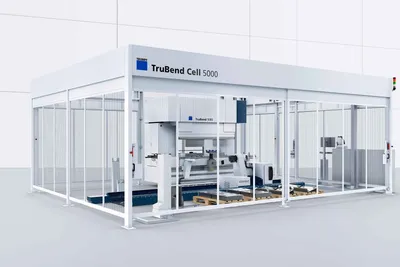
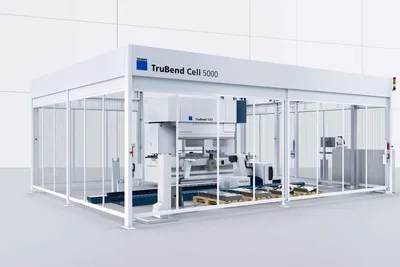
Yes. The TruBend Cell 7000 pairs the 7050 with the BendMaster compact robot for automated loading, bending, and unloading of small and medium parts. The cell runs lights-out and is popular in electronics, automotive supplier, and medical device shops with high-volume repetitive bending. Programming happens offline through TruTops Boost.

05 What materials can the TruBend 7050 bend?

The 7050 handles mild steel, stainless steel, aluminum, copper, and brass within its 50-ton capacity. For mild steel, that's approximately 4–5 mm thickness at full bending length depending on die width and material grade. Thinner stock — 1–3 mm sheet — bends easily across the full 1,530 mm length. For thicker material, the effective bending length decreases proportionally as tonnage per meter increases.

07

Videos

TruBend 7036 and 7050 Product Video

TruBend 7036 and 7050 Product Video

TRUMPF Inc.

TRUMPF TruBend 7050 bends thicker materials and has touch screen control

TRUMPF TruBend 7050 bends thicker materials and has touch screen control

MTDCNC

Live Webinar- The New TruBend 7050

Live Webinar- The New TruBend 7050

TRUMPF Inc.

Abkanten: TruBend 7050

Abkanten: TruBend 7050

VA SOLUTIONS GmbH & Co. KG

08

Community Discussions

09

Related Machines