Starrag LX 021
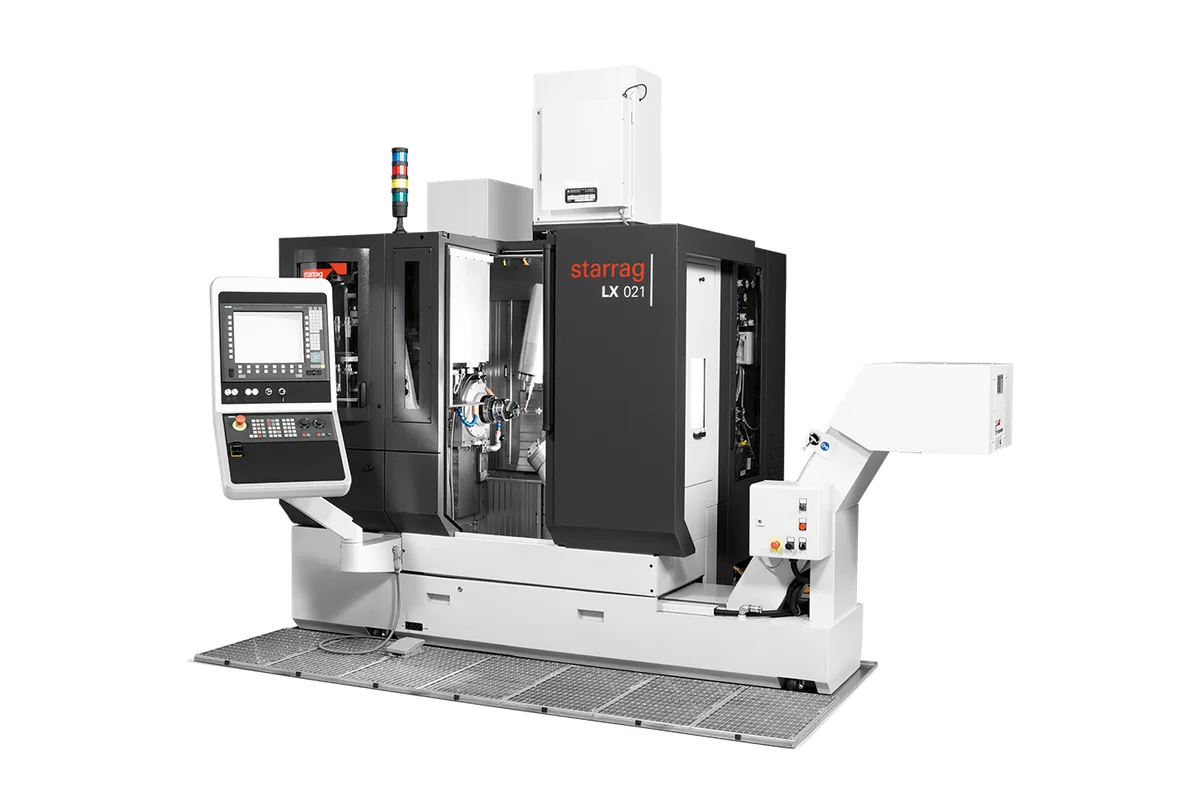
Image: starrag.com, Starrag
Key Specifications
X Travel
Y Travel
Z Travel
Max Spindle
Spindle Taper
Tool Capacity
How much does the Starrag LX 021 cost?
Estimated price range
Our best estimate for a 5-axis machining center in this class — not a quote from Starrag. Configuration moves it a long way.
Overview
The Starrag LX 021 is a small blade machining center: X, Y and Z travels of 400 mm (15.75 in), 200 mm (7.87 in) and 410 mm (16.14 in), and a maximum blade length of about 210 mm (8.3 in). Starrag lists 6 axes, counted as X, Y, Z, A and B plus turning. The A axis rotates the part through 360° continuously and the B axis tilts from -45° to +95°, 140° in total.
The spindle is built for small cutters. It runs to 30,000 RPM on an HSK-A40 (HSK-T40) taper, with 20 kW (27 hp) and 22.5 Nm (16.6 ft-lb). Torque that low rules out large-diameter roughing tools, and the tool limits say the same thing: 79 mm (3.1 in) maximum diameter, 150 mm (5.9 in) maximum length and 1.2 kg (2.6 lb) maximum weight. What the spindle offers instead is surface speed on ball-nose and barrel cutters a few millimetres across, which is what a thin aerofoil section needs.
Turning is the feature that separates this machine from a plain five-axis mill. In turning mode the A axis spins at 4,000 RPM, and the taper is listed in its HSK-T40 form, the version of the interface intended for turning tools. Rotational features of a blade can therefore be cut in the same clamping as the aerofoil, without moving the part to a lathe.
Tool storage is 30 pockets in the standard disk magazine, with up to 90 available. The control is a Siemens SINUMERIK 840D sl. The larger LX 051 moves to an HSK-A63 taper with 30 kW (40 HP) continuous, so work that needs bigger cutters belongs there.
Full Specifications
| Parameter | Value |
|---|---|
| X-Axis Travel | 400 mm (15.75 in) |
| Y-Axis Travel | 200 mm (7.87 in) |
| Z-Axis Travel | 410 mm (16.14 in) |
| A Axis Range | 360° (continuous) |
| A Axis Speed | 4,000 RPM (turning mode) |
| B Axis Range | -45° to +95° (140° total) |
| Max Spindle Speed | 30,000 RPM |
| Spindle Taper | HSK-A40 (HSK-T40) |
| Spindle Motor Power | 20 kW (27 hp) |
| Spindle Torque | 22.5 Nm (16.6 ft-lb) |
| Tool Capacity | 30 (standard disk magazine), up to 90 |
| Max Tool Diameter (full magazine) | 79 mm (3.1 in) |
| Max Tool Length | 150 mm (5.9 in) |
| Max Tool Weight | 1.2 kg (2.6 lb) |
| Max Blade Length | ~210 mm (8.3 in) |
| Number of Axes | 6 (X, Y, Z, A, B + turning) |
| CNC Control | Siemens SINUMERIK 840D sl |
Specifications sourced from starrag.com — verified 2026-03-28
Strengths & Limitations
Strengths
- 30,000 RPM spindle on an HSK-A40 (HSK-T40) taper, suited to small ball-nose and barrel cutters
- Turning mode with the A axis at 4,000 RPM, so milled and turned features share one clamping
- B axis tilts from -45° to +95° (140° total) and the A axis rotates 360° continuously
- 30 tools in the standard disk magazine, with up to 90 available
- Travels of 400 mm (15.75 in), 200 mm (7.87 in) and 410 mm (16.14 in) are sized to blades of up to about 210 mm (8.3 in)
Limitations
- Blade length is limited to about 210 mm (8.3 in)
- 22.5 Nm (16.6 ft-lb) of spindle torque leaves no room for heavy roughing with large cutters
- Tools are limited to 79 mm (3.1 in) in diameter, 150 mm (5.9 in) in length and 1.2 kg (2.6 lb)
- Y travel is only 200 mm (7.87 in), so the machine does not double as a general five-axis mill for wider parts
Best For
Frequently Asked Questions
01
Starrag lists a maximum blade length of about 210 mm (8.3 in). The travels behind that figure are 400 mm (15.75 in) in X, 200 mm (7.87 in) in Y and 410 mm (16.14 in) in Z, with the A axis rotating 360° continuously and the B axis tilting from -45° to +95°.
02
Yes. Starrag lists 6 axes, X, Y, Z, A and B plus turning, and gives an A axis speed of 4,000 RPM in turning mode. The spindle taper is listed as HSK-A40 (HSK-T40). Turned features can be cut in the same clamping as the milled aerofoil.
03
A tool can be up to 79 mm (3.1 in) in diameter, 150 mm (5.9 in) long and 1.2 kg (2.6 lb). The standard disk magazine holds 30 tools, and up to 90 are available.
04
A 30,000 RPM spindle with an HSK-A40 (HSK-T40) taper, 20 kW (27 hp) and 22.5 Nm (16.6 ft-lb). The high speed and low torque suit small-diameter cutters; it is not a spindle for large roughing tools.
05
The LX 051 has a larger spindle interface and more power: HSK-A63 and 30 kW (40 HP) continuous, against HSK-A40 (HSK-T40) and 20 kW (27 hp) on the LX 021. The LX 051 is also listed with 40 m/min (1,575 IPM) rapid traverse. The LX 021 is the machine for small blades, with a 30,000 RPM spindle and a blade length limit of about 210 mm (8.3 in).
Videos

Starrag TV

MTDCNC
LEE HANGYEOL

MTDCNC North America
Comparisons
More from Starrag
Other 5-Axis Machining Centers
Soraluce FR 8000
Mazak VARIAXIS C
AWEA MVP-6032
Zayer THERA