Industrial CNC Machine Directory

Salvagnini P4 LEAN

$400,000 - $700,000 Updated 2026-03-17
01

Key Specifications

Accuracy

±0.05 mm

max panel size

1,250 x 1,000 mm (49.2 x 39.4 in)

min panel size

100 x 100 mm (3.9 x 3.9 in)

material thickness mild steel

0.5 - 3.0 mm (0.020 - 0.118 in)

material thickness stainless

0.5 - 2.0 mm

material thickness aluminum

0.5 - 3.0 mm

02

Overview

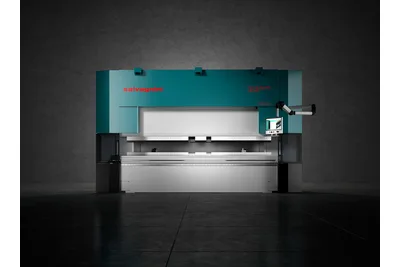
The Salvagnini P4 LEAN is an automatic panel bender from Italy's Salvagnini Group, designed for high-speed automated bending of sheet metal panels without operator intervention or tool changes. Salvagnini is the inventor and world leader in automatic panel bending, with panel benders installed in HVAC manufacturers, appliance producers, electrical enclosure fabricators, and sheet metal job shops worldwide.

The P4 LEAN is Salvagnini's entry-level automatic panel bender, providing the core panel bending automation in a compact, cost-effective package. It bends sheet metal panels up to 1,250 x 1,000 mm (49 x 39 in) with material thicknesses from 0.5 mm to 3.0 mm in mild steel, stainless steel, and aluminum. The automatic blade system makes all bends — up, down, and compound — without any tooling change, repositioning, or operator handling between bends.

The P4 LEAN's unique advantage is cycle time: a typical 6-bend panel that takes 60–90 seconds on a conventional press brake with manual handling takes 15–25 seconds on the P4 LEAN's automatic system. Over a production run of hundreds of identical panels, this productivity difference is transformative. Salvagnini's MAC2.0 adaptive bending system continuously measures and adjusts bending force to compensate for material spring-back variation, maintaining consistent bend angles across the production run.

The P4 LEAN competes with the Trumpf TruBend Center 5030 and the Bystronic Xpert 80 in the automatic panel bending segment, though the panel bender concept is distinctly Salvagnini's domain. Pricing typically runs $400,000–$700,000 depending on configuration.

03

Full Specifications

Parameter Value
Max Panel Size 1,250 x 1,000 mm (49.2 x 39.4 in)
Min Panel Size 100 x 100 mm (3.9 x 3.9 in)
Material Thickness Mild Steel 0.5 - 3.0 mm (0.020 - 0.118 in)
Material Thickness Stainless 0.5 - 2.0 mm
Material Thickness Aluminum 0.5 - 3.0 mm
Max Bend Length 1,250 mm (49.2 in)
Bending Force Up to 1,000 kN (224,809 lb)
Tooling System Universal blade (no tooling change required for up/down bends)
Bending Speed Up to 150 mm/s
Positioning Accuracy ±0.05 mm
Angle Accuracy ±0.5 degrees (MAC2.0 adaptive compensation)
Machine Weight 18,000 kg (39,683 lb) approximate
CNC Control Salvagnini SN84 CNC with Salvagnini Suite software
Electrical 400 VAC 3-phase 50 Hz

Specifications sourced from salvagninigroup.com — verified 2026-03-28

04

Strengths & Limitations

Strengths

  • Automatic bending without tool changes or panel repositioning reduces cycle time by 3–5x compared to conventional press brake production on typical panel geometries
  • Universal blade system requires no setup for up/down bends — eliminates tool setup time and tooling inventory investment for different bend radii and flange heights
  • MAC2.0 adaptive bending with continuous angle measurement eliminates spring-back variation — consistent angle accuracy batch to batch without operator adjustment
  • Suitable for lights-out production of standard panel geometries — the P4 LEAN can run unattended once loaded, enabling one operator to manage multiple machines
  • Salvagnini's 50+ years of panel bending leadership means the deepest installed base, most developed software (Salvagnini Suite), and well-understood process parameters

Limitations

  • Maximum material thickness of 3.0 mm limits the P4 LEAN to thin-gauge sheet metal — heavy gauge steel (4+ mm) and plate work requires conventional press brakes
  • Maximum panel size of 1,250 x 1,000 mm limits the machine to panels that fit this envelope — larger enclosure panels require larger Salvagnini models or conventional press brakes
  • Price of $400K–$700K requires substantial production volume of standardized panel geometries to justify the capital investment over conventional press brakes
05

Best For

HVAC equipment manufacturers bending duct sections, air handler panels, and sheet metal housings in high volume where panel geometry standardization enables automation Electrical enclosure fabricators bending control panel faces, back panels, and mounting plates in thin-gauge steel and aluminum in production quantities Appliance manufacturers bending side panels, door panels, and internal enclosure components for refrigerators, washing machines, and commercial cooking equipment Sheet metal job shops serving multiple industries who need the fastest possible bending throughput on thin-gauge panels up to 1,250 mm length
06

Frequently Asked Questions

01 What is a panel bender and how does it differ from a press brake?

A panel bender holds the sheet metal flat on a table surface using a blank holder (hold-down clamp) and makes bends by rotating bending blades above and below the panel edge — the panel doesn't move, the blades do. A press brake holds the sheet between upper punch and lower die, and the operator manually repositions the sheet between each bend. Panel benders are faster because: (1) no repositioning between bends — all bends are made automatically; (2) no tool changes — the universal blade makes both up and down bends; (3) no operator handling — no risk of marks from handling. Panel benders are optimized for box-and-pan style parts with multiple bends on the same edges; press brakes are more flexible for complex and unusual geometries.

02 What is MAC2.0 adaptive bending?

MAC2.0 (Material Adaptive Control) is Salvagnini's patented system for automatic spring-back compensation in panel bending. Sheet metal spring-back (the partial return toward the original flat position after bending force is released) varies with each sheet's exact yield strength, thickness, and temper — even within the same material specification. MAC2.0 measures the actual bend angle in real time during the bending stroke and adjusts the bending stroke depth on the fly to achieve the specified angle despite spring-back variation. The result is consistent ±0.5 degree angle accuracy without manual correction, test bends, or operator adjustment — critical for batch production of standardized panels.

03 What Salvagnini software is used with the P4 LEAN?

The P4 LEAN uses Salvagnini Suite software — Salvagnini's offline programming, nesting, and machine management platform. Salvagnini Suite accepts 3D part geometry from SolidWorks, Solid Edge, and other CAD systems and automatically generates the bending sequence and machine program. The software simulates the bending sequence to detect collisions between the panel and the machine before running on the actual machine. Salvagnini Suite integrates with ERP systems for production scheduling and batch management. The SN84 CNC on the machine executes the programs and provides real-time feedback on bend angle via MAC2.0.

04 Can the P4 LEAN bend closed boxes?

The P4 LEAN can bend three-sided and four-sided open-top boxes, as well as panels with flanges on multiple sides. True closed boxes (sealed on all sides) cannot be produced because the blank holder must have access to the flat panel surface, and the bend blades require panel edge access. For deep boxes with flanges on all four sides, a combination of panel bending for the first sides plus press brake bending for the remaining sides is sometimes used. Salvagnini's application engineers can advise on feasibility for specific box geometries.

05 What is the ROI justification for the P4 LEAN vs multiple conventional press brakes?

The ROI calculation for a P4 LEAN vs press brakes depends on production volume and part mix. A P4 LEAN producing 15–25 second cycles on standard panels replaces 2–3 conventional press brakes and operators for equivalent output on standardized part geometries. At 1,000 panels/day production, the labor and floor space savings typically provide a 3–5 year ROI at US labor rates. The calculation favors panel bending more strongly in high-labor-cost markets (Europe, North America) and for part families with standardized dimensions. For highly varied, low-volume job shop work, conventional press brakes remain more flexible and lower-risk.

07

Videos

Salvagnini panel bending: P4-2116 kit production with heavy gage parts

Salvagnini panel bending: P4-2116 kit production with heavy gage parts

Salvagnini

Salvagnini panel bending: streamline sheet metal working with P4 panel bender capabilities

Salvagnini panel bending: streamline sheet metal working with P4 panel bender capabilities

Salvagnini

Salvagnini panel bending  P4 high performances in sheet metal profile manufacturing   CUT option

Salvagnini panel bending P4 high performances in sheet metal profile manufacturing CUT option

Italian Machinery Association (IMA)

Salvagnini P4 Lean Panel Bender Installation

Salvagnini P4 Lean Panel Bender Installation

Alpha Manufacturing Ltd

SALVAGNINI P4 Panel Bender

SALVAGNINI P4 Panel Bender

IndMach

08

Related Machines