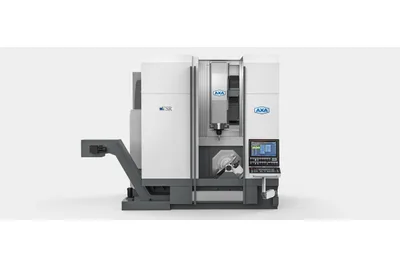
Röders RFM800
This model was not found in Röders's current lineup when we checked on 2026-10-03 . It may be a superseded or older model; the specifications below are as we last recorded them.
Key Specifications
X Travel
Y Travel
Z Travel
Max Spindle
Spindle Taper
Weight
How much does the Röders RFM800 cost?
Estimated price range
Our best estimate for a 5-axis machining center in this class — not a quote from Röders. Configuration moves it a long way.
Overview
The listed figures for the Röders RFM800 describe a linear-motor 5-axis machining center with 800 mm (31.5 in) of X travel, 600 mm (23.6 in) of Y and 400 mm (15.7 in) of Z, carrying up to 400 kg (882 lb) on the table. The model is absent from the current Röders lineup. Use the notes below as a guide for assessing an existing machine and confirm each figure against it.
The spindle rows need reading carefully. Maximum speed is 24,000 RPM, with 42,000 and 60,000 RPM shown as options, and power is 20 kW (26.8 hp). The only taper listed is CT 40. Nothing states what tool interface the two optional high-speed spindles use, so establish which spindle a machine has and what holders come with it before counting on tooling already in the shop.
A 400 kg (882 lb) table load on a 10,000 kg (22,046 lb) machine shows where the mass is: in the Granitan mineral cast composite base and the structure, not in the payload. Together with linear motors on all axes and 60 m/min (2,362 ipm) rapids, that points to light, fast cuts at high feed, backed by a listed positioning accuracy of < 0.003 mm (< 3 µm).
No table dimensions are listed. That is worth chasing, because 800 mm (31.5 in) of X travel says nothing about clamping area. B-axis swivel is ±120°. The control is the Röders RMS6 unless the optional alternative was ordered.
Full Specifications
| Parameter | Value |
|---|---|
| X-Axis Travel | 800 mm (31.5 in) |
| Y-Axis Travel | 600 mm (23.6 in) |
| Z-Axis Travel | 400 mm (15.7 in) |
| Max Spindle Speed | 24,000 RPM (42,000 / 60,000 RPM optional) |
| Spindle Taper | CT 40 |
| Spindle Motor Power | 20 kW (26.8 hp) |
| Table Load Capacity | 400 kg (882 lb) |
| B Axis Swivel | ±120° |
| Rapid Traverse Rate | 60 m/min (2,362 ipm) |
| Positioning Accuracy | < 0.003 mm (< 3 µm) |
| Machine Base | Granitan mineral cast composite |
| Drives | Linear motors (all axes) |
| CNC Control | Röders RMS6 (Siemens Sinumerik optional) |
| Machine Weight | 10,000 kg (22,046 lb) |
Specifications compiled from manufacturer literature and industry references. Not independently verified against a published spec sheet — confirm with the manufacturer or an authorised dealer before making a purchasing decision.
Strengths & Limitations
Strengths
- 800 mm (31.5 in) X, 600 mm (23.6 in) Y and 400 mm (15.7 in) Z travel with a ±120° B-axis swivel
- 20 kW (26.8 hp) spindle at 24,000 RPM, with 42,000 and 60,000 RPM options
- 400 kg (882 lb) table load capacity
- Linear motors on all axes, 60 m/min (2,362 ipm) rapids and < 0.003 mm (< 3 µm) listed positioning accuracy
Limitations
- No table size is listed, so the clamping area has to be confirmed on the machine
- Only CT 40 is listed as the taper; the interface of the optional 42,000 and 60,000 RPM spindles is not stated
- At 10,000 kg (22,046 lb) it needs a foundation and rigging plan sized for the weight
- 400 mm (15.7 in) of Z has to cover tool length, fixture height and the part
Best For
Frequently Asked Questions
01
The taper row lists CT 40. The spindle is shown at 24,000 RPM and 20 kW (26.8 hp), with 42,000 and 60,000 RPM as options, and the table does not give a separate interface for those faster spindles. Check the spindle fitted to the machine before buying holders.
02
Travel is 800 mm (31.5 in) in X, 600 mm (23.6 in) in Y and 400 mm (15.7 in) in Z, and the table load capacity is 400 kg (882 lb). Table dimensions are not listed, and the clearance needed for the ±120° B-axis swivel also limits its size.
03
Positioning accuracy is listed as < 0.003 mm (< 3 µm). No repeatability figure is given, and the row does not name a measuring standard. For a machine that has been in service, a recent laser or ballbar report is the practical check.
04
The listed weight is 10,000 kg (22,046 lb). Much of that is the Granitan mineral cast composite base. The table gives no footprint or power requirement, so those have to come from the machine's installation documents.
More from Röders
Other 5-Axis Machining Centers
Anderson Axxiom 1616 IP PT
Starrag Bumotec s230
Hartford Aero-841G
Mazak VARIAXIS C-600