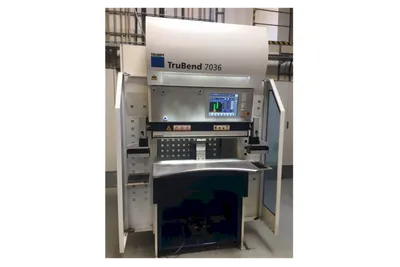
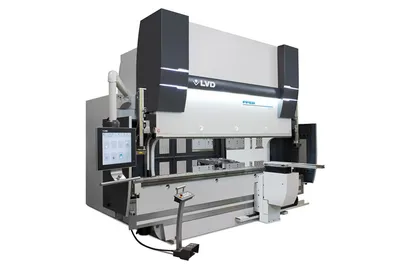
Prima Power HPB Hydraulic Press Brake
Key Specifications
press capacity
working length
stroke
ram repeatability
back gauge axes
control
Overview
The Prima Power HPB is a CNC hydraulic press brake series from Prima Power (part of the Prima Industrie Group, Italy) covering a range of tonnages and working lengths for general-purpose sheet metal bending. The HPB line uses a conventional hydraulic drive with CNC-controlled proportional valve systems that allow precise ram speed and position control without a full servo-hydraulic architecture. It is Prima Power's entry-to-mid-range press brake offering, positioned below the fully electric EPB series in both price and automation level.
The HPB series spans from approximately 40 metric tons to 220 metric tons and from 2,000 mm to 4,000 mm working lengths, covering the most common capacity combinations for general fabrication shops. The hydraulic system uses proportional control valves to regulate ram speed and force, providing adequate repeatability for most general fabrication applications -- typically ±0.02-0.05 mm ram repeatability depending on configuration. A built-in CNC crowning system on longer-bed models compensates for beam deflection under load.
The HPB runs on Prima Power's P-Series CNC control with the same touchscreen interface found across the EPB series. The 6-axis backgauge handles multi-bend programs automatically and integrates with Prima Power's offline programming software for job preparation. The control includes 3D graphical bend simulation and automatic bend sequence optimization, making it straightforward to set up complex part programs.
The HPB series is positioned for shops that need a reliable, straightforward CNC press brake for general fabrication without the premium cost of servo-electric technology. The hydraulic drive delivers proven, durable bending force for repetitive production in mild steel, stainless, and aluminum. Typical applications include HVAC components, enclosures, structural brackets, bus duct sections, and general sheet metal parts in the 1-6 mm gauge range.
New HPB pricing varies widely by tonnage and bed length -- entry-level configurations (40-80 tons, 2-2.5 meter beds) typically start around $80,000-$120,000, while mid-range configurations (120-160 tons, 3-3.5 meter beds) run $140,000-$220,000, and large configurations (200+ tons, 4-meter beds) reach $240,000-$340,000. This positions the HPB series as a budget-to-mid-range option relative to Amada's GPAS and HG series, Trumpf's TruBend 5000 series, and LVD's PPEB line. Prima Power's primary selling point for the HPB is the P-Series control ecosystem integration with their punching and laser cutting machines.
Full Specifications
| Parameter | Value |
|---|---|
| Press Capacity | 40 - 220 metric tons (series range) |
| Working Length | 2,000 - 4,000 mm (series range) |
| Stroke | 200 - 250 mm (model dependent) |
| Ram Repeatability | ±0.02 - ±0.05 mm (model dependent) |
| Back Gauge Axes | 6-axis CNC |
| CNC Control | Prima Power P-Series CNC (touchscreen with 3D simulation) |
| Drive System | Hydraulic with CNC proportional valve control |
| Crowning | CNC automatic crowning (on longer-bed models) |
| Approach Speed | 150 - 200 mm/sec (model dependent) |
| Pressing Speed | 10 - 15 mm/sec (model dependent) |
| Return Speed | 150 - 200 mm/sec (model dependent) |
Specifications compiled from manufacturer literature and industry references. Not independently verified against a published spec sheet — confirm with the manufacturer or an authorised dealer before making a purchasing decision.
Strengths & Limitations
Strengths
- Wide tonnage and bed-length range (40-220 tons, 2-4 meter beds) in a single series covers most general fabrication requirements without needing multiple product lines
- P-Series CNC control shared with the EPB series -- shops running both HPB and EPB machines have operators that work interchangeably on both platforms without retraining
- Lower upfront cost than servo-electric EPB series -- the proven hydraulic drive keeps the HPB competitive with other standard CNC press brakes in the market
- CNC crowning on longer-bed models keeps bend straightness without manual adjustment -- important for consistent quality on wide sheets across 3-4 meter bending lengths
- Integration with Prima Power's punching and laser cutting ecosystem for shops building a coordinated blanking-and-bending workflow under one control platform
Limitations
- Conventional hydraulic drive with proportional valve control is less energy-efficient than servo-hydraulic or servo-electric alternatives -- the pump motor runs continuously regardless of active bending demand
- Ram repeatability of ±0.02-0.05 mm is adequate for general fabrication but less precise than the servo-hydraulic HG series (±0.001 mm) or servo-electric EPB (±0.01 mm) -- precision sheet metal shops may find it limiting
- No automatic tool changer option, and the HPB lacks the premium features of Amada's HG-ATC or the energy efficiency of the EPB -- it occupies a middle position that can be harder to justify vs specialized alternatives
- Prima Power's North American service network is limited compared to Amada and Trumpf, which matters for hydraulic press brakes that require periodic oil service and pump maintenance
Best For
Frequently Asked Questions
01
The HPB uses a conventional hydraulic drive with CNC proportional valve control -- the pump runs continuously and valves direct flow to the cylinder. The EPB uses a fully servo-electric drive with no hydraulic components. Key differences: (1) The EPB is significantly more energy-efficient, consuming power only during active bending; (2) The EPB achieves better ram repeatability (±0.01 mm vs ±0.02-0.05 mm for the HPB); (3) The HPB is less expensive upfront; (4) The HPB requires hydraulic oil maintenance; (5) Both run the same P-Series CNC control. For precision or high-production environments, the EPB is the better long-term investment. For general fabrication on a tighter budget, the HPB is a practical choice.
02
The HPB series covers approximately 40 to 220 metric tons of pressing force and working lengths from 2,000 mm to 4,000 mm. Common configurations include: 40t/2000mm (entry shop), 80t/2500mm, 100t/3000mm, 135t/3000mm, 160t/3200mm, 200t/4000mm, and 220t/4000mm. Regional availability and specific model designations may vary -- consult the Prima Power regional office for the current model lineup and standard configurations.
03
Yes. The HPB uses the same Prima Power standard European-style punch and die tooling as the EPB series. This allows tooling to be shared across HPB and EPB machines in a shop running both product lines, reducing tooling inventory investment and simplifying setup logistics.
04
Both are CNC hydraulic press brakes with proportional valve control in similar tonnage ranges. The LVD PPEB is better supported in North America and Europe through a larger dealer and service network. The HPB's primary advantage is P-Series control integration with Prima Power's punching and laser cutting machines. For standalone press brake use in North America, the LVD PPEB generally has better local support and a larger used equipment market. The HPB is most compelling when building a Prima Power shop.
05
The HPB's hydraulic system requires periodic maintenance including hydraulic oil analysis and changes (typically every 2,000 operating hours or annually), hydraulic filter replacement, backgauge lubrication, and safety device inspections. The P-Series control runs diagnostics and maintenance reminders. Annual service inspections by a Prima Power certified technician are recommended. Hydraulic oil capacity varies by model -- typically 100-180 liters for mid-range configurations.
Videos

GMC Machine Tools

HT Mach Machinery

Prima China Prima CNC Machinery Co,.LTD.

Press brakes Ragos
Sheet Metal Machines
Community Discussions
Troubleshooting and problem-solving — Problem hydraulic press brake cnc upgrade - cnczone.com
Options and configuration advice — HACO Pressbrake controls upgrade. - CNCzone
Troubleshooting and problem-solving — Barnes Press brake problem - CNCzone
Capabilities and material handling — press brake questions - CNCzone
Options and configuration advice — Suggestions for Cheaper Press Brakes : r/Machinists - Reddit
Owner experience and review — What you know about hydraulic pump? This bad right? : r ...Leaking Hydraulic Press : r/Machinists - RedditAnyone ever make a lower die for a press brake? : r/MachinistsAnyone have any experience with hydraulic fixturing? : r ...Broken belt lead to threading gear box “re
Community discussion — Leaking Hydraulic Press : r/Machinists - Reddit
Community discussion — Anyone ever make a lower die for a press brake? :
Links to community discussions. Summaries are editorial — visit the original thread for full context.