Prima Power Express Bender
Key Specifications
Maximum Sheet Length
Maximum Sheet Width
Material Thickness Range
Drive System
Bend Types
Changeover Time
Overview
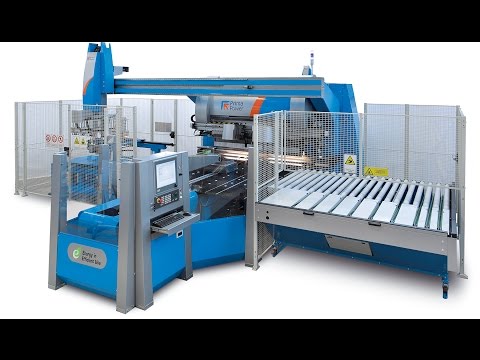
The Prima Power Express Bender is a flexible panel bender designed for small-batch and high-mix production environments where the automation benefits of panel bending are needed without the full-scale FMS commitment of the EB Bending system. Where the EB Bending is engineered for very high volumes of repeating parts, the Express Bender focuses on rapid changeover, offline programming flexibility, and the ability to handle a wide variety of part geometries in short runs — making it relevant to job shops, prototype facilities, and manufacturers with diverse product portfolios.
The Express Bender uses a servo-electric drive system for the bending blade and blank holder, inheriting the speed and energy efficiency advantages of Prima Power's electric actuation philosophy. The machine performs automatic up and down bends in sequence without operator intervention during the cycle, but the changeover from one part family to the next is faster and simpler than on the high-production EB Bending, with fewer dedicated tooling requirements and a more accessible tooling change process.
Programming is handled offline through Prima Power's CAD/CAM environment, which generates bend programs automatically from 3D part data. The Express Bender's control imports these programs and can execute them immediately, minimising the time between receiving a new job and producing the first correct part. This capability is central to the machine's value in high-mix environments where programming and setup time often represent a larger portion of total job cost than actual bending time.
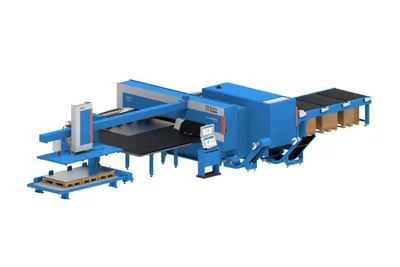
The Express Bender is typically positioned as a stand-alone machine or as part of a smaller automated cell rather than a full FMS line, making it accessible to a broader range of manufacturers than the EB Bending. It is particularly popular in European and North American sheet metal job shops upgrading from press brakes to panel bending automation for the first time, where the Express Bender's flexibility and moderate capital cost provide a compelling step-change in productivity without requiring the full automation infrastructure of a Prima Power FMS installation.
Full Specifications
| Parameter | Value |
|---|---|
| Maximum Sheet Length | Up to 2,500 mm (model dependent) |
| Maximum Sheet Width | Up to 1,250 mm |
| Material Thickness Range | 0.5–2.5 mm (mild steel); 0.5–2.0 mm (stainless) |
| Drive System | Servo-electric (bending blade and blank holder) |
| Bend Types | Automatic up and down bends in single cycle |
| Changeover Time | Rapid tooling changeover vs. EB Bending |
| Programming | Offline CAD/CAM with automatic bend sequence generation |
| CNC Control | Prima Power integrated CNC with offline program import |
| Automation | Stand-alone or small cell; upstream/downstream conveyor optional |
| Minimum Flange Length | Approx. 8 mm (configuration dependent) |
Strengths & Limitations
Strengths
- Faster changeover than high-production panel benders makes it practical for high-mix, small-batch sheet metal production
- Servo-electric drive delivers energy efficiency and speed advantages over hydraulic panel benders while enabling automatic up/down bending in one cycle
- Offline CAD/CAM programming from 3D part models minimises machine-side setup time and reduces first-off scrap rates
- Stand-alone installation is possible without full FMS infrastructure, lowering the capital and facility requirements compared to the EB Bending
- Automatic bending without manual workpiece repositioning between flanges significantly outperforms press brake throughput for panel-type parts
Limitations
- Panel bending geometry constraints mean some complex 3D profiles are not achievable without supplementary press brake operations
- Material thickness ceiling of approximately 2.5 mm mild steel excludes medium and heavy-gauge structural bending applications
- Higher unit cost versus a conventional hydraulic press brake of similar sheet capacity; the business case requires sufficient volume of panel-type parts
Best For
Frequently Asked Questions
01
The EB Bending is the high-production, FMS-integrated flagship for continuous high-volume runs of similar parts. The Express Bender is optimised for flexibility and changeover speed, making it better suited to job shops and manufacturers with more varied part families and shorter batch sizes. Both use servo-electric drives and offline programming, but the Express Bender trades raw throughput for adaptability.
02
Yes. Four-sided box profiles with flanges on all four sides are a typical application for the Express Bender. The machine performs the bends automatically in the correct sequence as programmed by the offline CAD/CAM system, including notched corner blanks. The limiting factor is the part's maximum flange height and the interference geometry of the blank holder.
03
The Express Bender handles mild steel, stainless steel, galvanised steel, pre-painted steel, and aluminium within the 0.5–2.5 mm thickness range. Programmable blank holder clamping force protects surface-sensitive materials such as pre-painted or brushed stainless from marking during clamping.
04
The Express Bender requires a level industrial floor rated for the machine's weight (which varies by model). Unlike some hydraulic press brakes, it does not require a foundation pit. A standard three-phase electrical supply and compressed air connection for the tooling system are typically required. Specific installation requirements are provided in Prima Power's foundation drawing package.
05
Tooling changeover on the Express Bender involves changing the bending blade profiles and adjusting the blank holder system for the new part geometry. Prima Power has engineered a faster changeover process than is typical for large EB Bending systems. The offline program specifies the required tooling configuration, and the operator follows step-by-step prompts on the control to complete the changeover correctly.
Videos
Prima Power North America
Prima Power
Enviro Industrial Laser
Prima Power
Community Discussions
Owner experience and review — Baileigh [Sponsored Forum] | Scroll Bender - Practical Machinist
Community discussion — Cnc bender for small lots - Practical Machinist
Community discussion — Building a electric/hydraulic tube bender ...
Community discussion — Fabrication: CNC Laser, Waterjet, Plasma, Welding | Bender ...
Options and configuration advice — Need Help! Compensation function locked; stima Engineering ...
Comparison and buying advice — Prima Power Platino 1530 - CNCzone
Community discussion — self-build electromagnetic sheetmetal bender... - CNCzone
Pricing and buying discussion — New Machine Build Prima Power Platino 6kW OR LVD Phoenix FL ...
Community discussion — What do you guys think of this machine? : r/machining - Reddit
Community discussion — Suggestions for Cheaper Press Brakes : r/Machinists - Reddit
Community discussion — Benchtop drill presses with low runout? : r/Machinists - Reddit
Options and configuration advice — benchtop lathe/mill recommendations? : r/Machinists - Reddit
Links to community discussions. Summaries are editorial — visit the original thread for full context.