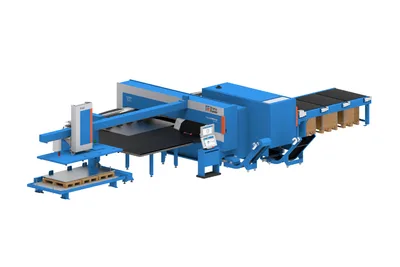
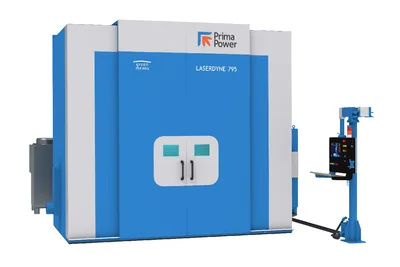
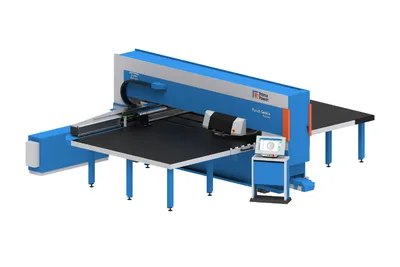
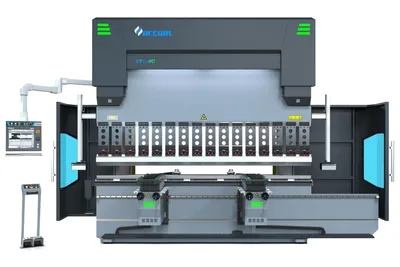
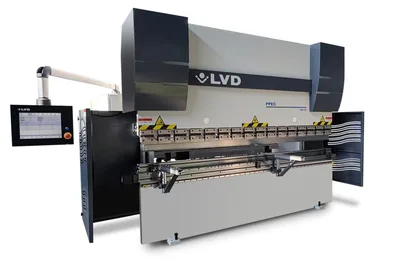
Prima Power EB Bending Panel Bender
This model was not found in Prima Power's current lineup when we checked on 2026-10-03 . It may be a superseded or older model; the specifications below are as we last recorded them.
Key Specifications
bending force
maximum sheet length
maximum sheet width
material thickness range
bending speed
blank holder
How much does the Prima Power EB Bending Panel Bender cost?
Estimated price range
Our best estimate for a cnc press brake in this class — not a quote from Prima Power. Configuration moves it a long way.
Overview
The Prima Power EB Bending Panel Bender is a servo-electric panel bender listed for sheets up to 3,000 mm long and up to 1,500 mm wide, both depending on model. It is not among the machines in Prima Power's current lineup, and the listed figures are thin on force, so anyone looking at a particular machine should get its capacity in writing.
Material range is the clearest row in the table: 0.5–3.0 mm in mild steel and 0.5–2.5 mm in stainless. That is light-gauge panel work, not structural bending. All axes are listed as servo-electric, and the blank holder has a programmable, servo-controlled clamping force, so the clamping load can be matched to thin material instead of being fixed.
Bending speed is listed as up to 100 bends/min on simple profiles. Treat that as a ceiling for the simplest work; panels with many different flanges will run slower.
The remaining rows concern how the machine fits into a line. Programming is offline from a 3D CAD model with automatic bend sequence generation, through a Prima Power CAD/CAM integrated control. Automation is listed as FMS/PSBB compatible with upstream and downstream conveyor I/O, which points to a machine meant to take blanks from, and pass panels to, other equipment as well as to run alone.
Full Specifications
| Parameter | Value |
|---|---|
| Bending Force | Servo-electric, configuration dependent |
| Maximum Sheet Length | Up to 3,000 mm (model dependent) |
| Maximum Sheet Width | Up to 1,500 mm (model dependent) |
| Material Thickness Range | 0.5–3.0 mm (mild steel); 0.5–2.5 mm (stainless) |
| Bending Speed | Up to 100 bends/min (simple profiles) |
| Blank Holder | Programmable clamping force, servo-controlled |
| Drive System | Full servo-electric (all axes) |
| CNC Control | Prima Power CAD/CAM integrated control |
| Automation Integration | FMS/PSBB compatible, upstream/downstream conveyor I/O |
| Programming | Offline from 3D CAD model, automatic bend sequence generation |
Specifications compiled from manufacturer literature and industry references. Not independently verified against a published spec sheet — confirm with the manufacturer or an authorised dealer before making a purchasing decision.
Strengths & Limitations
Strengths
- Servo-electric drive listed on all axes
- Blank holder with programmable, servo-controlled clamping force
- Listed for sheets up to 3,000 mm long and up to 1,500 mm wide, depending on model
- Offline programming from a 3D CAD model with automatic bend sequence generation
- Listed as FMS/PSBB compatible, with upstream and downstream conveyor I/O
Limitations
- No bending or clamping force figure: the row says only servo-electric, configuration dependent
- Material is limited to 3.0 mm in mild steel and 2.5 mm in stainless
- Sheet length and width are model-dependent maximums, so a given machine may take less than 3,000 mm by 1,500 mm
- The 100 bends/min figure applies to simple profiles only
Best For
Frequently Asked Questions
01
The listed range is 0.5–3.0 mm in mild steel and 0.5–2.5 mm in stainless. No range is given for aluminium or other materials, and no force figure is listed, so thicker or stronger material should be cleared with a test bend.
02
Maximum sheet length is listed as up to 3,000 mm and maximum sheet width as up to 1,500 mm, both model dependent. The figures are maximums for the family, so check the size of the specific machine against your largest blank.
03
Programming is listed as offline from a 3D CAD model, with automatic bend sequence generation, and the control is listed as a Prima Power CAD/CAM integrated control. In practice that means the bend order is worked out from the part model before the job reaches the machine.
04
The table lists it as FMS/PSBB compatible with upstream and downstream conveyor I/O. That covers the signals for linking to conveyors on both sides; which loading and unloading devices a given machine has is not listed.