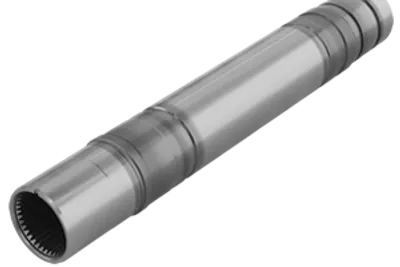
Mazak FabriGear 300
This model was not found in Yamazaki Mazak's current lineup when we checked on 2026-10-02 (lineup page). It may be a superseded or older model; the specifications below are as we last recorded them.
Key Specifications
Accuracy
max tube diameter
max square tube
max structural profile
max bar length
laser type
How much does the Mazak FabriGear 300 cost?
Estimated price range
Our best estimate for a cnc laser cutting machine in this class — not a quote from Yamazaki Mazak. Configuration moves it a long way.
Overview
The Mazak FabriGear 300 is a laser cutting machine for tube and structural profiles: round tube up to 305 mm (12 in), square tube up to 250 x 250 mm and bar lengths up to 12,500 mm (12.5 m). The listed laser is a fiber source of 4 kW or 6 kW. Mazak's current lineup does not include this model, so it may be an older one, and the figures here are the listed ones.
Beyond round and square tube, the listed profiles are H-beam, I-beam, angle and channel, with the limit depending on the size of the section. Together with a cutting head listed for continuous 360° rotation, that is what separates a machine like this from a flat-sheet laser. Holes, end cuts and joint profiles can be put on open structural sections in one handling, where a saw and a drill line would need several. The material is held in two chucks, a main chuck and a support chuck.
Thickness limits are given for the 6 kW source only: a 16 mm wall in mild steel and 12 mm in stainless. Nothing is listed for the 4 kW version, so a used machine with the smaller source needs its own cutting data. Positioning accuracy is listed at ±0.1 mm, which is a fabrication tolerance for fit-up of welded frames, not a machining tolerance.
Programming is listed as MAZATROL with FabriWIN software, and the supported file formats are DXF, STEP and DSTV, so both 3D models and structural steel detailing files can be brought in.
Full Specifications
| Parameter | Value |
|---|---|
| Max Tube Diameter | 305 mm (12 in) round |
| Max Square Tube | 250 x 250 mm |
| Max Structural Profile | H-beam, I-beam, angle, channel (size dependent) |
| Max Bar Length | 12,500 mm (12.5 m) |
| Laser Type | Fiber |
| Laser Power | 4 kW or 6 kW |
| Max Wall Thickness Mild Steel | 16 mm (6 kW) |
| Max Wall Thickness Stainless | 12 mm (6 kW) |
| Cutting Head Rotation | 360° continuous |
| Chuck Count | 2 (main + support chuck) |
| Positioning Accuracy | ±0.1 mm |
| CNC Control | MAZATROL + FabriWIN programming software |
| Supported File Formats | DXF, STEP, DSTV |
Specifications compiled from manufacturer literature and industry references. Not independently verified against a published spec sheet — confirm with the manufacturer or an authorised dealer before making a purchasing decision.
Strengths & Limitations
Strengths
- Round tube up to 305 mm (12 in) and square tube up to 250 x 250 mm
- Bar lengths up to 12,500 mm (12.5 m)
- Listed for H-beam, I-beam, angle and channel as well as tube
- Cutting head listed with continuous 360° rotation
- DXF, STEP and DSTV files are supported through FabriWIN programming software
Limitations
- Wall thickness is limited to 16 mm in mild steel and 12 mm in stainless, and those figures are for the 6 kW laser
- No thickness limits are listed for the 4 kW source
- Structural profile capacity is size dependent and not given as figures
- Not in Mazak's current lineup; confirm the listed figures and the laser power for any machine on offer
Best For
Frequently Asked Questions
01
The listed limits are 305 mm (12 in) for round tube and 250 x 250 mm for square tube, with a maximum bar length of 12,500 mm (12.5 m). H-beam, I-beam, angle and channel are also listed, with capacity depending on the size of the section.
02
With the 6 kW laser, the listed maximum wall thickness is 16 mm in mild steel and 12 mm in stainless. No figures are listed for the 4 kW laser, and none for other materials, so ask for the cutting data that belongs to the source fitted to the machine.
03
The listed laser type is fiber, with a power of 4 kW or 6 kW. The cutting head is listed with continuous 360° rotation, and the workpiece is held by two chucks, a main chuck and a support chuck. Listed positioning accuracy is ±0.1 mm.
04
The listed control is MAZATROL with FabriWIN programming software. Supported file formats are DXF, STEP and DSTV. STEP carries 3D part models and DSTV is an exchange format used in structural steel detailing, so parts can come from either kind of design system.
05
It is not in Mazak's current lineup and may be an older model. The figures on this page are the listed ones. For a used machine, establish whether it has the 4 kW or the 6 kW source, since the listed thickness limits apply to the 6 kW version only.
Videos

Lee Hancock
![Mazak - FabriGear MKII laser pipe cutting system @ EMO Hannover 2013 [ENG]](https://i.ytimg.com/vi/mxESyyqPxn8/hqdefault.jpg)
CNCMedia

johnhartlasers

Dan
More from Yamazaki Mazak
Mazak OptiPlex Champion
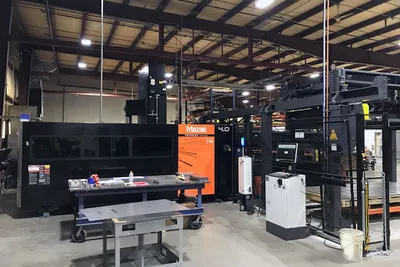
Mazak OPTIPLEX 3015 DDL
Mazak Super Turbo-X510
Mazak Optiplex Nexus 510 II Fiber Laser
Mazak OptiPlex 3015 Ez
Mazak OptiPlex Nexus 3015
Other CNC Laser Cutting Machines
Yawei YTB-6035
Dener E-FTL 9035
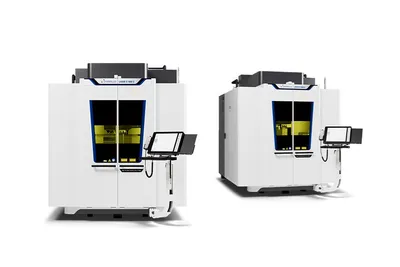
GF Machining CHARMILLES LASER S 1200 U fs
Bodor P-Series 3015 Fiber Laser
Durma HD-TC 60170