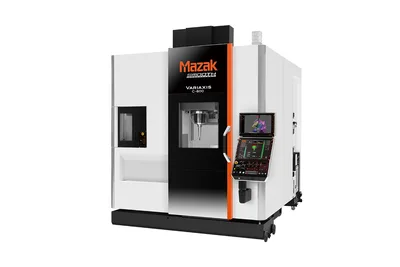
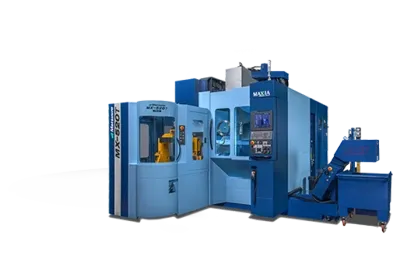
Matsuura MX-520 PC7
Key Specifications
X Travel
Y Travel
Z Travel
Max Spindle
Spindle Taper
Tool Capacity
How much does the Matsuura MX-520 PC7 cost?
Estimated price range
Our best estimate for a 5-axis machining center in this class — not a quote from Matsuura. Configuration moves it a long way.
Overview
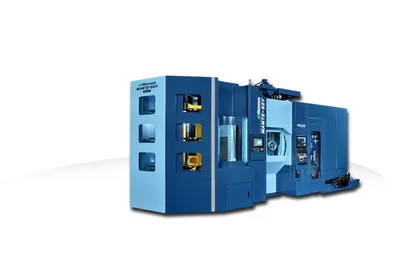
The Matsuura MX-520 PC7 puts a 7-pallet, two-tier tower pallet system on the MX-520 5-axis machining center. Travels are 630 mm (24.80 in) in X, 560 mm (22.04 in) in Y and 510 mm (20.07 in) in Z, the A axis tilts from -125° to +10° and the C axis turns 360°. Stacking the pallets in two tiers rather than in one row is what lets seven stations sit beside a machine of this size.
This is the member of the family whose table gives spindle figures: 11 / 25 kW of power and 159 Nm at 1,500 min-1 of maximum torque. The table does not tie those figures to one spindle. The standard spindle is 12,000 min-1 BT40, and 12,000 TorqueUp, 15,000 and 20,000 min-1 versions are options, so confirm which one the power and torque describe. Taper is CAT #40 / BT40, with HSK-A63 optional.
The magazine holds 60 tools as standard, with 90 / 120 optional. With seven pallets queued and a different part on each, 60 pockets fill quickly, so the larger magazines deserve a serious look alongside the tower.
Rapid traverse is 40 m/min (1,574.80 ipm) on the linear axes and 33 / 50 min-1 on A and C. The working surface is Ø300 mm (Ø11.81 in) as standard; Ø500 mm (Ø19.68 in), or Ø300 mm plus a flat table, are options. The control is the Matsuura G-Tech 31i running MiOS 4. Against the MX-520 PC4, which has the same travels with 4 pallets and 90 tools as standard, the PC7 trades a smaller standard magazine for a longer pallet queue.
Full Specifications
| Parameter | Value |
|---|---|
| X-Axis Travel | 630 mm (24.80 in) |
| Y-Axis Travel | 560 mm (22.04 in) |
| Z-Axis Travel | 510 mm (20.07 in) |
| A Axis Range | -125° to +10° |
| C Axis Range | 360° |
| Working Surface | Ø300 mm (Ø11.81 in) standard; Ø500 mm (Ø19.68 in) or Ø300 mm + flat table optional |
| Max Spindle Speed | 12,000 min-1 : BT40 standard (12,000 TorqueUp, 15,000 and 20,000 : BT40 optional) |
| Spindle Motor Power | 11 / 25 kW |
| Max Spindle Torque | 159 Nm / 1,500 min-1 |
| Spindle Taper | CAT #40 / BT40 standard (HSK-A63 optional) |
| Tool Capacity | 60 : BT40 standard (90 / 120 : BT40 optional) |
| Pallet Capacity | 7 (two-tier tower pallet system) |
| Rapid Traverse Xyz | 40 m/min (1,574.80 ipm) |
| Rapid Traverse AC | 33 / 50 min-1 |
| Operating System | MiOS 4 |
| CNC Control | Matsuura G-Tech 31i |
Specifications sourced from matsuura.co.jp — verified 2026-09-24
Strengths & Limitations
Strengths
- 7 pallets in a two-tier tower pallet system for long unattended runs
- Listed maximum torque of 159 Nm at 1,500 min-1 and 11 / 25 kW of spindle power
- Spindle options of 12,000 TorqueUp, 15,000 and 20,000 min-1 on BT40
- A/C rapids of 33 / 50 min-1 and 40 m/min (1,574.80 ipm) on the linear axes
- Matsuura G-Tech 31i control running MiOS 4
Limitations
- 60 tools as standard is few for seven pallets of different parts; 90 and 120 are options
- Neither pallet load nor pallet change time is given in this table
- 159 Nm on a 40-taper spindle suits medium roughing, not heavy face milling in steel
- The power and torque figures are not tied to a particular spindle option
Best For
Frequently Asked Questions
01
Seven, in a two-tier tower pallet system. The working surface is Ø300 mm (Ø11.81 in) as standard, with Ø500 mm (Ø19.68 in) or Ø300 mm plus a flat table as options. The table here gives no load per pallet or pallet change time.
02
The table lists 11 / 25 kW and a maximum torque of 159 Nm at 1,500 min-1, without saying which spindle option those figures belong to. The standard spindle is 12,000 min-1 BT40; 12,000 TorqueUp, 15,000 and 20,000 min-1 are options. Ask for the curve of the spindle you order.
03
Both have 630 mm X, 560 mm Y and 510 mm Z. The MX-520 PC4 has 4 pallets and 90 tools as standard. The MX-520 PC7 has 7 pallets in a two-tier tower and 60 tools as standard, with 90 / 120 optional, so the PC7 suits longer queues and the PC4 more tools per pallet.
04
The Matsuura G-Tech 31i, running the MiOS 4 operating system. It drives the A axis from -125° to +10° and the C axis through 360°, with rotary rapids of 33 / 50 min-1.
05
Linear rapids are 40 m/min (1,574.80 ipm) on X, Y and Z, and the A and C axes index at 33 / 50 min-1. Tool-change and pallet-change times are not given in this table.
Videos

Matsuura USA

Matsuura Machinery Corporation
More from Matsuura
Other 5-Axis Machining Centers
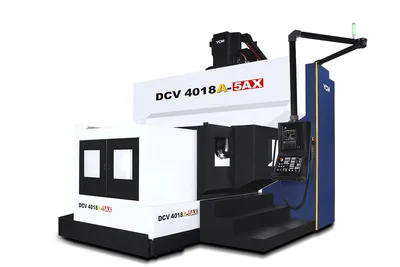
YCM DCV4018A-5AX
Röders RFM600
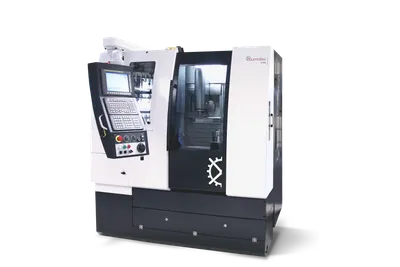
Starrag Bumotec s191V
Hartford Aero-841G-5X