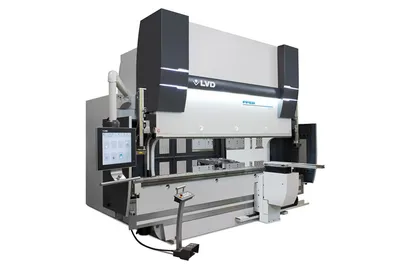
LVD HPB 320
Key Specifications
press capacity
working length
stroke
open height
throat depth
approach speed
Overview
The LVD HPB 320 is a heavy-tonnage CNC hydraulic press brake from LVD Company NV, the Belgian sheet metalworking machine manufacturer. The HPB 320 delivers 320 metric tons (352 US tons) of pressing force, making it one of the highest-tonnage machines in LVD's hydraulic press brake lineup. It is purpose-built for heavy plate fabrication, structural steel production, and large-format bending applications where standard 100-200 ton machines fall short.
The HPB series uses a conventional hydraulic drive system with CNC control of the proportional valves for speed and position regulation. The HPB 320 employs torsion bar synchronization to maintain ram parallelism under load -- a robust and proven approach for heavy-tonnage bending where absolute precision is less critical than durability and force delivery. Ram repeatability is typically ±0.05 mm, appropriate for heavy structural work where material thickness variation and springback variation dominate the achievable bend angle tolerance anyway.
Control is LVD's CADMAN-B touch CNC, the same system used across LVD's press brake range. CADMAN-B provides touchscreen programming, 3D graphical bend simulation, automatic bend sequence calculation, and springback correction. The 6-axis backgauge manages automated repositioning between bends for multi-bend programs. CADMAN-B integrates with LVD's offline programming software, allowing complex job programs to be prepared on a workstation and transferred to the machine.
The working length on the HPB 320 is typically 3,200 mm (126 in), placing it in a capacity class suited for wide structural panels, heavy bracket fabrication, bus duct, and switchgear panels. At 320 metric tons across 3,200 mm, the machine bends mild steel up to approximately 12-14 mm on the full working length and up to 25-30 mm on short sections of 1,000 mm or less. This is heavy-plate territory where hydraulic tonnage, durability, and low-maintenance operation matter more than energy efficiency or tight repeatability.
New HPB 320 pricing typically runs $220,000-$320,000 depending on backgauge specification and options. Used HPB 320 machines are occasionally available from heavy fabricators upgrading capacity, typically trading in the $100,000-$180,000 range depending on age, condition, and included tooling. LVD's primary competition in this segment includes Safan Darley, Durma, Gasparini, and Jansen & Heuning for European markets, with Cincinnati and Pacific Press for North American shops needing similar tonnage.
Full Specifications
| Parameter | Value |
|---|---|
| Press Capacity | 3,200 kN / 320 metric tons (352 US tons) |
| Working Length | 3,200 mm (126 in) |
| Stroke | 250 mm (9.8 in) |
| Open Height | ~550 mm (21.7 in) |
| Throat Depth | ~480 mm (18.9 in) |
| Approach Speed | 130 mm/sec |
| Pressing Speed | 8 - 12 mm/sec |
| Return Speed | 130 mm/sec |
| Ram Repeatability | ±0.05 mm |
| Back Gauge Axes | 6-axis CNC |
| CNC Control | LVD CADMAN-B touch CNC |
| Drive System | Hydraulic with torsion bar synchronization |
| Crowning | CNC automatic crowning |
| Power Requirement | 400V 3-phase, ~55 kVA |
| Machine Weight | ~28,000 kg (61,730 lb) |
Specifications compiled from manufacturer literature and industry references. Not independently verified against a published spec sheet — confirm with the manufacturer or an authorised dealer before making a purchasing decision.
Strengths & Limitations
Strengths
- 320 metric tons of hydraulic pressing force handles the heavy plate bending that most press brakes cannot -- structural steel up to 14 mm on a 3.2-meter bed, and 25-30 mm on short sections
- Conventional hydraulic drive with torsion bar synchronization is proven, durable, and straightforward to service -- at this tonnage, reliability and uptime over a 20+ year machine life matter more than servo efficiency
- CADMAN-B touch CNC is one of the most capable press brake controls available -- 3D simulation, bend sequence optimization, and springback correction reduce setup time and scrap on complex heavy parts
- CNC crowning compensates for beam deflection under 320 tons of load, producing straight bends across the full 3.2-meter working length without manual adjustment
- LVD's European manufacturing pedigree and established service network in Belgium and Western Europe provide reliable support for the machine's long service life
Limitations
- Conventional hydraulic drive with continuous pump operation is energy-intensive at 55 kVA -- operating costs are significantly higher than servo-hydraulic or servo-electric alternatives of similar tonnage
- Ram repeatability of ±0.05 mm is adequate for heavy structural fabrication but would limit precision sheet metal applications -- shops needing tight tolerances should evaluate LVD's PPEB-EFL or Synchromaster series instead
- At 28,000 kg and 3.2 meters long, the machine requires substantial foundation preparation, rigging, and floor loading capacity evaluation before installation
- Torsion bar synchronization is less precise than electronic closed-loop synchronization (as used in the Synchromaster SMC series) for eccentric loading scenarios -- long parts with off-center bends may show more angle variation
Best For
Frequently Asked Questions
01
The LVD PPEB (Precision Press Brake) series uses LVD's electro-hydraulic synchronization with higher-accuracy position control, achieving better ram repeatability (typically ±0.01-0.02 mm vs ±0.05 mm for the HPB). The PPEB also includes LVD's Easy-Form Laser in-process angle measurement on premium configurations. The HPB 320 uses a more conventional torsion bar synchronization at lower precision but similar tonnage. For heavy structural work where material variation limits practical bend angle accuracy anyway, the HPB 320 is adequate and typically less expensive. For precision sheet metal at high tonnage, the PPEB is the better specification.
02
At 320 metric tons across 3,200 mm, the HPB 320 bends mild steel (Rp0.2 = 250 MPa) up to approximately 12-14 mm on the full working length using standard die widths. On shorter bend sections of 1,000 mm, the concentrated force allows bending 25-30 mm mild steel. High-strength steel (Strenx 700) at equivalent thickness requires approximately 2.5x the force of mild steel -- so the HPB 320 handles Strenx 700 up to approximately 5-6 mm on the full length. The CADMAN-B control calculates required force automatically.
03
Yes. The HPB 320 includes a 6-axis CNC backgauge as standard equipment. The backgauge covers X (depth), R (height), and Z1/Z2 (individual left and right finger positioning) at minimum, with additional axes depending on configuration. The CADMAN-B control programs all backgauge movements as part of the bend program, repositioning automatically between bends. For heavy parts on a 320-ton machine, optional sheet followers and part support arms are available to assist operators handling large, heavy plates.
04
Cincinnati Machine (US) offers comparable tonnage hydraulic press brakes in the 300+ ton class. Key differences: (1) LVD uses CADMAN-B control while Cincinnati uses their own CNC; (2) LVD has stronger European distribution and support; (3) Cincinnati has stronger North American installed base and parts support; (4) Both use conventional hydraulic architectures at this tonnage class. For North American shops, Cincinnati's service network advantage is significant. For European operations, LVD's local support is superior. Both are proven heavy-tonnage hydraulic machines.
05
The HPB 320 weighs approximately 28,000 kg and requires a reinforced concrete foundation rated for the load, with LVD-specified anchor bolt placement. Electrical requirements are 400V 3-phase (480V in North America) with approximately 55 kVA continuous demand for the hydraulic pump motor. The machine also requires hydraulic oil (typically 200-300 liters for a machine of this scale) and may require oil cooling depending on ambient temperature and production cycle. Floor loading must be evaluated by a structural engineer before installation.
Videos

Surplex

jackchief

bquoss09

Dener Machinery

dg4rez
Community Discussions
Troubleshooting and problem-solving — Need Help! Alarms at power up, 320v power supply fault? - CNCzone
Troubleshooting and problem-solving — LVD Press Brake issues - cnczone.com
Community discussion — Need Help! LVD Pressbrake? - cnczone.com
Community discussion — Anyone familiar with an LVD mnc800 brake press/control?? (or ...
Links to community discussions. Summaries are editorial — visit the original thread for full context.