Liebherr LC 280
Key Specifications
Max Workpiece ⌀
max module
min module
max face width
max helix angle
operations
Overview
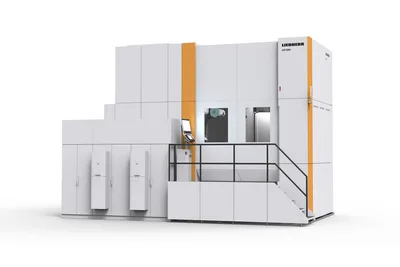
The Liebherr LC 280 is a CNC combined gear hobbing and chamfering machine that integrates gear hobbing and the subsequent deburring and chamfering of gear tooth ends into a single machine platform. Manufactured by Liebherr-Verzahntechnik GmbH in Kempten, Germany, the LC 280 is designed for automotive transmission gear producers and industrial gearbox manufacturers who require both operations — hobbing and chamfer/deburring — in a lean, integrated process that minimizes part handling, reduces floor space, and eliminates dedicated deburring machines from the production line. With a maximum workpiece diameter of 280 mm (11.02 in), the LC 280 covers the majority of passenger car and light commercial vehicle transmission gear sizes.
The integration of hobbing and chamfering in the LC 280 is based on Liebherr's proven two-station design. In the main hobbing station, the workpiece is hobbed to finished tooth form with a conventional gear hob running at high speed with direct-drive technology. After hobbing, the workpiece is automatically transferred on the same machine table to a secondary chamfering station where a chamfering tool removes the burrs and sharp edges left on the tooth ends by the hobbing process. Tooth end chamfering is critical because sharp hobbing burrs can cause assembly problems, damage hardening equipment (furnace basket contamination), and create stress concentration points that initiate fatigue cracks in service. By integrating chamfering into the LC 280, Liebherr eliminates the dedicated deburring station, saving floor space, part handling time, and investment cost.
Both hobbing and chamfering stations on the LC 280 use direct-drive torque motors on the key rotary axes, providing the repeatability, low maintenance, and fast cycle times associated with Liebherr's direct-drive architecture. The hob spindle reaches speeds up to 4,000 RPM to support modern carbide hob grades running at cutting speeds of 200–400 m/min on steel. The workpiece spindle accommodates gears on arbors or in chucks, and a tailstock is available for shaft-type workpieces requiring additional axial support. Dry hobbing and chamfering with an appropriate chip management system is supported, simplifying coolant management in automotive production cells.
Liebherr's WOP-G (Workshop Oriented Programming for Gear Cutting) operator interface on the Siemens SINUMERIK 840D sl control manages both hobbing and chamfering programs in a unified job setup workflow. Operators enter gear parameters once and WOP-G generates the NC programs for both operations automatically. The chamfering tool path — including chamfer angle, width, and edge break geometry — is defined parametrically rather than by hand-written NC code, reducing programming time and setup errors. Integration with Liebherr's production monitoring systems allows real-time tracking of cycle times, tool life, and machine utilization across a multi-machine cell.
The LC 280 competes with the Gleason Genesis 260GX combined hobbing/chamfering machine and with stand-alone hobbers paired with separate chamfering machines. New LC 280 machines are priced between $550,000 and $800,000, reflecting the higher investment required for the integrated dual-station design. For automotive gear producers running integrated production cells, the LC 280's combination of hobbing and chamfering in one machine typically provides a positive return on the incremental investment through floor space savings, reduced material handling, and elimination of a standalone deburring machine.
Full Specifications
| Parameter | Value |
|---|---|
| Max Workpiece Diameter | 280 mm (11.02 in) |
| Max Module | 6 mm |
| Min Module | 0.5 mm |
| Max Face Width | 200 mm (7.87 in) |
| Max Helix Angle | ±45° |
| Operations | Gear hobbing + chamfering/deburring |
| Hob Spindle Speed | Up to 4,000 RPM |
| Hob Diameter | Up to 130 mm (5.12 in) |
| Workpiece Spindle Speed | Up to 700 RPM |
| Spindle Drive | Direct-drive torque motors |
| Dry Cutting | Supported |
| Axes | 7 CNC axes (hobbing + chamfering) |
| CNC Control | Siemens SINUMERIK 840D sl with WOP-G |
| Machine Weight | 8,000 kg (17,637 lb) |
| Gear Quality | DIN 5–7 (hobbed) |
Specifications sourced from liebherr.com — verified 2026-03-28
Strengths & Limitations
Strengths
- Integration of hobbing and chamfering in a single machine eliminates a dedicated deburring station, saving floor space, material handling steps, and the capital cost of a separate chamfering machine in production cells
- Chamfering occurs on the same machine immediately after hobbing, eliminating inter-process material transport delays and reducing the risk of handling damage to freshly hobbed, unhardened gear blanks
- Direct-drive torque motors on hob and workpiece spindles provide fast acceleration, zero backlash, and low maintenance, supporting high-volume automotive production schedule demands
- WOP-G unified programming for both hobbing and chamfering operations reduces job setup time compared to managing separate hobber and chamfering machine programs and fixtures
- Liebherr's strong automotive production line expertise and European market presence provide reliable support in tier-1 automotive supply chain environments
- Dry cutting support reduces coolant management burden and environmental compliance costs in automotive manufacturing facilities with strict waste management programs
Limitations
- Higher purchase price ($550,000–$800,000) compared to a standalone hobber of equivalent capacity, requiring the chamfering integration cost savings to justify the incremental investment over a hobber plus separate deburrer
- If the chamfering station requires maintenance or tooling change, the hobbing operation is also unavailable — dual-process integration creates a dependency that a two-machine layout avoids
- Maximum 280 mm diameter and module 6 mm limits the LC 280 to small and medium automotive gears; large industrial gears require higher-capacity hobbers without integrated chamfering
Best For
Frequently Asked Questions
01
Sharp burrs and edges left on gear tooth ends after hobbing cause multiple problems: they can contaminate hardening furnace baskets and fixtures, create inconsistent case depth at the tooth ends due to stress concentration in the quench, generate stress concentration points that initiate fatigue cracks in service, and cause assembly interference during gear installation. Chamfering and deburring removes these sharp edges before hardening, producing a smooth, controlled edge break that improves part quality, reduces assembly issues, and extends service life.
02
The time savings from integrated chamfering depend on production volume and logistics. In high-volume automotive production, eliminating a separate deburring machine removes the transfer time between machines (typically 30–120 seconds per part for gantry or conveyor transfer), the queue time between hobbing and deburring (potentially minutes to hours in batch production), and the setup time for the separate deburring machine. For production volumes of 50,000+ gears per year, the accumulated time savings are significant, and the single-machine footprint typically saves 4–8 square meters of floor space compared to two separate machines.
03
The LC 280's chamfering station produces chamfers on both ends of gear tooth faces. Chamfer geometry — angle (typically 30°–45°), width (typically 0.3–1.5 mm), and edge break profile — is defined parametrically in the WOP-G interface. The chamfering tool path is generated automatically from the gear geometry parameters and the specified chamfer dimensions. Both symmetric and asymmetric chamfers can be produced, and the system accommodates helical gears where the tooth end geometry varies with helix angle.
04
The Liebherr LC 280 and Gleason Genesis 260GX are both CNC hobbing and chamfering machines targeting automotive transmission gear production. The Genesis 260GX has a maximum workpiece diameter of 260 mm vs. 280 mm for the LC 280. Both integrate hobbing and chamfering in dual-station designs with direct-drive spindles. Liebherr's WOP-G and Gleason's GEMS are comparable in operator-friendliness for gear parameter entry. Liebherr is particularly strong in European automotive supply chains; Gleason has a dominant position in North American and Asian automotive markets. Application support quality is high for both.
05
The LC 280's secondary station is specifically designed and tooled for the chamfering and deburring operation. It is not configured to perform gear shaving (a separate finishing process requiring specialized shaving machine kinematics) or power skiving (which requires a high-speed skiving spindle and different axis geometry). For shops requiring both hobbing and skiving, Liebherr offers the LSE series dedicated skiving machines. The LC 280's secondary station can in principle accommodate other light secondary operations requiring similar tooling access, but chamfering is the primary and designed use case.
Videos
Liebherr
Liebherr
Liebherr
Liebherr
Liebherr
Community Discussions
Community discussion — Help with Weiler LZ 280 - Practical Machinist
Pricing and buying discussion — Which Leblond to buy?
Troubleshooting and problem-solving — Best Benchtop Lathe
Pricing and buying discussion — LeBlond Lathe Identification by serial number
Community discussion — Actual current "Made in USA" large engine lathes? - Reddit
Owner experience and review — Can you help me pick a used Swiss? : r/Machinists - Reddit
Pricing and buying discussion — Cheap Combination Mill/Lathe. Great value entry level setup ...
Pricing and buying discussion — How much should I offer for this lathe? It looks ... - Reddit
Links to community discussions. Summaries are editorial — visit the original thread for full context.