Industrial CNC Machine Directory

Klingelnberg P 65

$2,500,000 - $4,500,000 Updated 2026-03-17
01

Key Specifications

Max Workpiece ⌀

650 mm (25.6 in)

Accuracy

±0.002 mm tooth-to-tooth

max module

16

max face width

180 mm (7.1 in)

number of teeth range

6 - 120

spiral angle range

0 - 55 degrees

02

Overview

The Klingelnberg P 65 is a CNC bevel gear cutting machine from Germany's Klingelnberg GmbH, designed for producing spiral bevel and hypoid gears using the Cyclo-Palloid® face-milling process for high-volume automotive and commercial vehicle applications. The P 65 handles workpieces up to 650 mm (25.6 in) outer diameter — the largest in Klingelnberg's standard P-series lineup — accommodating large rear axle differentials, transfer case bevel sets, and heavy truck crown wheel and pinion gears.

The P 65 uses Klingelnberg's Cyclo-Palloid face-milling process, which produces a tooth geometry where each tooth has a lengthwise curvature generated by the cutter-head rotation. This geometry provides excellent load distribution, reduced noise, and the ability to be both cut and ground (after heat treatment) on the same basic machine concept. The process is extensively used in automotive axle production where millions of gear sets per year require consistent, predictable geometry.

The machine's six CNC axes execute coordinated motion to generate the complex spiral bevel tooth flank geometry. Klingelnberg's KIMoS® (Klingelnberg Integrated Manufacturing of Spiral Bevel Gears) software coordinates cutting data, machine setup, and SPC quality management across the production flow from design to inspection. The proprietary control, based on Siemens hardware, handles all gear-specific cycles with Klingelnberg's gear geometry algorithms.

The P 65 competes with the Gleason Phoenix 450G and the Mitsubishi ZA40CNC in the large bevel gear generator class. Klingelnberg's differentiation is the Cyclo-Palloid process's tooth geometry advantages for high-load, high-speed automotive applications and the deep KIMoS software integration. Pricing for a new P 65 typically runs $2.5M–$4.5M for a production-configured system.

03

Full Specifications

Parameter Value
Max Workpiece Diameter 650 mm (25.6 in)
Max Module 16
Max Face Width 180 mm (7.1 in)
Number Of Teeth Range 6 - 120
Spiral Angle Range 0 - 55 degrees
Cutter Head Diameter Max 457 mm (18 in)
Axes 6 CNC axes
Workpiece Spindle Speed 0 - 200 RPM (variable)
Cutter Spindle Power 45 kW (60 hp)
Dry Cutting Capable Yes (with appropriate tooling)
Coolant Oil cooling or dry cutting (CBN tooling)
Positioning Accuracy ±0.002 mm tooth-to-tooth
Lead Accuracy Grade 5 (DIN 3965) production; Grade 4 achievable
Machine Weight 28,000 kg (61,729 lb)
CNC Control Klingelnberg CNC (Siemens hardware, KIMoS software)
Floor Space Required approximately 4.5 m x 3.5 m
Electrical 400 VAC 3-phase 50 Hz, 3-phase 60 Hz option
Module Range (0.20)*2, 0.30 – 35 mm
Horizontal Measuring Interval Roll Path Length ±200 mm
Clamping Testing Diameter Of Cylindrical Gears Between Centers 650 mm
Permissible Moment Of Inertia 100 kgm²
Permissible Workpiece Weight Approx 500 kg
Vertical Measuring Interval 800 (1,200) mm*7
Distance Between Centers 50 – 1,000 (1,500) mm*7
Machine Accuracy Gear Measurement According To Vdi Vde 2612 Sheet 6 6 Group A
Reference Temperature Gradient 2 K/h; 12 K/d; 2 K/m
Mpee0 Iso 10360 2 3 4 6 1.8 µm + L/250 mm
Roundness 100 L Vdi Vde2617 Sheet 8 4 5 6 0.5 µm
Total Axial Runout Vdi Vde2617 Sheet 8 4 6 1.8 µm
Rated Power Of The Machine Including Printer 2.3 kVA
Compressed Air Connection 6 bar – 1 l/min
Net Weight Incl Standard Equipment Approx 4,050 kg
Machine Dimensions Approx 2,220 x 2,140 x 2,430 (2,930) mm
Salutation Mr.Mrs.
Zip Code City*
Country E-Mail*
Phone Fax

Specifications sourced from klingelnberg.com — verified 2026-03-28

04

Strengths & Limitations

Strengths

  • Cyclo-Palloid face-milling process produces spiral bevel tooth geometry optimized for high-load automotive axle applications with superior noise and efficiency characteristics
  • 650 mm maximum diameter handles large rear axle differentials, transfer case gears, and heavy truck crown wheel and pinion sets in a standard platform
  • KIMoS software integration from design through production to inspection creates a closed-loop quality system that enables consistent SPC-controlled production
  • Dry cutting capability with CBN tooling eliminates cutting oil management and disposal costs in high-volume automotive production environments
  • Klingelnberg's process integration extends from the cutting machine through the P-series grinding machines, enabling a matched cutting-and-grinding process for maximum geometry consistency

Limitations

  • Price of $2.5M–$4.5M limits the P 65 to automotive OEM and Tier 1 supplier production environments with the volume to justify the capital investment
  • The Cyclo-Palloid process is Klingelnberg-proprietary — production facilities using P-series machines are committed to Klingelnberg's process ecosystem for tooling, software, and inspection
  • Machine weight of 28,000 kg requires heavy concrete foundations and specialized rigging — installation is a multi-week process requiring Klingelnberg application engineers
05

Best For

Automotive OEMs and Tier 1 axle suppliers producing rear differential bevel sets in volumes requiring consistent SPC-controlled gear geometry to automotive noise and efficiency standards Commercial vehicle and heavy truck manufacturers producing large-module crown wheel and pinion gears requiring 650 mm outer diameter capacity Aerospace bevel gear manufacturers producing large helicopter gearbox bevel sets where Cyclo-Palloid geometry and tight tolerance capability meet rotorcraft certification requirements Industrial gearbox manufacturers producing large bevel gears for construction equipment, mining machinery, and marine drives requiring module 16 and 650 mm outer diameter
06

Frequently Asked Questions

01 What is the Cyclo-Palloid bevel gear process?

Cyclo-Palloid is Klingelnberg's proprietary face-milling process for producing spiral bevel and hypoid gears. In this process, a face-mill cutter head with multiple blade groups rotates continuously while the workpiece indexes between each cut. The resulting tooth has a lengthwise curvature (the 'Palloid' characteristic) that provides favorable load distribution across the tooth face. Cyclo-Palloid gears can be lapped after cutting (conventional finishing) or hardened and then ground on Klingelnberg G-series machines. The process is dominant in automotive axle production.

02 What is KIMoS software?

KIMoS (Klingelnberg Integrated Manufacturing of Spiral Bevel Gears) is Klingelnberg's proprietary software platform that connects machine design, setup, cutting, grinding, and inspection data in a single integrated system. On the P 65 cutting machine, KIMoS manages the machine setup from bevel gear design parameters (module, spiral angle, number of teeth, face width), generates the cutting cycle automatically, stores process data for quality traceability, and exports measurement data for closed-loop feedback from gear inspection machines. This integration reduces setup time and enables true SPC-controlled bevel gear production.

03 Can the P 65 cut hypoid gears as well as spiral bevel gears?

Yes. The P 65 cuts both spiral bevel gears (where pinion and ring gear axes intersect) and hypoid gears (where the axes are offset — the common configuration in automotive rear axles). Hypoid offset enables larger pinion diameter relative to the ring gear, improving strength and NVH performance. Klingelnberg's Cyclo-Palloid process handles both geometries within the machine's capacity envelope. Hypoid gears require additional KIMoS setup parameters for the offset calculation.

04 How does the P 65 compare to the Gleason Phoenix 450G?

The Gleason Phoenix 450G uses Gleason's face-hobbing process (Sequential Duplex), which produces a different tooth geometry than Klingelnberg's Cyclo-Palloid. Both are valid for automotive bevel gear production; the geometric differences affect noise, efficiency, and ease of matching between mating pairs. Automotive OEMs typically standardize on one process or the other across their axle production. Switching between processes is a major investment in new tooling, software, and engineering — so the P 65 vs Phoenix 450G choice is typically determined by the existing process ecosystem at the production plant.

05 What is the dry cutting capability on the P 65?

The P 65 supports dry cutting — machining without cutting oil — using CBN (cubic boron nitride) coated carbide blade tooling designed for high-temperature interrupted cutting. Dry cutting eliminates the cost and environmental burden of cutting oil management, heating, and disposal in high-volume production. Dry cutting also improves chip handling because chips are not contaminated with oil. The requirement is CBN tooling specifically designed for dry bevel gear cutting — conventional HSS or uncoated carbide blades cannot sustain the heat load of dry cutting.

07

Videos

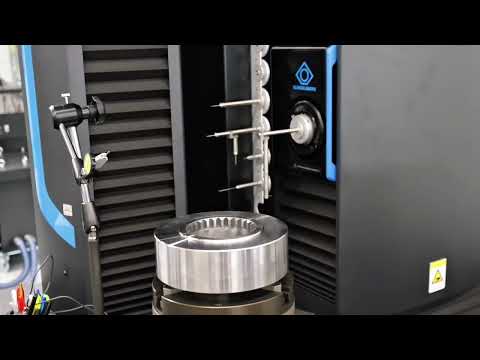
Klingelnberg P65 Precision Measuring Center

Klingelnberg P65 Precision Measuring Center

UG 360 Tour.

Klingelnberg P 65 Roughness Measurement Bevel Gear

Klingelnberg P 65 Roughness Measurement Bevel Gear

KLINGELNBERG Group

Klingelnberg P 65 Roughness Measuring Cylindrical Gear

Klingelnberg P 65 Roughness Measuring Cylindrical Gear

KLINGELNBERG Group

Klingelnberg Optical Metrology 2025 (English)

Klingelnberg Optical Metrology 2025 (English)

KLINGELNBERG Group

08

Community Discussions

09

Related Machines