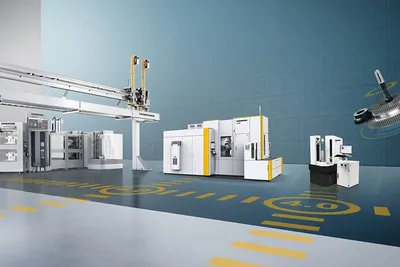
Klingelnberg P 26 G
Key Specifications
machine type
max ring gear diameter
max pinion diameter
max module
min module
max face width
Overview
The Klingelnberg P 26 G is a CNC bevel gear grinding machine engineered for the precision finish grinding of small-module spiral bevel, hypoid, and Palloid bevel gears up to 260 mm in ring gear diameter. As the compact end of Klingelnberg's Oerlikon-heritage bevel gear grinding range, the P 26 G serves the automotive passenger car differential and transfer case market, small industrial gearboxes, and power tool transmission applications where bevel gear sets are typically 50-200 mm in diameter with modules from 0.5 to 5 mm. Klingelnberg, headquartered in Zurich and Hückeswee, Germany, brings the full heritage of the Oerlikon bevel gear system and the Palloid cutting method to the P 26 G platform.
The P 26 G uses Klingelnberg's face-hobbing process (Oerlikon system) or face-milling process depending on configuration, with cup grinding wheels dressed to exact tooth form geometry. Klingelnberg's KIMoS (Klingelnberg Integrated Manufacturing of Spiral Bevel Gears) software drives all 6 CNC axes in coordinated motion to generate the complex flank surfaces of spiral bevel and hypoid gears. KIMoS handles both Klingelnberg (Palloid) and Gleason tooth systems, allowing the P 26 G to service existing gear designs regardless of which original cutting system was used. Flank topography correction is built into the software, enabling systematic error correction from measured deviations.
The work spindle on the P 26 G accommodates small bevel gear blanks up to 260 mm in diameter, with high-speed work spindle operation enabling the short cycle times required for automotive production. An integrated CNC dressing unit maintains the grinding wheel profile during production. Klingelnberg's proprietary control system handles the full spectrum from job programming to SPC data logging. The P 26 G supports automatic loading integration through a standardized robot interface, making it compatible with cell-level automation for unmanned production shifts.
Priced in the range of $800,000-$1,200,000, the P 26 G competes with the Gleason Phoenix 280C (in smaller configurations) and the Gleason 260H in the small-to-medium automotive bevel gear grinding segment. For shops running Klingelnberg P-series measuring instruments alongside their grinding machines, the KIMoS closed-loop feedback from P-series measurement to P 26 G grinding is a significant integration advantage — measured flank deviations translate directly to grinding corrections without manual interpretation.
Full Specifications
| Parameter | Value |
|---|---|
| Machine Type | CNC Bevel Gear Grinding Machine |
| Max Ring Gear Diameter | 260 mm (10.2 in) |
| Max Pinion Diameter | 160 mm (6.3 in) |
| Max Module | 5 mm |
| Min Module | 0.5 mm |
| Max Face Width | 50 mm (1.97 in) |
| Tooth Systems Supported | Klingelnberg Palloid (face hobbing), Gleason (face milling) |
| Number Of Cnc Axes | 6 |
| Grinding Spindle Power | 20 kW (26.8 hp) continuous |
| Surface Finish Achievable | Ra 0.3 - 0.6 µm |
| Quality Achievable | DIN 3965 Class 3-5 / AGMA Q11-13 |
| Dressing System | Integrated CNC diamond dressing unit |
| Loading | Robotic loading interface (robot by customer) |
| CNC Control | Klingelnberg proprietary CNC (KIMoS software) |
| Machine Weight | 10,000 kg (22,046 lb) |
| Machine Dimensions | 3,500 x 2,800 x 2,800 mm (138 x 110 x 110 in) |
Specifications sourced from klingelnberg.com — verified 2026-03-28
Strengths & Limitations
Strengths
- Smallest-capacity bevel gear grinder in the Klingelnberg P-series — covers the full passenger car and small industrial bevel gear size range
- Supports both Klingelnberg Palloid and Gleason face-milling tooth systems, enabling service of existing gear designs from either standard
- KIMoS closed-loop integration with Klingelnberg P-series measuring instruments translates measured flank deviations directly into grinding corrections
- Integrated CNC dressing unit maintains wheel form during production runs, eliminating manual dressing intervention and enabling lights-out operation
- DIN Class 3-5 and AGMA Q11-13 quality capability meets automotive NVH requirements for quiet-running differentials and transfer case bevel gears
Limitations
- 260 mm maximum ring gear diameter limits the machine to passenger car, light truck, and small industrial applications — larger gears require the P 40 or P 65 models
- Klingelnberg's Palloid-optimized process provides maximum advantage only for gears designed on the Klingelnberg system — Gleason tooth system gears can be ground but with less process optimization
- $800K-$1.2M investment requires sustained production volume to achieve ROI, making it difficult to justify for low-volume job shop use
Best For
Frequently Asked Questions
01
The Palloid system is Klingelnberg's proprietary bevel gear tooth system, which uses a continuous face-hobbing (epicyclic cutter) process to generate bevel and hypoid gears. Palloid gears have a uniform tooth depth along the face width (unlike the tapered depth of Gleason face-milled gears) and are characterized by a spiral angle that varies along the tooth depth. Klingelnberg machines are optimized for Palloid gears but can also process Gleason-system gears.
02
The P 40 handles ring gears up to 400 mm and is positioned for the truck axle and larger industrial gearbox market. The P 26 G is the smaller machine, optimized for passenger car and small industrial bevel gears up to 260 mm. The P 26 G has lower spindle power and a smaller physical footprint, making it more suitable for automotive cell-level integration where floor space is at a premium.
03
Yes. The P 26 G grinds both spiral bevel gears (intersecting axes) and hypoid gears (offset parallel axes) within its size envelope. The KIMoS software handles the offset geometry of hypoid gears in its flank calculation algorithms. Most automotive differential gear sets are hypoid rather than spiral bevel, so this capability is essential for the automotive market.
04
KIMoS (Klingelnberg Integrated Manufacturing of Spiral Bevel Gears) is Klingelnberg's software platform that spans gear design, cutting, grinding, and measurement. Closed-loop feedback works by taking measured flank deviations from a Klingelnberg P-series measuring instrument, processing them through KIMoS to calculate the required grinding path corrections, and applying those corrections to the P 26 G's grinding program. This eliminates the engineering interpretation step and can reduce first-part qualification from hours to one or two iterations.
05
New P 26 G machines typically price between $800,000 and $1,200,000 depending on configuration, tooling package, and automation options. Total project cost including grinding wheels, dressing rolls, workholding, and any robotic loading system integration typically adds $150,000-$300,000 to the base machine price.
Videos

KLINGELNBERG Group

KLINGELNBERG Group

KLINGELNBERG Group

KLINGELNBERG Group

Rave Gears
Community Discussions
Community discussion — 5 Axis Length Comp - Practical Machinist
Options and configuration advice — Tooling, Parts and Accessories For Sale or Wanted | Vintage ...
Community discussion — Any information on this lathe ...
Community discussion — Help with identification ...
Community discussion — Best paint marker? : r/Machinists - Reddit
Community discussion — Greetings, fellow clausing owners : r/Machinists - Reddit
Community discussion — Milling machine advice : r/Machinists - Reddit
Community discussion — help with quill spring replacement : r/Machinists - Reddit
Links to community discussions. Summaries are editorial — visit the original thread for full context.
Related Machines
Gleason Genesis 200GX
Gleason P600G
KAPP NILES KX 300 P