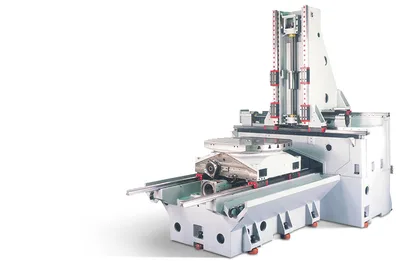
Kitamura Mycenter-800G
This model was not found in Kitamura Machinery's current lineup when we checked on 2026-09-24 (lineup page). It may be a superseded or older model; the specifications below are as we last recorded them.
Key Specifications
X Travel
Y Travel
Z Travel
Max Spindle
Spindle Taper
Tool Capacity
How much does the Kitamura Mycenter-800G cost?
Estimated price range
Our best estimate for a 5-axis machining center in this class — not a quote from Kitamura Machinery. Configuration moves it a long way.
Overview
The Kitamura Mycenter-800G is listed as a 5-axis machining center with an 800 mm (31.5 in) rotary table rated for 1,000 kg (2,205 lb) and travels of 1,050 mm (41.3 in), 850 mm (33.5 in) and 750 mm (29.5 in) in X, Y and Z. It does not appear in Kitamura's current lineup, so this page covers it as an older model, from listed figures.
What stands out is the pairing of a heavy-part table with a light, fast spindle. The listed spindle is a direct-drive CAT 40 / Big Plus dual-contact unit at 20,000 RPM, 18.5 kW (25 hp) and 200 Nm (148 ft-lbf) maximum torque. That suits finishing and semi-finishing of large components with small and medium cutters. Removing a lot of material from a part near the table limit would be slow going on this spindle.
The tilt axis is listed as B, with a range of −30° / +110°, and C rotates 360° continuously. Rapids are 30,000 mm/min (1,181 ipm) on X and Y and 24,000 mm/min (945 ipm) on Z. The tool changer holds 40 tools with a 3.5 sec chip-to-chip time; for large 5-axis parts that need many cutters, 40 pockets can become the limit before the travels do. Machine weight is 12,000 kg (26,455 lb). Check any individual machine's control and spindle against its own documentation.
Full Specifications
| Parameter | Value |
|---|---|
| X-Axis Travel | 1,050 mm (41.3 in) |
| Y-Axis Travel | 850 mm (33.5 in) |
| Z-Axis Travel | 750 mm (29.5 in) |
| Rotary Table Diameter | 800 mm (31.5 in) |
| B Axis Tilt | −30° / +110° |
| C Axis Rotation | 360° continuous |
| Max Spindle Speed | 20,000 RPM |
| Spindle Taper | CAT 40 / Big Plus (Dual Contact) |
| Spindle Motor Power | 18.5 kW (25 hp) |
| Spindle Torque Max | 200 Nm (148 ft-lbf) |
| Spindle Drive | Direct Drive |
| Tool Capacity | 40-tool ATC |
| Tool Change (chip-to-chip) | 3.5 sec |
| Table Load Max | 1,000 kg (2,205 lb) |
| Rapid Traverse X | 30,000 mm/min (1,181 ipm) |
| Rapid Traverse Y | 30,000 mm/min (1,181 ipm) |
| Rapid Traverse Z | 24,000 mm/min (945 ipm) |
| Machine Weight | 12,000 kg (26,455 lb) |
| CNC Control | Fanuc 31i-B5 / Heidenhain TNC 640 |
Specifications compiled from manufacturer literature and industry references. Not independently verified against a published spec sheet — confirm with the manufacturer or an authorised dealer before making a purchasing decision.
Strengths & Limitations
Strengths
- 800 mm (31.5 in) rotary table with a listed load of 1,000 kg (2,205 lb)
- Travels of 1,050 mm (41.3 in) in X, 850 mm (33.5 in) in Y and 750 mm (29.5 in) in Z
- Direct-drive 20,000 RPM spindle with CAT 40 / Big Plus dual-contact tooling
- B-axis tilt of −30° / +110° with a C axis that rotates 360° continuously
Limitations
- Spindle torque tops out at 200 Nm (148 ft-lbf) with 18.5 kW (25 hp), light for roughing parts of the size the table accepts
- 40-tool changer, small for long 5-axis programs on large parts
- Z rapid is 24,000 mm/min (945 ipm), slower than the 30,000 mm/min (1,181 ipm) of X and Y
Best For
Frequently Asked Questions
01
It is not in Kitamura's current lineup and is treated here as an older model. The figures are the listed ones. For a specific machine, confirm the spindle, the control and the tool changer from its nameplate and documentation, since those are the items most likely to differ between builds.
02
The rotary table is listed at 800 mm (31.5 in) with a maximum load of 1,000 kg (2,205 lb), fixture included. Travels are 1,050 mm (41.3 in) in X, 850 mm (33.5 in) in Y and 750 mm (29.5 in) in Z. The machine itself weighs 12,000 kg (26,455 lb).
03
The listed spindle is direct drive, 20,000 RPM, 18.5 kW (25 hp) and 200 Nm (148 ft-lbf) maximum torque, with CAT 40 / Big Plus dual-contact tooling. Those figures favour high-speed cutting with small and medium tools over heavy roughing.
04
The B axis tilts −30° / +110° and the C axis rotates 360° continuously. Linear rapids are 30,000 mm/min (1,181 ipm) on X and Y and 24,000 mm/min (945 ipm) on Z. The tool changer holds 40 tools with a chip-to-chip time of 3.5 sec.
Community Discussions
Owner experience and review
Links to community discussions. Summaries are editorial — visit the original thread for full context.
More from Kitamura Machinery
Other 5-Axis Machining Centers
FANUC RoboDrill a-D21MiB5 5-Axis
GF Machining Liechti go-Mill 600
Starrag Heckert X90
Hartford HSA-528EA