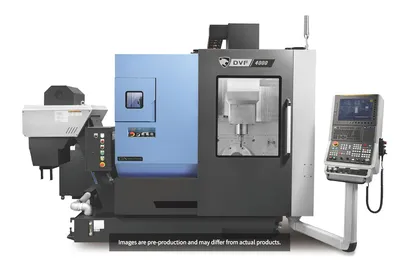
Kitamura Supercell-300G
Image: kitamura-machinery.com, Kitamura Machinery
Key Specifications
X Travel
Y Travel
Z Travel
Max Spindle
Spindle Taper
Tool Capacity
How much does the Kitamura Supercell-300G cost?
Estimated price range
Our best estimate for a 5-axis machining center in this class — not a quote from Kitamura Machinery. Configuration moves it a long way.
Overview
The Kitamura Supercell-300G is a 5-axis horizontal machining center built as an unattended cell for small parts: a 20-station automatic pallet changer and a 188-tool magazine come as standard on a machine with a Ø200 mm (Ø7.9 in) table. Travels are 510 mm (20.1 in) in X and Y and 460 mm (18.1 in) in Z.
The workpiece limit is Ø330 mm (Ø13.0 in) x 200 mm (7.9 in). That is a small envelope, and the point of the machine is how many of those parts it can queue. With 20 pallets loaded and 188 tools in the magazine, a shift's worth of different jobs can sit ready, each with its own tooling, without an operator swapping cutters between them. Kitamura also lists 100-tool and 284-tool magazines as options, so the count can go down as well as up.
The spindle is NST No. 40 with a 200 - 20,000 rpm range. The 200 rpm floor and the small table both point at light, fast cutting. Tool changes take 1.3 sec tool-to-tool and 2.5 sec chip-to-chip, and linear rapids are 60 m/min (2,362 ipm), figures that matter on small parts where the cut itself is short. The tilt axis A covers 150° (+30 to -120°) and the rotary axis B turns 0 to 360°.
Positioning accuracy is ±0.001 mm (±0.000039 in) over full stroke with ±0.0005 mm (±0.00002 in) repeatability. The control is Arumatik-Mi and the supply is 60 kVA at 200 V AC, 3-phase. The Supercell-400G is the next size up, with 560 mm (22.0 in) of X on the same Y and Z and a 122-tool standard magazine.
Full Specifications
| Parameter | Value |
|---|---|
| X-Axis Travel | 510 mm (20.1 in) |
| Y-Axis Travel | 510 mm (20.1 in) |
| Z-Axis Travel | 460 mm (18.1 in) |
| Pallet Diameter | 200 mm (7.9 in) |
| Max Pallet Height | 200 mm (7.9 in) |
| Max Spindle Speed | 200 - 20,000 rpm |
| Spindle Taper | NST No. 40 |
| Tool Capacity | 188 tools (100, 284 optional) |
| Pallet Changer | 20-station APC (up to 80 pallets optional) |
| Rapid Traverse Rate | 60 m/min (2,362 ipm) |
| A Axis Range | 150° (+30 to -120°) |
| B Axis Range | 0 to 360° |
| Positioning Accuracy | ±0.001 mm (±0.000039″)/Full stroke |
| Repeatability | ±0.0005 mm (±0.00002″) |
| Power Supply | 60 kVA, 200 V AC, 3-phase |
| Table Size | Ø200 mm (Ø7.9″) |
| CNC Control | Arumatik-Mi |
| Pallet Size | Ø156 mm (Ø6.1 in) |
| Max Workpiece Size | Ø330 mm (Ø13.0 in) x 200 mm (7.9 in) |
| Pallet Count | 20 Station APC - 9, 12, 15 Optional |
| Tool to Tool Time | 1.3 sec |
| Chip to Chip Time | 2.5 sec |
| Rotary Indexing Speed | 60m/min (2,362ipm) |
Specifications sourced from kitamura-machinery.com — verified 2026-10-03
Strengths & Limitations
Strengths
- 20-station automatic pallet changer as standard
- 188 tools as standard, with 100-tool and 284-tool magazines listed as options
- 1.3 sec tool-to-tool and 2.5 sec chip-to-chip tool changes
- Positioning accuracy of ±0.001 mm (±0.000039 in) over full stroke and ±0.0005 mm (±0.00002 in) repeatability
- 200 - 20,000 rpm NST No. 40 spindle with 60 m/min (2,362 ipm) rapids
Limitations
- Workpieces are limited to Ø330 mm (Ø13.0 in) x 200 mm (7.9 in)
- Spindle speed starts at 200 rpm, so slow, high-torque operations are outside the range
- Needs 60 kVA at 200 V AC, 3-phase, a large supply for a machine with a Ø200 mm (Ø7.9 in) table
- X travel is 510 mm (20.1 in); the Supercell-400G extends X to 560 mm (22.0 in)
Best For
Frequently Asked Questions
01
The standard machine has a 20-station automatic pallet changer and a 188-tool magazine. Kitamura lists 100-tool and 284-tool magazines as options. Other pallet station counts are also listed as options; confirm which with Kitamura for the configuration you need.
02
The maximum workpiece is Ø330 mm (Ø13.0 in) x 200 mm (7.9 in) on a Ø200 mm (Ø7.9 in) table. Travels are 510 mm (20.1 in) in X, 510 mm (20.1 in) in Y and 460 mm (18.1 in) in Z, with an A axis range of 150° (+30 to -120°) and a B axis of 0 to 360°.
03
An NST No. 40 spindle with a speed range of 200 - 20,000 rpm. Tool changes take 1.3 sec tool-to-tool and 2.5 sec chip-to-chip. Kitamura's table for this model does not state spindle power or torque, so ask for those if the parts involve heavier cuts.
04
The Supercell-400G has more X travel, 560 mm (22.0 in), with the same 510 mm (20.1 in) of Y and 460 mm (18.1 in) of Z, and its standard magazine is 122 tools with 188 and 284 as options. The Supercell-300G starts at 188 tools. Both use an NST No. 40 spindle at 200 - 20,000 rpm with 60 m/min (2,362 ipm) rapids.
05
Positioning accuracy is ±0.001 mm (±0.000039 in) over full stroke and repeatability is ±0.0005 mm (±0.00002 in). The machine needs 60 kVA at 200 V AC, 3-phase, and runs Kitamura's Arumatik-Mi control.
Videos

KitamuraMachinery2

REDIMAGROUP
More from Kitamura Machinery
Other 5-Axis Machining Centers
Mazak VORTEX i-V