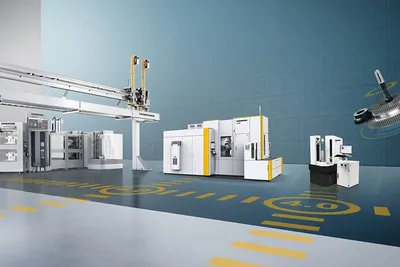
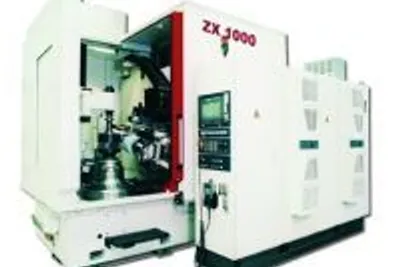
KAPP NILES ZX 300
Key Specifications
axes
max gear outside diameter
max gear module
max face width
max helix angle
honing process
Overview
The KAPP NILES ZX 300 is a CNC gear honing machine for external gears up to 300 mm (11.81 in) outside diameter. Gear honing — also called continuous generating gear honing or hard finishing by honing — is a process distinct from gear grinding: it uses an abrasive-coated gear-form tool (the honing wheel) in continuous meshing contact with the workpiece gear, running at a crossed-axes angle to create a sliding cutting action across the tooth flanks.
The gear honing process delivers several advantages over generating grinding for specific applications: lower heat input to the workpiece (reducing the risk of surface zone damage or grinding burn), the ability to correct for distortion from prior heat treatment, better surface texture with a crosshatch pattern that retains lubricating oil in transmission applications, and very fast cycle times for small-module gears in high-volume production. Automotive transmission gears, particularly those requiring absolute gear noise (GTE) control, are the primary application for gear honing.
The ZX 300 performs continuous generating gear honing with a corundum or CBN-coated internal gear honing tool. The honing wheel engages the external gear workpiece at a small crossed-axes angle (typically 10-15 degrees), creating the characteristic honing kinematics. The honing tool is dressed by a profile master gear or diamond form tool between batches.
Machine construction uses a polymer concrete base with precision guideway systems and a direct-drive workpiece spindle. The control system is KN grind on Siemens Sinumerik 840D sl, with honing-specific process parameter management including honing pressure, kinematics, and dressing cycle control.
New ZX 300 machines are typically priced in the $500,000-$900,000 range. The ZX series competes directly with Gleason-Hurth and Reishauer honing machines in automotive gear production.
Full Specifications
| Parameter | Value |
|---|---|
| Axes | 5 (X, Z linear + A workpiece rotation, B honing wheel, C dressing) |
| Max Gear Outside Diameter | 300 mm (11.81 in) |
| Max Gear Module | 6 mm |
| Max Face Width | 300 mm (11.81 in) |
| Max Helix Angle | ±45 degrees |
| Honing Process | Continuous generating gear honing (internal honing wheel) |
| Honing Wheel Diameter | Up to 320 mm (12.6 in) internal gear form |
| Workpiece Spindle | Direct-drive, backlash-free |
| Crossed Axes Angle | Adjustable, typically 10-15 degrees |
| Dressing | Profile master gear or diamond form dressing |
| Machine Bed | Polymer concrete (mineral casting) |
| Machine Dimensions | 3,200 x 2,000 x 2,300 mm (126 x 78.7 x 90.6 in) |
| CNC Control | KN grind on Siemens Sinumerik 840D sl |
Specifications compiled from manufacturer literature and industry references. Not independently verified against a published spec sheet — confirm with the manufacturer or an authorised dealer before making a purchasing decision.
Strengths & Limitations
Strengths
- Gear honing process produces a crosshatch surface texture on gear flanks that retains lubricating oil film better than ground surfaces, reducing noise and wear in transmission applications
- Lower heat input compared to generating grinding reduces risk of thermal damage to the gear surface zone — critical for thin-section gears and case-hardened components
- Very fast cycle times for small-module automotive gears make honing the most productive hard gear finishing process for high-volume transmission manufacturing
- Honing corrects for distortion from prior heat treatment, improving both geometry and surface texture in one operation
- KN grind software and Sinumerik 840D sl control are shared with KAPP NILES' grinding machines, enabling common programming knowledge across the factory
- 300 mm OD and module 6 capacity covers the full range of automotive passenger car and light commercial vehicle transmission gears
Limitations
- Gear honing is less capable than grinding for correcting large gear geometry errors — if heat treat distortion is severe, grinding is required before honing
- Honing wheel (internal form gear) is an expensive consumable; the honing tool must be dressed regularly and replaced periodically, adding to the cost per gear
- Module 6 limit excludes larger commercial vehicle and industrial gears that require heavy-duty generating grinding on machines like the KX 260 or KX 300P
- Crossed-axes honing kinematics add a twist component to the tooth flank topography — this is managed in programming but requires specific knowledge to control
- Process development for honing requires understanding of honing tool selection, dressing strategy, and kinematics that differs substantially from grinding expertise
Best For
Frequently Asked Questions
01
Gear grinding removes stock from hardened gear teeth using abrasive wheels in a generating or profile grinding motion, achieving tight geometry corrections and DIN 3-5 accuracy. Gear honing uses a gear-form abrasive tool in continuous meshing contact at a small crossed-axes angle — the process removes very little stock but improves surface texture, corrects minor geometry errors, and creates a crosshatch pattern that retains lubricant. Honing follows grinding when the best combination of geometry accuracy, surface texture, and productivity is required.
02
In high-volume automotive transmission production, the ZX 300 typically follows a generating grinder (like the KX 260) in a linked hard finishing cell. The grinder corrects heat treat distortion and sets the baseline geometry; the honing machine finishes the surface texture for NVH and lubrication performance. In some low-distortion applications with tight heat treatment control, honing alone may be sufficient without prior grinding. KAPP NILES' applications team can evaluate whether single-process honing meets a specific gear's quality requirements.
03
For small-module automotive gears (module 2-4, under 100 mm OD), gear honing cycle times are typically 30-60 seconds per gear, faster than equivalent generating grinding times. The time advantage is because honing removes very little stock and relies on the crosshatch cutting action at relatively low force — the process is not a roughing operation. For larger-module gears where significant stock removal is needed, generating grinding remains faster.
04
New KAPP NILES ZX 300 machines are typically priced between $500,000 and $900,000 depending on honing tool configuration, automation level, and measuring system. The ZX 300 competes directly with Gleason-Hurth and Reishauer gear honing machines in the automotive Tier 1 market. Contact KAPP NILES or their North American representative for a quotation based on your gear range and production requirements.
05
The ZX 300 is a continuous generating gear honing machine for external gears, using an internal honing wheel in crossed-axes meshing contact. The ZPI (in KAPP NILES' lineup) is a gear profile inspection machine for measuring finished gears — not a manufacturing machine. The two serve entirely different functions: the ZX 300 finishes gear flanks, while the ZPI verifies gear quality after manufacturing.
Videos
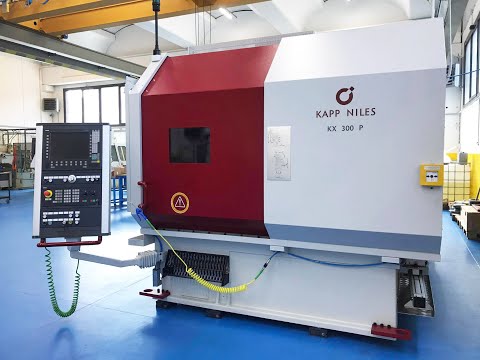
Gandini ingranaggi

KAPP NILES

Gear Technology India

KAPP NILES

KAPP NILES
Community Discussions
Pricing and buying discussion — What are your experience with okuma machines? :
Comparison and buying advice — Milling CNC precision & stability - why does Haas suck? : r ...
Pricing and buying discussion — Where to buy taps that are not garbage : r/Machinists - Reddit
Community discussion — Any recommendations for cutters for stainless? :
Links to community discussions. Summaries are editorial — visit the original thread for full context.
Related Machines
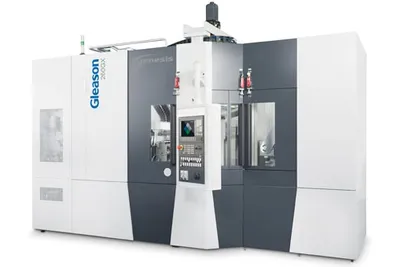
Gleason Genesis 200GX
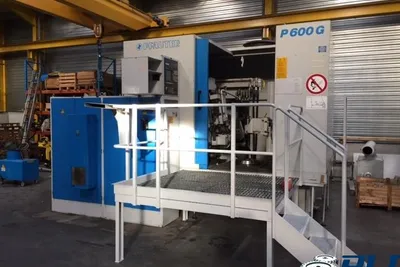
Gleason P600G
KAPP NILES KX 300 P