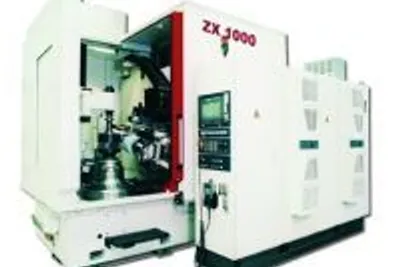
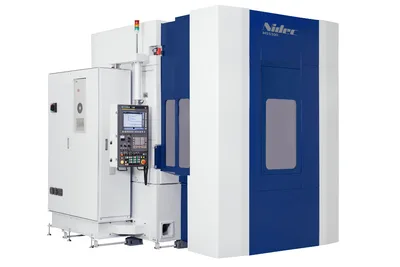
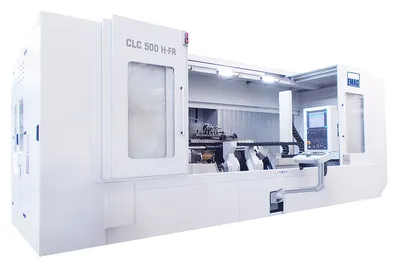
Kapp Niles ZPI
Key Specifications
Max Workpiece β
module range
max face width
grinding wheel diameter
grinding spindle speed
workpiece spindle
Overview
The Kapp Niles ZPI is a profile gear grinding machine designed for high-precision finishing of external and internal spur and helical gears. Kapp Niles, headquartered in Coburg, Germany, is one of the world's leading manufacturers of gear grinding technology, and the ZPI represents their solution for shops requiring maximum flexibility in gear profile grinding with the quality standards demanded by automotive, aerospace, and precision gearing applications.
The ZPI accommodates workpiece diameters up to 500 mm (19.7 in) and module ranges from 0.5 to 10 mm, covering the majority of precision gear grinding applications in transmission manufacturing and industrial gearbox production. The profile grinding process uses a dressable grinding wheel that is profiled to the exact tooth geometry, then traverses across the gear face width to grind one tooth gap at a time. This method produces superior surface finish and profile accuracy compared to generating grinding for certain gear types, particularly when complex profile modifications are required.
The machine features direct-drive workpiece and grinding wheel spindles for zero-backlash positioning. The grinding wheel spindle operates at speeds up to 6,000 RPM with power sufficient for both roughing and finishing passes. Integrated dressing capability with a diamond dresser roller maintains grinding wheel geometry throughout production. The machine includes an integrated probing system for automatic stock distribution measurement, ensuring consistent material removal across all teeth before grinding begins.
The ZPI runs on Siemens SINUMERIK 840D sl with Kapp Niles' proprietary gear grinding software. This software handles tooth profile definition, grinding parameter optimization, and automatic dressing cycle management. Integrated gear measurement capability allows in-process quality verification without removing the part from the machine, eliminating the inspection bottleneck common in gear production. Pricing for the Kapp Niles ZPI starts around $600,000 to $800,000 depending on size range, automation level, and measurement system options. Fully configured machines with robotic loading and comprehensive measurement capability can exceed $1,000,000. Competitors include the Reishauer RZ series (generating grinding), Gleason P600G (profile grinding), and Liebherr gear grinding platforms.
Full Specifications
| Parameter | Value |
|---|---|
| Max Workpiece Diameter | 500 mm (19.7 in) |
| Module Range | 0.5 - 10 mm |
| Max Face Width | 300 mm (11.8 in) |
| Grinding Wheel Diameter | Up to 350 mm (13.8 in) |
| Grinding Spindle Speed | Up to 6,000 RPM |
| Workpiece Spindle | Direct-drive, zero backlash |
| Dressing System | Integrated diamond roller dresser |
| In Process Measurement | Integrated gear measurement probe |
| Number Of Axes | 6 CNC axes |
| Profile Accuracy | DIN 3962 Class 3 or better |
| Surface Finish | Ra 0.2 - 0.4 Β΅m |
| CNC Control | Siemens SINUMERIK 840D sl with Kapp Niles software |
| Machine Weight | 12,000 kg (26,455 lb) |
Strengths & Limitations
Strengths
- Profile grinding method produces superior tooth geometry accuracy and surface finish for gears requiring complex profile modifications or crowning
- Integrated gear measurement system eliminates the need to transfer parts to a separate CMM, reducing inspection cycle time by 60-80%
- Direct-drive spindles with zero backlash ensure consistent gear quality across production lots without mechanical wear degradation
- Kapp Niles proprietary software includes advanced dressing optimization that maximizes grinding wheel life while maintaining profile accuracy
- Flexible work range from module 0.5 to 10 mm covers everything from small instrument gears to medium-sized industrial gearbox gears on one machine
- German engineering and Kapp Niles' 120+ year heritage in gear technology ensure long machine life and excellent support for precision gear manufacturing
Limitations
- $600K+ entry price is a major investment; shops without dedicated gear production volume may struggle to justify the capital outlay
- Profile grinding is inherently slower than generating grinding for high-volume production of standard gear geometries; a Reishauer RZ series machine will outproduce the ZPI on simple spur gears
- Siemens control with Kapp Niles overlay requires specialized operator training; gear grinding expertise is a scarce skill set in many markets
- 12,000 kg machine weight and precision requirements demand a climate-controlled environment and vibration-isolated foundation for optimal results
Best For
Frequently Asked Questions
01
Profile grinding uses a grinding wheel dressed to the exact tooth shape, grinding one tooth gap at a time by traversing across the face width. Generating grinding uses a threaded grinding wheel that simultaneously grinds multiple teeth through a generating motion. Profile grinding offers better flexibility for complex profile modifications and internal gears. Generating grinding (Reishauer RZ series) is faster for high-volume production of standard gear geometries.
02
The ZPI routinely achieves DIN 3962 Class 3 or better on profile and lead measurements. Surface finish ranges from Ra 0.2 to 0.4 Β΅m. For NVH-critical automotive gears, the integrated measurement system verifies quality in-process and can automatically compensate for systematic errors. With optimized dressing and grinding parameters, DIN Class 2 is achievable on favorable gear geometries.
03
The ZPI is primarily configured for external gears. Kapp Niles offers separate machines (KX series) specifically designed for internal gear grinding, which requires different wheel geometries and access angles. For shops needing both internal and external gear grinding, Kapp Niles can provide application-specific recommendations for the optimal machine combination.
04
The ZPI includes a touch-trigger probe that measures gear tooth geometry directly on the machine without removing the workpiece. The system measures profile, lead, pitch, and runout per DIN 3962 standards. Results are displayed in real-time and can automatically trigger grinding parameter adjustments. This eliminates the need to transport parts to a separate gear inspection machine for quality verification, reducing total processing time by 30-50%.
05
The ZPI uses dressable vitrified bond grinding wheels, typically aluminum oxide for conventional steels and CBN for high-hardness applications. Diamond roller dressers maintain the grinding wheel profile throughout production. Wheel selection depends on the gear material, required surface finish, and production volume. Kapp Niles provides wheel recommendations optimized for each application as part of their process engineering support.
06
Kapp Niles offers integrated robotic loading systems for the ZPI, enabling unattended production. The robot handles workpiece loading and unloading from palletized magazine systems. With robotic loading and the integrated measurement system, the ZPI can run extended unmanned shifts with automatic quality verification. Automation packages typically add $150,000-$250,000 to the base machine cost.
Videos
KAPP NILES
MATLAB
Product Process People
Siemens Knowledge Hub
Juan Pablo
Community Discussions
Community discussion β Niles-Bement-Pond Company Machine Tools Catalogue 1903
Capabilities and material handling β Gearing Up to Make Big Gears - Practical Machinist
Troubleshooting and problem-solving β Z height issues - Practical Machinist
Community discussion β Z Offsets: How do YOU set them? - Practical Machinist
Community discussion β How to manually set work offset for Z - CNCzone
Community discussion β Need Help! WIPS Programming - cnczone.com
Troubleshooting and problem-solving β Need Help! Z axis dives into workpiece - cnczone.com
Community discussion β Z offset setting - CNCzone
Links to community discussions. Summaries are editorial β visit the original thread for full context.