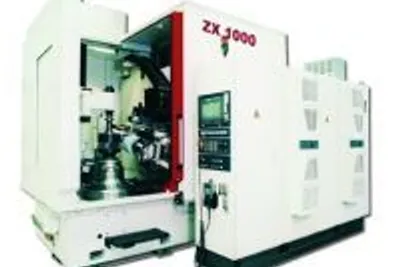
Kapp Niles KX 160
Key Specifications
Max Workpiece ⌀
min workpiece diameter
module range
max face width
grinding method
grinding spindle power
Overview
The Kapp Niles KX 160 is a CNC profile gear grinding machine designed for high-precision finishing of gears up to 160 mm (6.3 in) outside diameter. Kapp Niles, the German gear finishing specialist formed by the merger of Kapp and Niles, is one of the three dominant players in precision gear grinding alongside Reishauer and Gleason. The KX 160 sits in the small-to-medium gear size range, targeting automotive transmission, robotics, and industrial gearbox applications where gear quality classes of DIN 3 or better are required.
The KX 160 employs profile grinding (also called form grinding) using CBN or conventional grinding wheels. Profile grinding machines each tooth space individually, which provides superior control over tooth profile and lead accuracy compared to generating (threaded wheel) grinding. The machine handles modules from 0.5 to 5 mm, face widths up to 100 mm (3.94 in), and both external and internal gears. Workpiece diameter range is 10-160 mm (0.39-6.3 in).
The grinding spindle delivers power up to 15 kW at speeds reaching 6,000 RPM, with direct-drive technology for vibration-free operation. The dressing system uses diamond dressing rolls for automatic wheel profiling, enabling consistent tooth geometry across production batches. Cycle times are competitive with generating grinding for small-lot production, and the profile grinding approach offers flexibility to handle non-standard gear geometries, modifications, and special tooth forms without custom threaded wheels.
The KX 160 runs on Siemens SINUMERIK 840D sl with Kapp Niles' proprietary gear grinding software, which includes automatic grinding strategy optimization, in-process measurement with Marposs or equivalent gauging, and direct interface to Klingelnberg and Wenzel gear measuring machines for closed-loop quality control. The machine features automatic loading options for unattended production. New KX 160 machines typically price in the $500,000-$750,000 range depending on configuration. Used units are uncommon in this specialized market.
Full Specifications
| Parameter | Value |
|---|---|
| Max Workpiece Diameter | 160 mm (6.3 in) |
| Min Workpiece Diameter | 10 mm (0.39 in) |
| Module Range | 0.5 - 5 mm |
| Max Face Width | 100 mm (3.94 in) |
| Grinding Method | Profile (form) grinding |
| Grinding Spindle Power | 15 kW |
| Grinding Spindle Speed | Up to 6,000 RPM |
| Wheel Type | CBN or conventional (vitrified/electroplated) |
| Dressing System | Diamond roll dressing, CNC-controlled |
| Gear Types | External and internal, spur and helical |
| Achievable Quality | DIN 3 / AGMA 13 |
| In Process Measurement | Marposs or equivalent |
| CNC Control | Siemens SINUMERIK 840D sl with Kapp Niles software |
| Loading | Manual or automatic (ring loader/robot) |
Strengths & Limitations
Strengths
- Profile grinding method provides superior control over tooth geometry modifications compared to generating grinding, essential for optimized NVH characteristics
- DIN 3 / AGMA 13 achievable quality meets the most demanding gear precision requirements in automotive, robotics, and aerospace
- CBN grinding wheel capability enables significantly faster cycle times and longer wheel life compared to conventional abrasives
- Direct-drive grinding spindle eliminates belt-induced vibration, critical for achieving sub-micron surface finishes on tooth flanks
- Closed-loop integration with Klingelnberg and Wenzel gear measurement systems enables data-driven process optimization
- Handles both external and internal gears with module range of 0.5-5 mm, covering the full spectrum of small-to-medium precision gears
Limitations
- 160 mm maximum diameter limits the machine to small-to-medium gears; larger gears require stepping up to the KX 260 or KX 500
- Profile grinding is inherently slower than generating grinding on high-volume production of simple gear geometries
- Investment of $500K-$750K is substantial for a dedicated gear finishing machine, requiring sufficient gear production volume to justify
- Specialized nature means the machine has limited utility if gear production volumes decrease; it cannot be repurposed easily
Best For
Frequently Asked Questions
01
New Kapp Niles KX 160 machines typically range from $500,000 to $750,000 depending on CBN vs. conventional wheel configuration, dressing system options, in-process measurement systems, and automation. A fully automated cell with ring loader and integrated measurement can approach $900,000. Used KX 160 units are rare; when available, they typically sell for $300,000-$500,000 due to the specialized nature of the market.
02
Profile grinding uses a wheel dressed to the exact tooth space profile and grinds one tooth at a time, providing maximum control over profile and lead modifications. Generating grinding uses a threaded wheel that grinds all teeth in a continuous process, which is faster for high volumes of standard gears. Profile grinding excels for complex modifications, small lots, and internal gears. The KX 160 uses profile grinding, which is ideal for its target applications.
03
CBN wheels offer 3-5x faster cycle times, longer wheel life, and more consistent quality over the wheel's lifetime compared to conventional vitrified wheels. However, CBN wheels cost significantly more upfront ($5,000-$15,000 per wheel vs. $500-$2,000 for conventional). For high-volume production, CBN pays for itself quickly. For prototype work and small batches with frequent profile changes, conventional wheels are more economical since they can be re-dressed to new profiles.
04
The Reishauer RZ 260 is a generating (threaded wheel) grinding machine optimized for high-volume production. It can be faster on large batches of standard gears. The Kapp Niles KX 160 uses profile grinding, which offers more flexibility for complex modifications, internal gears, and small-lot production. For automotive mass production of 500,000+ identical gears annually, the Reishauer may be faster. For mixed production and quality-critical applications, the Kapp Niles is more versatile.
05
Yes, the KX 160 can grind internal gear teeth, which is a significant advantage of profile grinding over generating grinding. Internal gears are common in planetary gear sets used in automotive transmissions and industrial reducers. The machine accommodates internal gear diameters within its working envelope, though the minimum bore diameter for internal grinding is constrained by wheel access. This capability is one reason many transmission manufacturers choose profile grinding.
06
The KX 160 achieves gear flank surface finishes of Ra 0.2-0.4 micrometers with conventional grinding and Ra 0.1-0.2 micrometers with CBN grinding using optimized parameters. For applications requiring even finer finishes, a subsequent superfinishing or honing operation may be used. The direct-drive spindle and vibration-damped machine structure contribute to achieving these finishes consistently across production batches.
Videos
KAPP NILES
KAPP NILES
KAPP NILES
KAPP NILES
KAPP NILES
Community Discussions
Troubleshooting and problem-solving — Microsoft Word - Tool Setter Calibration.doc - CNCzone
Community discussion — Adjusting mill spindle bearings - CNCzone
Community discussion — Calypso control software - cnczone.com
Community discussion — OKK - CNCzone
Links to community discussions. Summaries are editorial — visit the original thread for full context.