KAPP NILES KVS 1400
Key Specifications
Max Workpiece ⌀
gear module range
gear types
process
surface finish
gear quality improvement
Overview
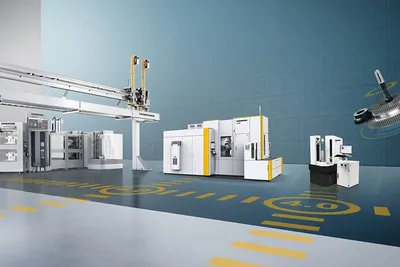
The KAPP NILES KVS 1400 is a large-capacity CNC gear honing machine from KAPP NILES GmbH & Co. KG, the Coburg, Germany-based specialist in gear finishing and gear grinding technology. The KVS 1400 applies the gear honing process — also called gear skiving honing or power honing — to large external spur and helical gears up to approximately 1,400 mm pitch diameter, making it one of the largest-capacity gear honing machines in KAPP NILES' portfolio and a key solution for large industrial gearbox, wind turbine, and marine gear finishing applications.
Gear honing is a finishing process that uses an abrasive, gear-shaped honing tool (the honing ring) to mesh with the workpiece gear under a controlled crossed-axis angle. The crossed-axis engagement between honing tool and workpiece generates the cutting action, removing small amounts of material from the flanks while simultaneously imparting a characteristic crossed-hatch surface texture. This surface texture — analogous to the crosshatch produced by cylinder honing in engine manufacturing — provides improved oil retention and reduced sliding friction in the gear mesh, contributing to lower noise levels and improved gear efficiency under lubricated operating conditions. Gear honing is therefore particularly effective as a final finishing step following heat treatment and hard turning, and is widely used in automotive transmission manufacturing for gears destined for high-performance or noise-sensitive applications.
The KVS 1400's large capacity extends the honing process to gear sizes well beyond automotive transmissions. Industrial gearboxes, wind turbine stage gears, marine propulsion gears, and large-module power transmission gears can all benefit from the surface quality and noise reduction that honing delivers when applied after profile grinding. The KVS 1400 can operate both as a standalone honing machine and in combination with KAPP NILES' profile grinding machines — a workflow where profile grinding establishes the gear's geometric accuracy to DIN quality level and honing then refines the surface texture and reduces noise to the lowest achievable level.
Control is via Siemens SINUMERIK 840D sl with KAPP NILES' proprietary WOP (Workshop-Oriented Programming) software. WOP allows operators to define gear parameters and honing parameters in a practical, shop-floor-oriented interface without manual G-code programming. The machine monitors honing force, tool engagement, and cycle time in real time, with automatic compensation for tool wear. Coolant management is fully integrated, with temperature-controlled coolant supply essential for maintaining dimensional stability during the thermal loads generated by the honing process.
The KVS 1400 is most valuable in production environments where the combination of large gear size and demanding noise or surface quality requirements creates a need for a dedicated large-gear honing capability. Wind turbine gear manufacturers, marine gearbox makers, and large industrial gearbox producers represent the primary user base. KAPP NILES also provides the honing tools — internally manufactured to match the workpiece gear geometry — ensuring that tool specification, process parameters, and machine performance are optimized as a system.
Full Specifications
| Parameter | Value |
|---|---|
| Max Workpiece Diameter | 1,400 mm (55.1 in) |
| Gear Module Range | 2 - 20 mm |
| Gear Types | External spur, external helical |
| Process | Gear honing (power honing / skiving honing) with crossed-axis abrasive honing ring |
| Surface Finish | Ra 0.3 - 0.8 µm typical post-honing |
| Gear Quality Improvement | Noise reduction and surface texture improvement after profile grinding |
| CNC Control | Siemens SINUMERIK 840D sl with KAPP NILES WOP software |
| Coolant | Temperature-controlled coolant supply integrated |
| Tool | KAPP NILES abrasive honing ring (internally produced, workpiece-specific) |
| Automation Interface | Robot loading/unloading interface available |
| Machine Weight | Approx. 30,000 - 45,000 kg |
Specifications compiled from manufacturer literature and industry references. Not independently verified against a published spec sheet — confirm with the manufacturer or an authorised dealer before making a purchasing decision.
Strengths & Limitations
Strengths
- 1,400 mm capacity enables gear honing on large industrial gearbox, wind turbine, and marine gears that no smaller honing machine can reach
- Crossed-hatch surface texture from honing improves lubrication retention and reduces gear mesh friction and noise beyond what grinding alone achieves
- Complements profile grinding in a combined grind-then-hone workflow — grinding establishes geometry, honing refines surface quality to the lowest noise level
- KAPP NILES internally produces the honing tools — tool, process, and machine are engineered as a system for optimal results
- WOP software enables shop-floor programming without G-code expertise, reducing setup time for new gear families
- Siemens SINUMERIK 840D sl control provides broad Industry 4.0 connectivity and familiar interface for operators with SINUMERIK experience
Limitations
- Gear honing removes only small stock amounts — it is a finishing process, not a stock-removal process; significant material removal must be done by prior grinding
- Honing tools are workpiece-specific and must be ordered from KAPP NILES for each gear family, adding tooling lead time and cost for new programs
- Investment in the $1M-$1.8M range requires a clear volume justification and a production context where gear noise and surface quality drive the honing step
- Large machine footprint and weight require significant facility preparation including foundation engineering
- Crossed-axis honing process is less universally applicable than profile grinding — not all gear types or quality requirements benefit equally from the honing step
Best For
Frequently Asked Questions
01
Gear honing is a hard finishing process that uses an abrasive, gear-shaped honing ring to mesh with the workpiece gear under a crossed-axis angle. The relative motion at the crossed angle generates cutting action that removes small amounts of material from the tooth flanks while creating a characteristic crosshatch surface texture. The KVS 1400 applies this process to large external gears up to 1,400 mm diameter, finishing tooth surfaces after profile grinding to improve noise behavior and oil retention.
02
Gear grinding uses abrasive wheels to remove significant material stock and establish the final gear geometry to a target DIN quality level. Gear honing uses an abrasive honing ring to remove only a small amount of material (typically 0.01-0.05 mm per flank) as a final finishing step after grinding. Honing's primary purpose is surface texture improvement — creating the crosshatch pattern that improves lubrication and reduces noise — rather than geometric correction. The two processes are often used together: grind first for geometry, then hone for surface quality.
03
The KAPP NILES KVS 1400 accommodates external spur and helical gears up to approximately 1,400 mm pitch diameter with module range from approximately 2 to 20 mm. This covers large industrial gearbox gears, wind turbine stage gears, marine propulsion gears, and other large power transmission gears that require honing as part of their manufacturing process.
04
Yes. Gear honing requires a honing ring that is geometrically matched to the workpiece gear — the honing ring's tooth form, module, helix angle, and diameter are specific to the gear being finished. KAPP NILES manufactures these honing rings internally, which allows the tool geometry, abrasive specification, and bond system to be optimized for each gear family. New gear programs require ordering a specific honing ring from KAPP NILES, which adds tooling lead time compared to processes that use general-purpose grinding wheels.
05
The KAPP NILES KVS 1400 typically prices in the range of $1,000,000 to $1,800,000 new, depending on configuration, automation, and tooling. As a large-capacity specialized gear honing machine, it represents a significant investment typically justified by high-value large gear production in wind energy, marine, or industrial gearbox applications where gear noise and surface quality are premium requirements.
Community Discussions
Community discussion — Niles Vertical Boring machine needs help - Practical Machinist
Community discussion — Jones and Shipman 'X' model info (1400X or 540X)
Community discussion — Niles 36ft Vertical Boring ...
Community discussion — Niles-Bement-Pond Company Machine Tools Catalogue 1903
Troubleshooting and problem-solving — Is Haas Really That Bad? : r/Machinists - Reddit
Pricing and buying discussion — Vertical Lathe for 1250mm OD parts : r/Machinists - Reddit
Pricing and buying discussion — Where to buy taps that are not garbage : r/Machinists - Reddit
Community discussion — Polycarbonate speeds/feeds? : r/Machinists - Reddit
Links to community discussions. Summaries are editorial — visit the original thread for full context.
Related Machines
Gleason Genesis 200GX
Gleason P600G
KAPP NILES KX 300 P