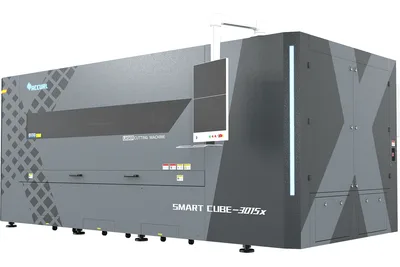
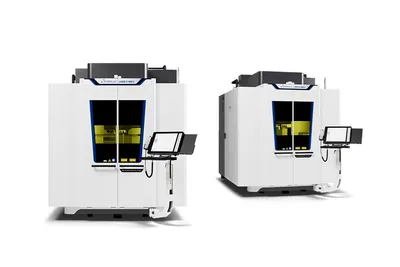
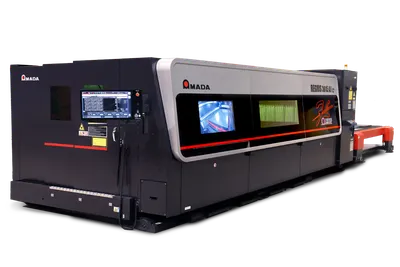
IPG Photonics YLR Series
Key Specifications
laser type
wavelength
power range
common cutting powers
beam quality bpp
output fiber
Overview
The IPG Photonics YLR Series is the industry-leading family of continuous-wave ytterbium (Yb) fiber laser sources powering the majority of the world's commercial fiber laser cutting machines. Unlike the machine builders in this category, IPG Photonics is a laser source manufacturer — the YLR Series is not a complete cutting machine but rather the laser oscillator that OEM machine builders (TRUMPF, Bystronic, Mazak, Mitsubishi Electric, Han's Laser, Bodor, and many others) integrate into their flatbed laser cutting platforms. Understanding the YLR Series is essential for evaluating any fiber laser cutting machine, since beam quality, power delivery, and long-term reliability are fundamentally determined by the laser source.
The YLR Series spans power levels from under 1 kW to over 30 kW in standard catalog configurations, with the 1 kW, 2 kW, 3 kW, 4 kW, 6 kW, 8 kW, 10 kW, 12 kW, 15 kW, and 20 kW variants being the most widely deployed in industrial laser cutting applications. All YLR modules operate at approximately 1,070 nm wavelength — the near-infrared range that is absorbed efficiently by metals including steel, stainless, aluminum, copper, and brass, enabling the superior thin-gauge cutting speeds and copper/brass cutting capability that distinguishes fiber from CO2 technology. IPG's proprietary fiber gain medium and pump diode packaging achieve beam quality figures (BPP) that enable focused spot sizes enabling cutting quality unachievable with CO2 at equivalent power.
The YLR Series delivers its output through a process fiber (typically 50–200 µm core diameter depending on power level and beam quality specification) that plugs into the machine's cutting head via a standard QBH or similar fiber connector. This delivery architecture makes YLR modules field-replaceable — a failed module can be exchanged in hours rather than requiring full machine service, an important operational consideration for production shops where machine uptime is critical. IPG publishes MTBF data in excess of 25,000 hours for their production modules, reflecting the solid-state reliability advantage of fiber over gas resonator technology.
IPG Photonics holds the dominant market share in industrial fiber laser sources — estimates range from 40–60% of global industrial fiber laser revenue across the period when fiber laser cutting adoption accelerated. This market position means that when evaluating any fiber laser cutting machine, buyers are often indirectly evaluating IPG technology. Machines using genuine IPG YLR modules are generally preferred by buyers who prioritize source reliability and global parts/service availability; some machine builders offer alternative sources (nLIGHT, Coherent, Raycus, Max Photonics) at lower price points. IPG YLR modules are sold through machine builder OEM channels and not direct to end users for new machine integration.
Full Specifications
| Parameter | Value |
|---|---|
| Laser Type | Ytterbium Fiber (CW) |
| Wavelength | ~1,070 nm |
| Power Range | 1 kW – 30+ kW (standard catalog) |
| Common Cutting Powers | 2 kW, 4 kW, 6 kW, 8 kW, 10 kW, 12 kW |
| Beam Quality Bpp | varies by power; <2.0 mm·mrad at 2 kW, up to ~8 mm·mrad at 20 kW |
| Output Fiber | Process fiber with QBH or equivalent connector (50–200 µm core) |
| Electrical Efficiency | up to ~45% wall-plug efficiency |
| Cooling | Water-cooled modules |
| Design Life Mtbf | 25,000+ hours |
| Form Factor | Rack-mount modules (integrated into machine enclosure by OEM) |
| Emission Wavelength | 1,070 nm (near-IR) |
| Polarization | Random |
Specifications sourced from ipgphotonics.com — verified 2026-03-28
Strengths & Limitations
Strengths
- Dominant global market position means widespread OEM support, replacement module availability, and field service expertise across all major industrial markets
- Solid-state architecture with no gas, mirrors, or mechanical resonator components — MTBF exceeds 25,000 hours and failed modules are field-replaceable in hours
- Near-IR wavelength at 1,070 nm enables efficient coupling into copper and brass that CO2 cannot achieve, and delivers superior thin-gauge cutting speeds across all metals
- Covers the full industrial power spectrum from 1 kW to 30+ kW in a scalable module architecture — machine builders configure power level to application without changing platform
Limitations
- YLR modules are sold through OEM machine builder channels only — end users cannot purchase or integrate YLR sources independently for new cutting machine construction
- Premium pricing versus Chinese fiber laser alternatives (Raycus, Max Photonics) means machines built on IPG sources carry a higher capital cost than equivalent-power Chinese-source machines
- High-power modules (above 10 kW) require significant water cooling infrastructure and electrical supply — integration demands that add cost and complexity to machine designs
Best For
Frequently Asked Questions
01
The YLR is the laser oscillator — the component that generates and amplifies the laser light. It is not a complete cutting machine. Machine builders purchase YLR modules and integrate them with a machine structure, cutting head, motion system, CNC, and software to create a complete laser cutting system. When you buy a TRUMPF, Mazak, Bystronic, or other fiber laser machine, you are often buying a machine that contains an IPG YLR source inside.
02
Many leading Western and Asian machine builders use IPG YLR sources, including TRUMPF (in TruFiber configurations), Bystronic, Mazak (in some OptiPlex configurations), Mitsubishi Electric (in some LF and GX-F configurations), and others. Chinese machine builders including Han's Laser and Bystronic's lower-cost lines use both IPG and domestic alternatives. Machine builders may use different sources across their product lines — verify with the specific model.
03
BPP (Beam Parameter Product) measures beam quality — lower BPP means the laser can be focused to a smaller spot with a tighter depth of field. Better BPP enables higher cutting speeds on thin gauge and cleaner edges. IPG's YLR modules maintain excellent BPP at 2–6 kW power levels. At very high power (10–20 kW), managing BPP while scaling power requires advanced fiber design. Lower BPP at high power is a key technical differentiator among fiber laser sources.
04
IPG YLR modules typically offer higher beam quality (BPP), longer published MTBF data, and broader global service infrastructure compared to Chinese fiber laser sources at equivalent power levels. Raycus and Max Photonics have rapidly improved quality and are widely used in Chinese-built machines (Han's Laser, Bodor, Accurl). The gap in reliability and beam quality is smaller than it was in 2018–2020. The primary differentiators today are BPP at high power, service ecosystem depth, and price.
05
Field module replacement is technically possible but must be coordinated through the machine builder's service organization. IPG does not supply modules directly to end users for field service — the machine builder or their authorized service partners manage source replacement. The QBH or equivalent fiber connector standard allows module swap in some platforms, but alignment, control integration, and safety certification verification are required after any source change.
Videos
2BMotionMedia
MachineryNetwork
Somjin Th. Mahasarakham
Kim Lee
Community Discussions
Comparison and buying advice — Trudisk vs Trufiber vs IPG - Practical Machinist
Troubleshooting and problem-solving — Laser weld does not penetrate - Practical Machinist
Owner experience and review — Opinions on laser welders - Practical Machinist
Community discussion — Small Footprint Fiber Laser - Practical Machinist
Troubleshooting and problem-solving — Need Help! IPG Laser:System Error! - CNCzone
Troubleshooting and problem-solving — Problem Diagnosing root cause of no laser output - cnczone.com
Troubleshooting and problem-solving — Fiber laser cutting machine alarm - CNCzone
Community discussion — Need Help! Y-axis does not move... as soon the ... - CNCzone
Community discussion — What’s the best/most comfortable eye protection you’ve had ...
Community discussion — Can someone explain post processors to me : r/Machinists - Reddit
Owner experience and review — End mill coatings? : r/Machinists - Reddit
Community discussion about this machine.
Links to community discussions. Summaries are editorial — visit the original thread for full context.