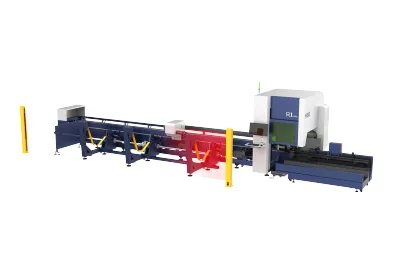
IPG Photonics YLM Series
This model was not found in IPG Photonics's current lineup when we checked on 2026-10-03 . It may be a superseded or older model; the specifications below are as we last recorded them.
Key Specifications
laser technology
wavelength
output power range
beam quality m
process fiber core diameter
output connector
How much does the IPG Photonics YLM Series cost?
Estimated price range
Our best estimate for a cnc laser cutting machine in this class — not a quote from IPG Photonics. Configuration moves it a long way.
Overview
Multi-mode and continuous-wave are the two terms that define the IPG Photonics YLM Series, a family of ytterbium fiber laser sources listed from 1 kW – 50 kW depending on model. The series is not in IPG Photonics's current lineup. The listed figures are unconfirmed and describe a source alone, so nothing here covers a machine's travels or cutting capacity.
The spread of the series is wide. Beam quality is listed as 2 – 25, depending on power and model, and process fiber core diameter from 100 µm to 600 µm. A unit at the fine end of both ranges and a unit at the coarse end are very different tools. A small core and a low beam quality number concentrate the power for cutting, while a 600 µm core spreads it over a larger spot, better suited to processes that want a wide, even heat input.
Modulation is better documented than most rows. Power modulation is analog 0–100% or digital pulse shaping, and modulation frequency is listed as up to 5 kHz. That ceiling matters for pulsed piercing and for fine features cut with gated power. Power stability is listed as < ±1% RMS, wavelength as 1070 – 1080 nm, and the output connector as QBH, described as standard IPG.
Each unit is water-cooled and needs a chiller. With wall-plug efficiency listed as > 30% and an operating temperature range of 10 – 40°C, the chiller and the electrical supply should be sized from the documentation of the specific model.
Full Specifications
| Parameter | Value |
|---|---|
| Laser Technology | Multi-mode Continuous-Wave Ytterbium Fiber Laser |
| Wavelength | 1070 – 1080 nm |
| Output Power Range | 1 kW – 50 kW (model dependent) |
| Beam Quality M | 2 – 25 (power/model dependent) |
| Process Fiber Core Diameter | 100 µm – 600 µm |
| Output Connector | QBH (standard IPG) |
| Power Modulation | Analog 0–100% or digital pulse shaping |
| Modulation Frequency | Up to 5 kHz |
| Power Stability | < ±1% RMS |
| Operating Temperature | 10 – 40°C |
| Cooling | Water-cooled (chiller required) |
| Electrical Efficiency | > 30% wall-plug efficiency |
Specifications compiled from manufacturer literature and industry references. Not independently verified against a published spec sheet — confirm with the manufacturer or an authorised dealer before making a purchasing decision.
Strengths & Limitations
Strengths
- Output power range of 1 kW – 50 kW (model dependent) under one series
- Modulation frequency up to 5 kHz with analog 0–100% control or digital pulse shaping
- Process fiber core diameters from 100 µm to 600 µm
- Operating temperature range of 10 – 40°C and power stability of < ±1% RMS
Limitations
- Beam quality of 2 – 25 varies with power and model, so the series figure says little about one unit
- Water-cooled: a chiller is required and adds to the installation
- Wall-plug efficiency is listed only as > 30%
- Source only; the listed figures hold no cutting thickness or machine data
Best For
Frequently Asked Questions
01
The laser technology row reads Multi-mode Continuous-Wave Ytterbium Fiber Laser. The listed beam quality of 2 – 25 and process fiber cores of 100 µm – 600 µm show the practical result: the beam arrives through a comparatively large fiber, and spot size depends on the core and optics chosen.
02
Modulation frequency is listed as up to 5 kHz. Power modulation is analog 0–100% or by digital pulse shaping. Whether a given process needs more than that should be settled before the source is chosen, since the listed figures give one ceiling for the whole series.
03
The output power range is listed as 1 kW – 50 kW and is model dependent. Individual models are not broken out in the listed figures, so beam quality and fiber core for a particular power have to be taken from that model's own data sheet.
04
The cooling row says water-cooled with a chiller required. Operating temperature is listed as 10 – 40°C and wall-plug efficiency as > 30%. Size the chiller from the model's own documentation, because the heat load depends on its rated power.
Videos

Somjin Th. Mahasarakham
More from IPG Photonics
Other CNC Laser Cutting Machines
Ermak Fibermak Momentum Gen-5 SM 16x2.6
Yawei HLF-2040
Trumpf TruLaser 3060 Fiber
GF Machining CHARMILLES LASER P 1200 U Dedicated
Trumpf TruLaser 5030