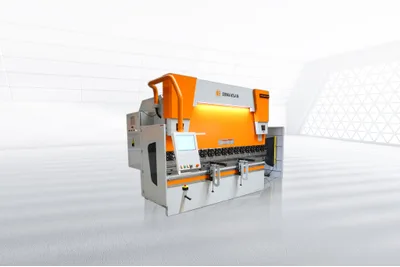
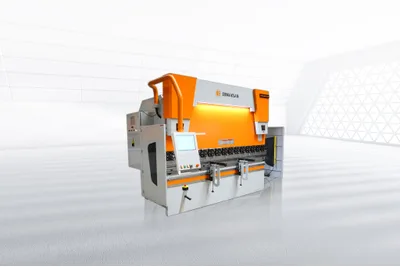
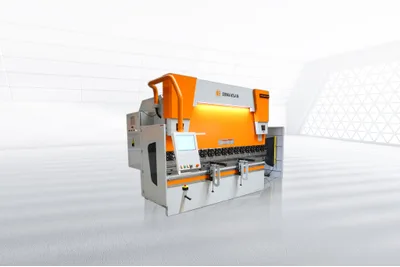
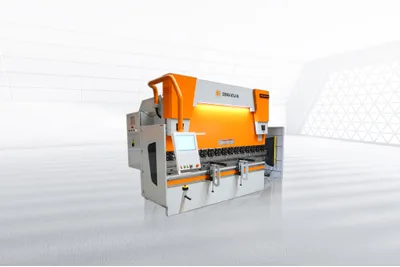
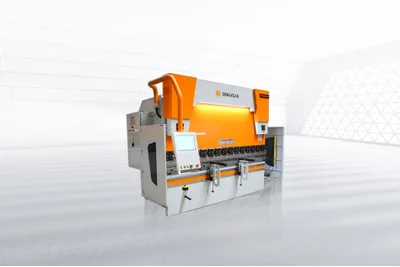
Ermak Speed-Bend 3100-110
This model was not found in Ermak's current lineup when we checked on 2026-10-03 . It may be a superseded or older model; the specifications below are as we last recorded them.
Key Specifications
pressing force
working length
distance between uprights
throat depth
open height
stroke
How much does the Ermak Speed-Bend 3100-110 cost?
Estimated price range
Our best estimate for a cnc press brake in this class — not a quote from Ermak. Configuration moves it a long way.
Overview
The Ermak Speed-Bend 3100-110 is a compact electric press brake: an AC servo and ball screw drive delivering 110 tonnes (1,100 kN) over a 3,100 mm working length. Ermak does not show this model name in its current lineup, so what follows rests on the listed figures alone.
Two things stand out in those figures. The first is the cycle. The ram approaches at 200 mm/s and returns at 180 mm/s, and bending speed is programmable over 1–10 mm/s. The second is the Y-axis positioning accuracy of ±0.005 mm, the figure that governs how closely the bend angle repeats from part to part. Together they describe a machine meant for runs of small and medium sheet-metal parts with many bends each.
The working envelope is on the small side. Stroke is 180 mm and open height 480 mm, so tall tooling and deep channels use up the opening quickly. The throat is 420 mm and there is 2,550 mm between the uprights. For the back gauge the only row is an X-axis travel of 700 mm. No R or Z axes are listed, which is the first thing to verify on an actual machine.
The control is a Delem DA-69T. Weight is approx. 8,800 kg.
Full Specifications
| Parameter | Value |
|---|---|
| Pressing Force | 110 tonnes (1,100 kN) |
| Working Length | 3,100 mm |
| Distance Between Uprights | 2,550 mm |
| Throat Depth | 420 mm |
| Open Height | 480 mm |
| Stroke | 180 mm |
| Approach Speed | 200 mm/s |
| Bending Speed | 1–10 mm/s (programmable) |
| Return Speed | 180 mm/s |
| Y Axis Positioning Accuracy | ±0.005 mm |
| Back Gauge X Axis Travel | 700 mm |
| Drive System | AC Servo + Ball Screw |
| CNC Control | Delem DA-69T |
| Machine Weight | Approx. 8,800 kg |
Specifications compiled from manufacturer literature and industry references. Not independently verified against a published spec sheet — confirm with the manufacturer or an authorised dealer before making a purchasing decision.
Strengths & Limitations
Strengths
- Approach speed of 200 mm/s and return speed of 180 mm/s for short cycles
- Y-axis positioning accuracy listed at ±0.005 mm
- AC Servo + Ball Screw drive, with no hydraulic ram circuit in the listed figures
- Delem DA-69T is the listed CNC control
- 2,550 mm between the uprights and a 420 mm throat on a 3,100 mm working length
Limitations
- Stroke of 180 mm and open height of 480 mm leave little room for tall tooling or deep channels
- 110 tonnes (1,100 kN) over 3,100 mm rules out thick plate on long bends
- Only the back gauge X-axis travel of 700 mm is listed; no R or Z axes appear
- No crowning or motor power is given in the listed figures
Best For
Frequently Asked Questions
01
The listed figures give an approach speed of 200 mm/s, a bending speed of 1–10 mm/s (programmable) and a return speed of 180 mm/s. With a stroke of 180 mm, the approach and return strokes take up very little of each cycle.
02
The drive system is listed as AC Servo + Ball Screw, an electric drive. Pressing force is 110 tonnes (1,100 kN). The listed figures give no motor power or supply voltage, so the electrical connection needs to be confirmed on the machine.
03
Open height is 480 mm and the stroke is 180 mm. Throat depth is 420 mm and the distance between the uprights is 2,550 mm. Check the combined height of punch, die and part against the 480 mm opening before planning box or channel work.
04
The listed figures give a back gauge X-axis travel of 700 mm and nothing more. No R, Z1 or Z2 axis is listed, and no back gauge speed or accuracy. Inspect the machine to see which axes are actually fitted.
Videos

Mac-Tech