Industrial CNC Machine Directory

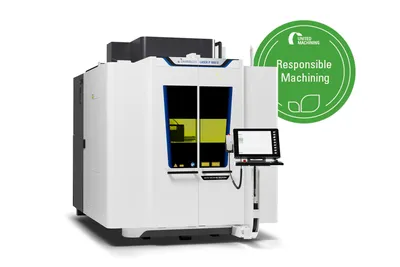
EMAG ELC 6

$400,000 - $650,000 Updated 2026-03-19
EMAG ELC 6 CNC Laser Cutting
01

Key Specifications

max external diameter

300 mm (12 in)

max workpiece height

300 mm (12 in)

axial welding diameter

mmin

radial welding diameter

mmin

initial tension

Up to 10 kN (30 kN optional)

system type

Rotary indexing with fixed lens / moving workpiece

02

Overview

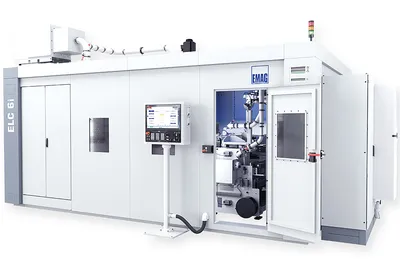
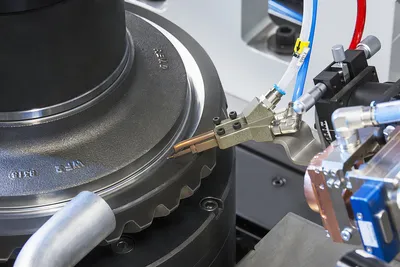
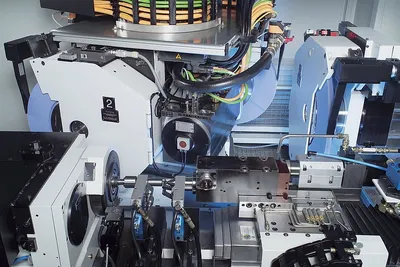
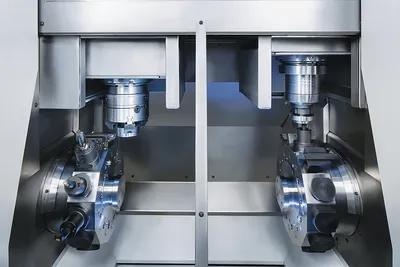
The EMAG ELC 6 is a production laser welding system designed for maximum output on classic powertrain components with round welds. Built around a rotary indexing system with dedicated machining and loading/unloading stations, the ELC 6 uses a fixed-lens/moving-workpiece principle that keeps the optical system stationary while the workpiece rotates and translates — a design that enhances safety, simplifies lens maintenance, and ensures consistent beam delivery to the weld joint.

The ELC 6 handles workpieces up to 300 mm in external diameter and 300 mm in height, with axial welding diameters from 75 to 200 mm and radial welding diameters from 75 to 250 mm. This work envelope covers the majority of automotive differential housings, torque converter assemblies, transmission components, and similar round-weld powertrain parts. The initial clamping tension capability of up to 10 kN (with a 30 kN option) ensures secure fixturing during the welding process, which is critical for maintaining joint integrity on press-fit assemblies.

The rotary indexing architecture separates the loading/unloading station from the machining station, enabling workpiece exchange during the welding cycle. This overlap of handling and process time maximizes laser utilization and throughput. The electric drive units — chosen over pneumatic and hydraulic systems — provide precise, repeatable clamping and motion control while reducing maintenance requirements and contamination risks in the laser welding environment.

The ELC 6 emphasizes compact design, excellent accessibility, and short retooling times, making it suitable for both dedicated high-volume production and moderate-volume applications with frequent changeover between part numbers. The minimization of equipment and change parts reduces changeover time and operator training requirements. For automotive powertrain plants producing differential assemblies, torque converter housings, and similar round-weld components, the ELC 6 delivers the combination of throughput, quality, and operational simplicity that production demands.

03

Full Specifications

Parameter Value
Max External Diameter 300 mm (12 in)
Max Workpiece Height 300 mm (12 in)
Axial Welding Diameter mmin
Radial Welding Diameter mmin
Initial Tension Up to 10 kN (30 kN optional)
System Type Rotary indexing with fixed lens / moving workpiece
Stations Machining station + loading/unloading station
Drive Type Electric (no pneumatic/hydraulic)
Design Principle Fixed lens, moving workpiece
CNC Control Siemens SINUMERIK 840D sl
External Diameter Max mmin
Workpiece Height Max mmin

Specifications sourced from emag.com — verified 2026-03-28

04

Strengths & Limitations

Strengths

  • Rotary indexing system enables workpiece loading during welding cycle, maximizing laser utilization and throughput
  • Fixed-lens/moving-workpiece design enhances safety and simplifies optical maintenance compared to moving-lens systems
  • 300 mm diameter and height capacity covers the majority of automotive powertrain round-weld components
  • Electric drive units provide precise clamping and motion control without hydraulic contamination risks
  • Compact design with excellent accessibility and short retooling times supports both high-volume and mixed production
  • 30 kN optional clamping force secures heavy press-fit assemblies during the welding process

Limitations

  • Optimized for round welds — complex non-circular weld paths may require a different EMAG laser platform
  • 300 mm maximum diameter excludes larger powertrain components like truck differential housings
  • Fixed-lens design limits flexibility for weld geometries that benefit from lens repositioning during the cycle
  • Application-specific fixturing adds engineering cost and lead time for each new part introduction
05

Best For

Automotive powertrain manufacturers welding differential housings, torque converter assemblies, and transmission drums at production rates Drivetrain component suppliers producing round-weld assemblies for passenger car and light truck applications Press-fit-and-weld applications where components are joined by interference fit and then laser welded for permanent assembly Production environments requiring electric-drive precision without hydraulic system maintenance and contamination concerns Plants needing a compact, accessible laser welding cell with quick changeover between different round-weld part numbers
06

Frequently Asked Questions

01 What is the fixed-lens/moving-workpiece principle?

In the ELC 6, the laser lens remains stationary while the workpiece rotates and translates to create the weld path. This approach keeps the optical system in a fixed, protected position, simplifies lens maintenance, and provides consistent beam delivery. The workpiece motion is controlled by CNC axes for precise, repeatable weld paths.

02 What types of welds can the ELC 6 produce?

The ELC 6 is optimized for round welds on cylindrical and disc-shaped components, including circumferential seam welds (axial 75-200 mm) and radial face welds (75-250 mm). These cover the majority of automotive powertrain welding applications on differential housings, torque converters, and transmission drums.

03 How does the rotary indexing system improve throughput?

The rotary indexing system has separate machining and loading/unloading stations. While one part is being welded at the machining station, the operator or automation system loads the next raw part and unloads the previous finished part at the load station. This overlapping of handling and process time maximizes laser utilization.

04 Why does the ELC 6 use electric drives instead of hydraulics?

Electric drives provide precise, repeatable clamping and motion control without the contamination risk, maintenance burden, and environmental concerns of hydraulic systems. In a laser welding environment, eliminating hydraulic oil also reduces fire risk and simplifies cleanroom compatibility for sensitive applications.

07

Videos

Machine in Focus: ELC 6 Laser Welding System - Innovation in Production

Machine in Focus: ELC 6 Laser Welding System - Innovation in Production

EMAGLLC

EMAG Laser welding systems ELC 160 - EMAG Videos

EMAG Laser welding systems ELC 160 - EMAG Videos

EMAG

VL 6 – Vertical Lathe Turning Machine for Heavy Workpieces –  EMAG

VL 6 – Vertical Lathe Turning Machine for Heavy Workpieces – EMAG

EMAGLLC

ELC 6 - Neue Produktions-Laserschweißanlage für höchste Ausbringung

ELC 6 - Neue Produktions-Laserschweißanlage für höchste Ausbringung

EMAG

ELC 6 Laserschweißanlage - Innovation in der Fertigung

ELC 6 Laserschweißanlage - Innovation in der Fertigung

EMAG

08

Related Machines