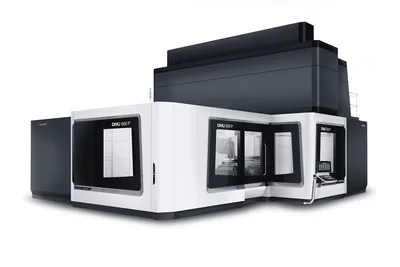
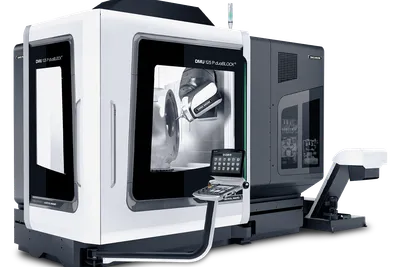
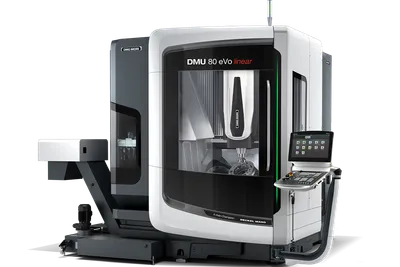
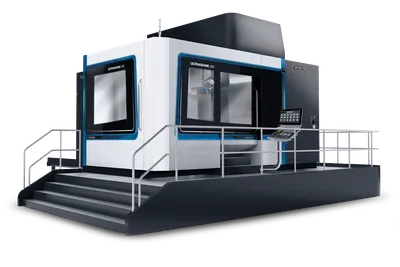
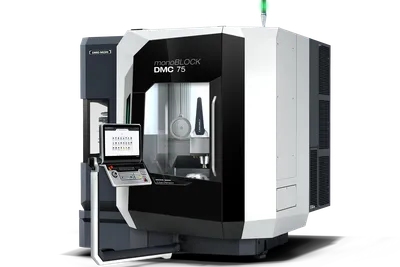
DMG Mori ULTRASONIC 20 linear
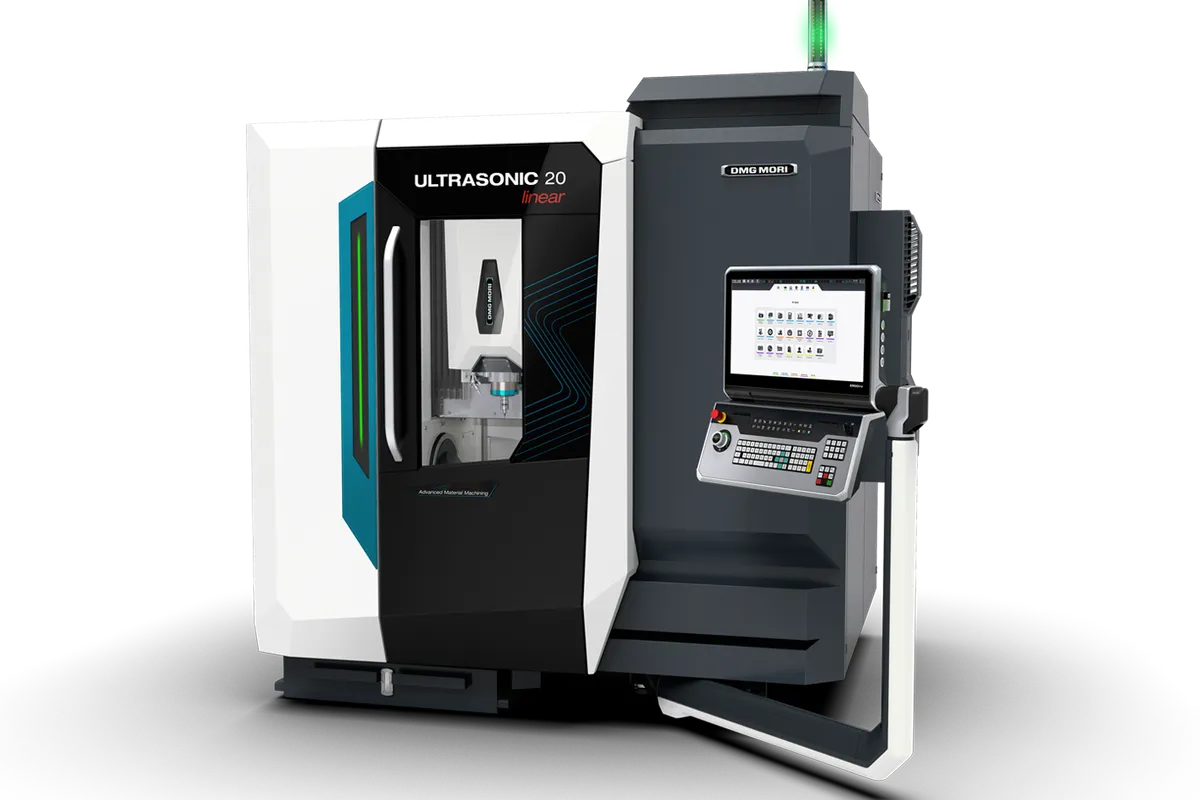
Image: dmgmori.com, DMG Mori
Key Specifications
X Travel
Y Travel
Z Travel
Max Spindle
Spindle Taper
Max Workpiece ⌀
How much does the DMG Mori ULTRASONIC 20 linear cost?
Estimated price range
Our best estimate for a 5-axis machining center in this class — not a quote from DMG Mori. Configuration moves it a long way.
Overview
On the DMG MORI ULTRASONIC 20 linear 3rd Generation the tool does two things at once: it rotates in a high-frequency spindle, and it carries an ultrasonic oscillation of up to 15 µm in amplitude on top of that rotation. The machine around this process is small, with travels of 220 mm (8.7 in) in X, 370 mm (14.6 in) in Y and 290 mm (11.4 in) in Z.
DMG MORI integrates the ultrasonic function through the HSK-E32 interface and puts a number on its effect: process forces reduced by up to 50%. Lower force is the purpose of the whole design. With less load on each cutting edge or abrasive grain, a small tool can be fed harder before it deflects or breaks, and a fragile feature is less likely to chip. The manufacturer names three outcomes, each qualified as depending on requirements: higher feed rates, improved surface finishes down to Ra < 0.1 µm, and longer tool service life. It also states that the advantages are kept even with non-optimal tools and that a stable process window gives reproducible, consistent results.
Spindle speed is the other half. The spindles are high-frequency units on the HSK-32 interface: 42,000 rpm, with max. 60,000 rpm reached by an optional spindle. Small tools need that kind of speed to arrive at a workable surface speed, so decide early whether the optional spindle belongs in the quotation.
The structure is built to hold position over long cycles: a FEM-optimized cast bed, temperature management that DMG MORI calls finely tuned and highly sensitive, and linear drives with acceleration of up to 1.2 g. The workpiece limit is Ø 220 x 283 mm at 15 kg (33.1 lb). For bigger parts the ULTRASONIC 60 eVo linear offers 750 mm (29.5 in) of X and 550 mm (21.7 in) in both Y and Z.
Full Specifications
| Parameter | Value |
|---|---|
| Max Workpiece Diameter | 220 mm (8.7 in) |
| Max Workpiece Height | 283 mm (11.1 in) |
| Max Workpiece Weight | 15 kg (33.1 lb) |
| X-Axis Travel | 220 mm (8.7 in) |
| Y-Axis Travel | 370 mm (14.6 in) |
| Z-Axis Travel | 290 mm (11.4 in) |
| Max Spindle Speed | 42,000 rpm (HSK-32 high frequency spindle); max. 60,000 rpm optional |
| Ultrasonic Amplitude | Up to 15 µm |
| A Axis Swivel | +130° to -93° |
| Spindle Taper | HSK-E32 |
| Table Speed | 150 rpm standard; 1,500 rpm optional (C-axis) |
Specifications sourced from dmgmori.com — verified 2026-10-02
Strengths & Limitations
Strengths
- Process forces reduced by up to 50% by the ultrasonic function, according to DMG MORI
- Surface finishes down to Ra < 0.1 µm are stated as achievable, depending on requirements
- HSK-32 high-frequency spindle with 42,000 rpm; max. 60,000 rpm with the optional spindle
- FEM-optimized cast bed and temperature management aimed at long-term stability
- DMG MORI states that the ultrasonic advantages are kept even with non-optimal tools
Limitations
- The top spindle speed of max. 60,000 rpm belongs to an optional spindle; the HSK-32 spindle is otherwise listed at 42,000 rpm
- Workpieces are limited to Ø 220 x 283 mm and 15 kg (33.1 lb)
- Force reduction, finish and tool life are stated as upper bounds that depend on requirements, so they need proving on your own part
- Ultrasonic integration is listed for the HSK-E32 interface only, which confines the process to small tools
Best For
Frequently Asked Questions
01
DMG MORI states a reduction of up to 50%. It links that to higher feed rates, improved surface finishes down to Ra < 0.1 µm and longer tool service life, all depending on requirements. Treat the figure as the best case and ask for a test cut in your material if the business case rests on it.
02
The ultrasonic function is integrated through the HSK-E32 interface, and the oscillation superimposed on tool rotation has amplitudes of up to 15 µm. The spindles are listed as high-frequency HSK-32 units. An interface of this size is meant for small tools, which fits the 15 kg (33.1 lb) workpiece limit.
03
DMG MORI gives max. 60,000 rpm for the spindle range. The HSK-32 high-frequency spindle is listed at 42,000 rpm, and the higher figure belongs to an HSK-32 spindle listed as optional. Confirm on the quotation which spindle is included.
04
Three things are listed. The cast bed is FEM-optimized for long-term stability, the temperature management is described as finely tuned and highly sensitive, and the linear drives are described as wear-free. The drives are also rated at acceleration of up to 1.2 g.
05
Travels are 220 mm (8.7 in) in X, 370 mm (14.6 in) in Y and 290 mm (11.4 in) in Z. The workpiece can be up to Ø 220 x 283 mm and 15 kg (33.1 lb), on a table whose A-axis swivels from +130° to -93°. The C-axis runs at 150 rpm as standard and 1,500 rpm as an option.
Videos

DMG MORI

DMG MORI

G+S Werkzeugmaschinen

ATMH- Werkzeugmaschinen-Handel GmbH ®