DMG Mori LASERTEC 50 Shape Femto
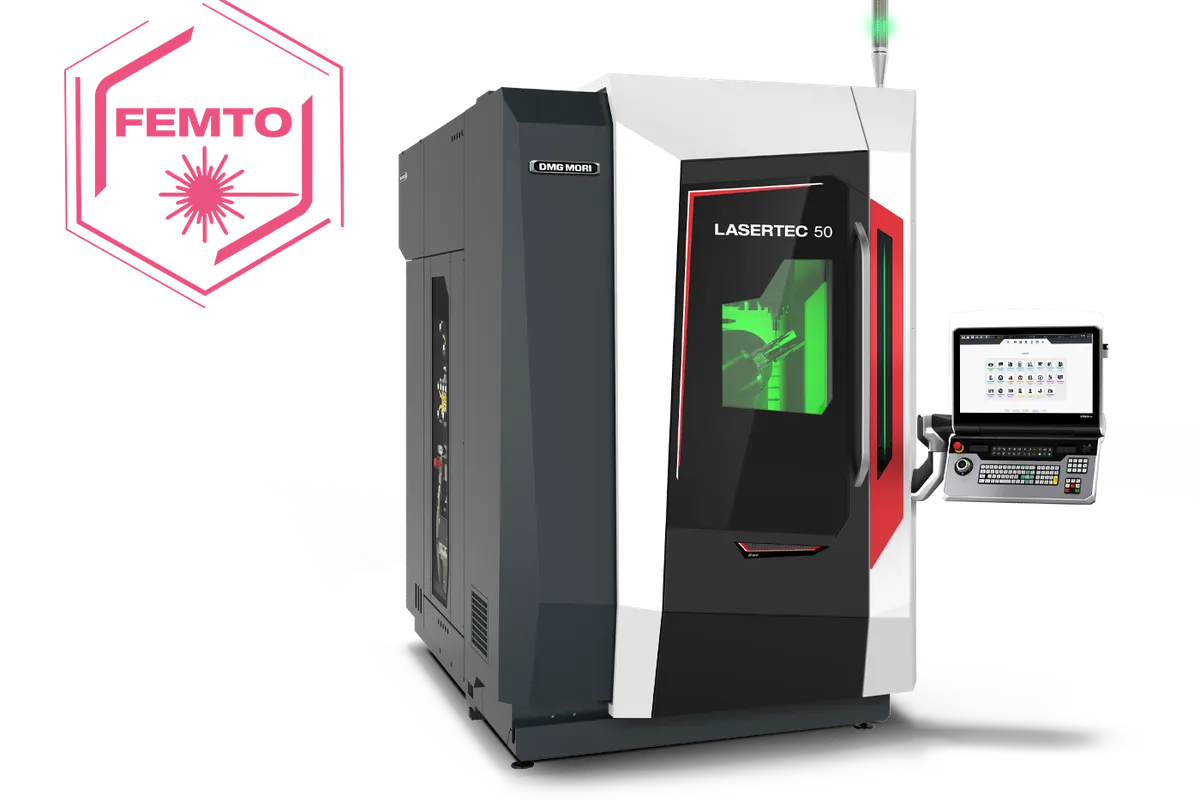
Image: dmgmori.com, DMG Mori
Key Specifications
X Travel
Y Travel
Z Travel
Accuracy
laser source
surface quality
How much does the DMG Mori LASERTEC 50 Shape Femto cost?
Price estimate
We do not have a price for the DMG Mori LASERTEC 50 Shape Femto that we can stand behind, so we show no number. Configuration, options and installation move the final price a long way: a quote is the reliable figure.
Overview
The DMG MORI LASERTEC 50 Shape Femto is a 5-axis machine for 3D laser ablation. DMG MORI lists it for miniature molds, extrusion dies, inscriptions and engravings, and for complex prototypes and special processing in carbide, powder-metal steels, ceramics and other advanced materials. Travels are 540 mm (21.3 in) in X, 500 mm (19.7 in) in Y and 700 mm (27.6 in) in Z.
What defines this variant is the laser. The source is tunable, with variable pulse length and burst modes. Pulse length and burst settings decide how much material each pulse removes and how much heat is left in the part, so being able to change them per job is what allows one machine to work carbide, ceramics and glass. DMG MORI's Highlights give no power or pulse-duration figure, and those are the first numbers to ask for.
The quoted results are a positioning accuracy of ≤ 8 μm and surface qualities up to Ra < 0.1 µm in carbide tools. Because the process is contact-free, fine detail in a hard material does not depend on an electrode being made or on a small cutter surviving the cut. There are no electrodes and there is no tool wear.
Mechanically the machine uses linear drives with more than 1 g of acceleration and torque motors in both rotary axes, B and C. A CCD camera and a 3D measuring probe are there for setup, which shortens the job of locating a small cavity or an engraving on a part that is already finished elsewhere. The footprint is 4 m².
Full Specifications
| Parameter | Value |
|---|---|
| X-Axis Travel | 540 mm (21.3 in) |
| Y-Axis Travel | 500 mm (19.7 in) |
| Z-Axis Travel | 700 mm (27.6 in) |
| Positioning Accuracy | ≤ 8 μm |
| Laser Source | Tunable laser source with variable pulse length and burst modes |
| Surface Quality | up to Ra < 0.1 µm in carbide tools |
| Axis Acceleration | > 1 g (linear drives) |
| Rotary Axes | B- and C-axis, torque motors |
| Floor Space Required | 4 m² |
Specifications sourced from dmgmori.com — verified 2026-10-02
Strengths & Limitations
Strengths
- Tunable laser source with variable pulse length and burst modes
- Positioning accuracy of ≤ 8 μm
- Surface qualities up to Ra < 0.1 µm in carbide tools, by DMG MORI's figure
- Works carbide, powder-metal steels, ceramics, glass and tungsten carbide with no electrodes and no tool wear
- CCD camera and 3D measuring probe for setup
- Footprint of 4 m² with 540 × 500 × 700 mm of travel
Limitations
- DMG MORI's Highlights for this model state no laser power or pulse duration
- The data gives travels but no maximum workpiece size or weight, so fixture and part mass have to be cleared with DMG MORI
- It is presented for miniature molds, dies, inscriptions and engravings, not as a machine for removing large volumes of material
- No pallet or tool automation appears in the Highlights for this model
Best For
Frequently Asked Questions
01
3D laser ablation. DMG MORI names miniature molds, extrusion dies, inscriptions and engravings, plus complex prototypes and special processing. The machine has five axes, with B and C as the rotary axes, so the laser can be brought square to features on curved or inclined surfaces.
02
DMG MORI lists carbide, powder-metal steels, ceramics and other advanced materials, and describes the range as running from standard materials up to glass, ceramics and tungsten carbide. The process is contact-free, without electrodes and without tool wear.
03
DMG MORI states a positioning accuracy of ≤ 8 μm and surface qualities up to Ra < 0.1 µm in carbide tools. The surface figure is an upper result for one material, so ask for a sample in the material and geometry you intend to run.
04
The source has variable pulse length and burst modes. Those settings govern how much material each pulse removes and how much heat reaches the part, so they can be matched to the material and to whether the pass is for removal or for finish. DMG MORI's Highlights do not state the laser power, so ask for it.
05
The travels are 540 mm (21.3 in) in X, 500 mm (19.7 in) in Y and 700 mm (27.6 in) in Z, and DMG MORI gives the footprint as 4 m². The linear drives are rated at more than 1 g of acceleration. Setup is done with a CCD camera and a 3D measuring probe.
Videos

DMG MORI

DMG MORI

DMG MORI

DMG MORI
More from DMG Mori
Other CNC Laser Cutting Machines
Yawei HLE-32130
Trumpf TruLaser 3000 Bevel Cut Edition
Trumpf TruLaser 3040
HSG Cell 3015G
LVD Puma 4020