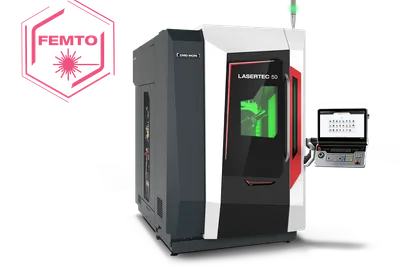
DMG Mori LASERTEC 50 PrecisionTool
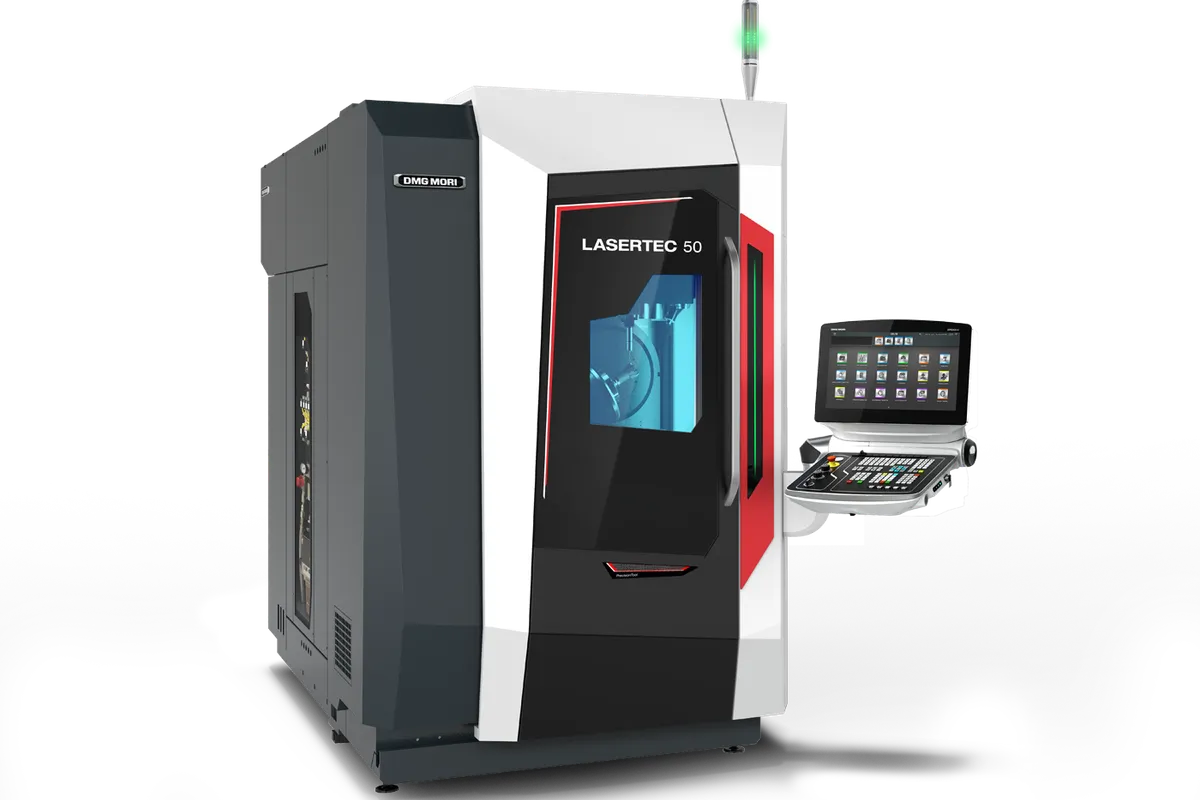
Image: dmgmori.com, DMG Mori
Key Specifications
X Travel
Y Travel
Z Travel
rotary axes
max tool diameter
max tool length
How much does the DMG Mori LASERTEC 50 PrecisionTool cost?
Estimated price range
Our best estimate for a cnc laser cutting machine in this class — not a quote from DMG Mori. Configuration moves it a long way.
Overview
The DMG MORI LASERTEC 50 PrecisionTool is a 5-axis laser machine for diamond tools up to Ø 355 mm and 420 mm in length. Its travels are 540 mm (21.3 in) in X, 500 mm (19.7 in) in Y and 700 mm (27.6 in) in Z, on a footprint that DMG MORI gives as 4 m². The tool diameter is what sets it apart: large cutter bodies and disc-type tools fit, not just shank tools and inserts.
Motion comes from linear drives with more than 1 g of acceleration and from torque motors in both rotary axes, B and C. The laser works without contact, so no electrodes are needed and nothing wears on the machine side. That counts on a large tool with many cutting edges, where every edge has to be machined the same way from the first to the last.
Automation is the PH50 pallet handling unit, which has a footprint of 2.7 m² (1.6 × 1.7 m) and is operated directly on the machine control. Its capacity depends on tool size. It holds up to 6 HSK-63 tools of ø 355 mm and 370 mm length, 11 tools of ø 200 mm and 440 mm length, or up to 21 tools of ø 90 mm and 440 mm length. Schunk and Erowa pallets are possible too. A run of full-diameter tools is therefore six pieces between loads, while small tools give a much longer unattended stretch.
DMG MORI also lists 3D laser ablation among the machine's uses: miniature molds, extrusion dies, inscriptions and engravings, in materials from standard grades up to glass, ceramics and tungsten carbide. A shop that buys it for tools can put the same axes and source to work on small die and engraving jobs.
Full Specifications
| Parameter | Value |
|---|---|
| X-Axis Travel | 540 mm (21.3 in) |
| Y-Axis Travel | 500 mm (19.7 in) |
| Z-Axis Travel | 700 mm (27.6 in) |
| Rotary Axes | B- and C-axis, torque motors |
| Max Tool Diameter (full magazine) | Ø 355 mm (diamond tools) |
| Max Tool Length | 420 mm (diamond tools) |
| Floor Space Required | 4 m² |
| Axis Acceleration | > 1 g (linear drives) |
| Pallet Automation | PH50: up to 6 HSK-63 tools ø 355 mm, 11 tools ø 200 mm or up to 21 tools ø 90 mm |
Specifications sourced from dmgmori.com — verified 2026-10-02
Strengths & Limitations
Strengths
- Takes diamond tools up to Ø 355 mm and 420 mm in length
- Linear drives with more than 1 g of acceleration and torque motors in the B- and C-axis
- The PH50 pallet automation has a footprint of 2.7 m² (1.6 × 1.7 m) and is operated directly on the machine control
- PH50 holds up to 21 tools of ø 90 mm, 11 tools of ø 200 mm or up to 6 HSK-63 tools of ø 355 mm
- Also listed for 3D laser ablation in glass, ceramics and tungsten carbide
- Contact-free process with no electrodes and no tool wear
Limitations
- PH50 capacity falls to 6 tools at ø 355 mm, so unattended runs of large tools are short
- DMG MORI's data for this model states no laser type or laser power; confirm the source in the quotation
- The PH50 list gives 440 mm as the length of the smaller tools while the machine is described for tools 420 mm in length, so the usable tool length needs confirming
- With the PH50, the 2.7 m² of the automation comes on top of the 4 m² machine footprint
Best For
Frequently Asked Questions
01
DMG MORI describes it as a 5-axis laser precision machine for diamond tools up to Ø 355 mm and 420 mm in length. The travels behind that are 540 mm (21.3 in) in X, 500 mm (19.7 in) in Y and 700 mm (27.6 in) in Z.
02
It depends on the tool. DMG MORI lists up to 6 HSK-63 tools of ø 355 mm and 370 mm length, 11 tools of ø 200 mm and 440 mm length, or up to 21 tools of ø 90 mm and 440 mm length. Schunk and Erowa pallets are also possible. The PH50 is operated directly on the machine control.
03
DMG MORI gives the machine footprint as 4 m². The PH50 pallet automation has its own footprint of 2.7 m² (1.6 × 1.7 m). Service and loading clearances are not stated in DMG MORI's data for this model and have to come from the installation drawing.
04
Yes. DMG MORI lists 3D laser ablation for miniature molds, extrusion dies, inscriptions and engravings. The materials named run from standard materials up to advanced ones such as glass, ceramics and tungsten carbide, all machined without contact and without electrodes.
05
Linear drives with an acceleration of more than 1 g, and torque motors in both rotary axes, the B- and C-axis. Together with the three linear travels that makes five axes, which is what lets the laser follow the edges of a round tool.
Videos

DMG MORI

DMG MORI

Saber Diamond Tools

DMG MORI Japan
More from DMG Mori
Other CNC Laser Cutting Machines
Baykal BLT 8220
Machitech Fiber Prime XL 10x60
Ermak Fibermak Momentum Gen-5 SM 8x2
Yawei HLX-2560
Trumpf TruLaser Cell 8030