DMG Mori LASERTEC 20 PrecisionTool
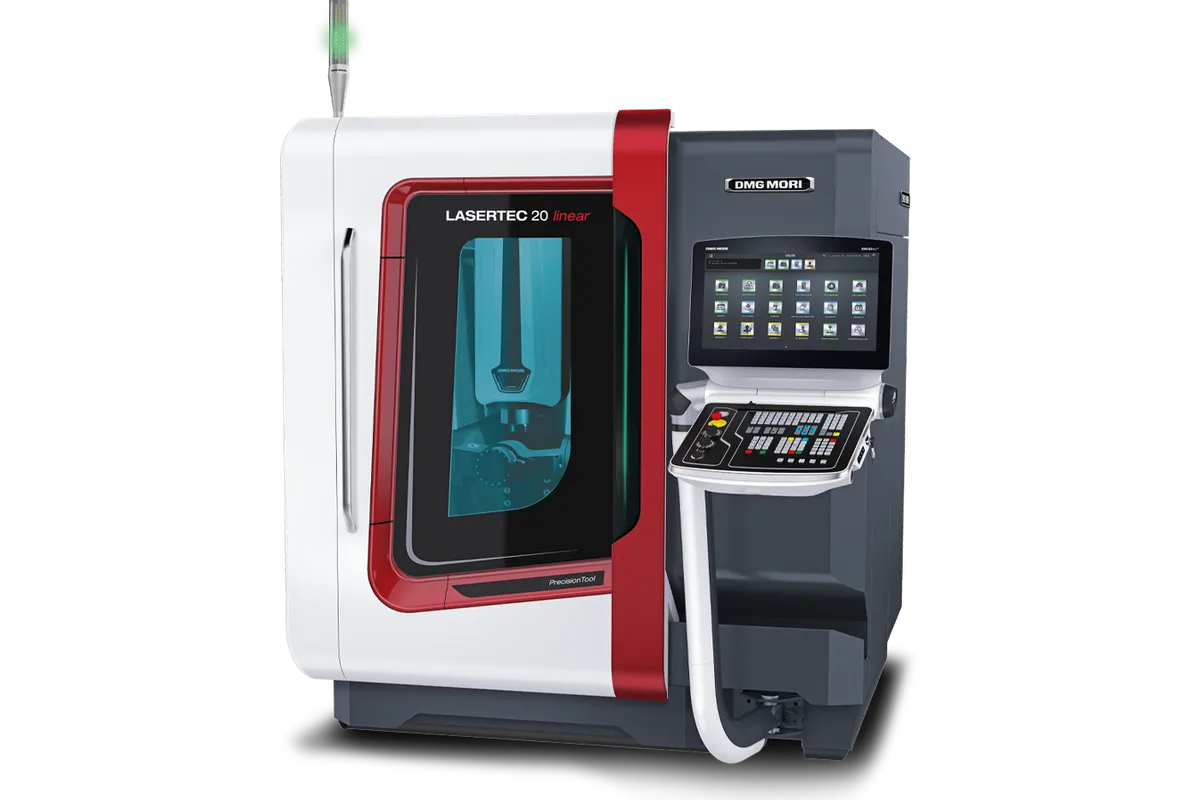
Image: dmgmori.com, DMG Mori
Key Specifications
X Travel
Y Travel
Z Travel
control
axis acceleration
swivel range
How much does the DMG Mori LASERTEC 20 PrecisionTool cost?
Price estimate
We do not have a price for the DMG Mori LASERTEC 20 PrecisionTool that we can stand behind, so we show no number. Configuration, options and installation move the final price a long way: a quote is the reliable figure.
Overview
The DMG MORI LASERTEC 20 PrecisionTool is a 5-axis laser machine for finishing cutting tools in PCD, CVD-D and CBN. It works in a small envelope, 200 mm (7.9 in) in X, 400 mm (15.7 in) in Y and 280 mm (11 in) in Z, and DMG MORI gives the footprint as 37.7 ft². The laser cuts the edges, relief angles and chip breakers without touching the tool, so there are no electrodes to make and no tool wear to compensate.
The machine is a portal design with linear drives in X, Y and Z, which DMG MORI rates at more than 2 g. The 4th and 5th axes are a swivel rotary table with torque drives, included as standard, with a swivel range of –10° / +130°. All axes are cooled. For tool work this is the figure that counts: an edge is a short path with many reversals, so acceleration sets how quickly a relief or a chip breaker gets traced, and top speed hardly matters.
A version called PreCut separates cutting inserts out of blanks in 5 axes. DMG MORI states that this separation is up to ten times faster than conventional wire EDM, and that laser machining extends tool life by up to a factor of 2.5. Both are upper figures from the manufacturer, so ask for results on your own insert grades and geometries.
The control is a Siemens 840D solutionline with Operate 4.7 on CELOS, with LASERSOFT software packages for shank and HSK tools, ISO and special cutting inserts and chip breakers. For unattended running there is the integrated linear magazine PH 10 | 100, which handles cutting discs, shaft tools and tools in HSK holders, mixed if needed. DMG MORI lists a 64.6 ft² footprint for that automation solution. Expanding it, or linking several LASERTEC 20 machines, is possible on request.
Full Specifications
| Parameter | Value |
|---|---|
| X-Axis Travel | 200 mm (7.9 in) |
| Y-Axis Travel | 400 mm (15.7 in) |
| Z-Axis Travel | 280 mm (11 in) |
| CNC Control | Siemens 840D solutionline with Operate 4.7 on CELOS |
| Axis Acceleration | > 2 g (linear drives in the X-, Y-, Z-axis) |
| Swivel Range | –10° / +130° (integrated swivel rotary table, 4th / 5th axis as standard) |
| Floor Space Required | 37.7 ft² |
| Automation | Integrated linear magazine PH 10 | 100 |
Specifications sourced from dmgmori.com — verified 2026-10-02
Strengths & Limitations
Strengths
- Contact-free laser machining of PCD, CVD-D and CBN, with no electrodes and no tool wear
- Linear drives in X, Y and Z rated at more than 2 g
- Swivel rotary table as standard 4th and 5th axis, with a swivel range of –10° / +130°
- The PreCut version separates inserts from blanks in 5 axes, up to ten times faster than wire EDM by DMG MORI's figure
- LASERSOFT packages cover shank and HSK tools, ISO and special cutting inserts and chip breakers
- Integrated linear magazine PH 10 | 100 handles cutting discs, shaft tools and HSK tools in combination
Limitations
- The envelope is small: 200 mm (7.9 in) of X and 280 mm (11 in) of Z limit the size of tool that fits
- DMG MORI's data for this model states no laser type or laser power, so the source has to be confirmed in the quotation
- Separating inserts from blanks belongs to the PreCut version, not to every LASERTEC 20 PrecisionTool
- The automation solution with the PH 10 | 100 is listed with a 64.6 ft² footprint, against 37.7 ft² for the machine
Best For
Frequently Asked Questions
01
PCD, CVD-D and CBN. DMG MORI lists chip-free cutting edges, relief angles and chip breakers in those three materials. The process is contact-free, so it needs no electrodes and there is no tool wear on the machine side.
02
200 mm (7.9 in) in X, 400 mm (15.7 in) in Y and 280 mm (11 in) in Z. The three linear axes have linear drives rated at more than 2 g. The 4th and 5th axes are an integrated swivel rotary table, standard on the machine, with a swivel range of –10° / +130°.
03
PreCut is the version that separates cutting inserts out of blanks in 5 axes. DMG MORI states the separation is up to ten times faster than conventional wire EDM. That is a maximum figure, so the gain on a particular insert shape and blank thickness should be confirmed with a test cut.
04
An integrated linear magazine, the PH 10 | 100. It handles cutting discs, shaft tools and tools with HSK holders, and different tool types can be combined in one load. DMG MORI lists a 64.6 ft² footprint for the automation solution and offers customized expansion or a combination with additional LASERTEC 20 machines on request.
05
A Siemens 840D solutionline with Operate 4.7 on CELOS. The tool-specific programming is done in LASERSOFT software packages, which DMG MORI lists for shank and HSK tools, ISO and special cutting inserts and chip breakers.
Videos

LaserKim

Surplex

DMG MORI Japan
Comparisons
More from DMG Mori
Other CNC Laser Cutting Machines
Yawei HLE-2040
Accurl SmartLINE X 3001.15
Prima Power LASERDYNE 811
Mitsubishi Electric GX-F Advanced II