DMG Mori DMU 60 FD eVo 2nd Generation
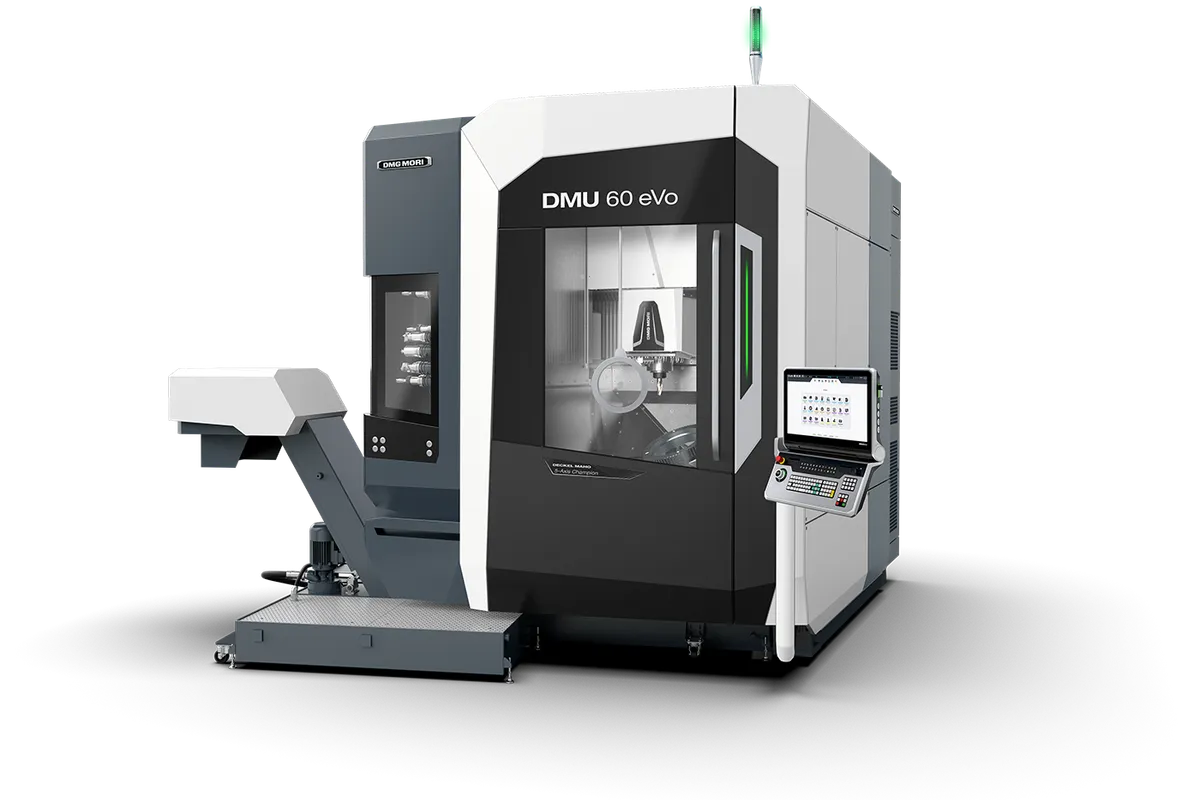
Image: dmgmori.com, DMG Mori
Key Specifications
X Travel
Y Travel
Z Travel
Max Spindle
Tool Capacity
Max Workpiece ⌀
How much does the DMG Mori DMU 60 FD eVo 2nd Generation cost?
Estimated price range
Our best estimate for a 5-axis machining center in this class — not a quote from DMG Mori. Configuration moves it a long way.
Overview
DMG MORI presents the DMU 60 FD eVo 2nd Generation as a further development of the eVo concept and puts numbers on the change: 28% higher rigidity and accuracy, 40% more working area space than the previous machine, and 80% higher rigidity of the Z-axis. The machine is a 5-axis machining center with 750 × 550 × 550 mm (29.5 × 21.7 × 21.7 in) of travel on a footprint of 9 m².
Those percentages are the manufacturer's comparison with its own earlier model, so read them as the direction of the redesign and not as a specification. What stands behind them is concrete enough. The bed is a single piece of hybrid mineral casting. The Y-axis runs on three guideways, the Z-axis on 45 mm linear guides, and the frame is decoupled and fully temperature-controlled. The stated accuracy result is 4 µm in the double ballbar test.
The spindle line starts at 20,000 RPM with 130 Nm as standard. From there the speedMASTER options go in two directions, up to 30,000 RPM for small tools or up to 200 Nm for heavier cutting. They are alternatives, so the choice has to follow the material mix of the shop.
Inside, the machine takes a part up to 700 mm (27.6 in) in diameter and 550 mm (21.7 in) tall, weighing up to 500 kg (1,102.3 lb). DMG MORI says the installation area stays at 9 m² whether the magazine holds 30, 60 or 120 tools, and lists up to 300 tools with set-up parallel to machining time. The covers are stainless steel throughout and the chip conveyor opening is 60% larger, both of which help when high-volume roughing fills the work area with chips.
Full Specifications
| Parameter | Value |
|---|---|
| Max Workpiece Diameter | 700 mm (27.6 in) |
| Max Workpiece Height | 550 mm (21.7 in) |
| Max Workpiece Weight | 500 kg (1,102.3 lb) |
| X-Axis Travel | 750 mm (29.5 in) |
| Y-Axis Travel | 550 mm (21.7 in) |
| Z-Axis Travel | 550 mm (21.7 in) |
| Tool Capacity | 30, 60 or 120 tools; up to 300 tools |
| Max Spindle Speed | 20,000 rpm as standard; speedMASTER spindles up to 30,000 rpm |
| Spindle Torque | 130 Nm as standard (20,000 rpm spindle); speedMASTER spindles up to 200 Nm |
| Axis Speed Max | 50 m/min (basic version); up to 80 m/min (linear version) |
| Chip to Chip Time | 4.5 seconds |
| Installation Area | 9 m² (with 30, 60 or 120 tools) |
| Double Ballbar Test | 4 µm |
| Guideways | 45 mm linear guides (Z-axis); 3 guideways in Y-axis |
Specifications sourced from dmgmori.com — verified 2026-10-02
Strengths & Limitations
Strengths
- DMG MORI states 28% higher rigidity and accuracy and 40% more working area space compared to the previous machine
- Spindle options up to 30,000 RPM or up to 200 Nm, above a 20,000 RPM, 130 Nm standard spindle
- Footprint of 9 m² that does not grow with a 30-, 60- or 120-tool magazine
- 80% higher rigidity of the Z-axis with 45 mm linear guides and a reworked casting design
- Complete stainless steel covers and a 60% larger chip conveyor opening for chip flow
- Up to 300 tools, set up in parallel to machining time
Limitations
- The rigidity, accuracy and working-area gains are percentages against the previous machine, with no absolute stiffness figures to check them by
- The 30,000 RPM and 200 Nm spindles are options and exclude each other; the standard spindle is 20,000 RPM with 130 Nm
- Parts are limited to 500 kg (1,102.3 lb) and 550 mm (21.7 in) in height
- Although this is an FD model, the listed data states no table speed for turning
Best For
Frequently Asked Questions
01
According to DMG MORI: 28% higher rigidity and accuracy, 40% more working area space compared to the previous machine, 80% higher rigidity of the Z-axis with 45 mm linear guides, and a 60% larger opening of the chip conveyor. The bed is a single piece hybrid design made of mineral casting with three guideways in the Y-axis. These are comparisons with the earlier model made by the manufacturer.
02
The footprint is 9 m². DMG MORI states that the installation area is the same whether the machine has 30, 60 or 120 tools, so choosing a larger magazine within that range does not change the layout.
03
The standard spindle runs at 20,000 RPM with 130 Nm. Optional speedMASTER spindles reach up to 30,000 RPM or up to 200 Nm. A high-speed spindle and a high-torque spindle are different units, so decide between them by whether the shop mainly finishes with small tools or roughs tough materials.
04
Travels are 750 mm (29.5 in) in X, 550 mm (21.7 in) in Y and 550 mm (21.7 in) in Z. The largest workpiece is 700 mm (27.6 in) in diameter and 550 mm (21.7 in) in height, at up to 500 kg (1,102.3 lb).
05
The DMU 75 monoBLOCK 2nd Generation has the same 750 mm (29.5 in) of X travel, with 650 mm (25.6 in) of Y and 560 mm (22 in) of Z. The DMU 60 FD eVo 2nd Generation has 550 mm (21.7 in) in both Y and Z, and its listed data states a 20,000 RPM, 130 Nm standard spindle.
Videos

DMG MORI

DMG MORI

MTDCNC
Community Discussions
Troubleshooting and problem-solving
Links to community discussions. Summaries are editorial — visit the original thread for full context.
More from DMG Mori
Other 5-Axis Machining Centers
Huron MX 16 MT
AWEA MEGA5 G6037
Zimmermann FZU22
Johnford SDMC-11000x3200x1066-2H-5F