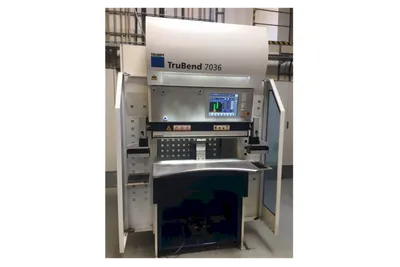
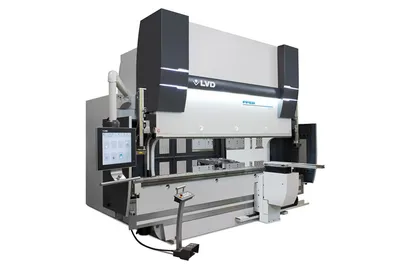
Boschert CB 125 CNC Press Brake
Key Specifications
bending force
working length
throat depth
stroke
open height
back gauge axes
Overview
The Boschert CB 125 is a CNC mechanical eccentric press brake from Boschert GmbH, a German manufacturer specializing in eccentric presses, punching machines, and sheet metal fabrication equipment. Unlike hydraulic or servo-electric press brakes, the CB 125 uses a mechanical eccentric drive — a crankshaft-driven ram system — delivering 125 tonnes of bending force with a fixed stroke determined by the eccentric geometry. Mechanical press brakes offer high ram speed, consistent force delivery, and a very long service life with low maintenance requirements compared to hydraulic systems.
The CB 125 is configured for CNC operation with a programmable back gauge system and depth stop control that regulates bend angle by adjusting the bottom dead center position of the ram. The eccentric mechanism provides a consistent, repeatable stroke that is well-suited to high-volume production of standardized parts where the fixed stroke cycle time advantage over hydraulic machines translates to meaningful throughput gains. The machine's straightforward mechanical design — fewer hydraulic components, no oil system to maintain — results in lower long-term maintenance costs and simpler troubleshooting.
Boschert manufactures its machines in Germany to high engineering standards, and the CB 125 features a robust cast-iron frame designed for decades of hard production use. The CNC control interfaces with the back gauge and ram depth stop to enable programmable bend sequences. Tooling follows European standards, compatible with Wila and Wilson Tool segmented tooling systems. The machine is particularly popular in German and Central European fabrication shops where high-volume, high-speed bending of standardized profiles and brackets is the primary application.
The CB 125 occupies a niche in the press brake market that few manufacturers address — industrial-grade mechanical eccentric bending with CNC control. It competes indirectly with hydraulic press brakes from Ermak, Haco, and Durma at similar tonnage ratings, but offers a fundamentally different drive system. Pricing for the Boschert CB 125 typically ranges from $85,000 to $125,000 depending on back gauge specification and CNC control options.
Full Specifications
| Parameter | Value |
|---|---|
| Bending Force | 125 tonnes (1,226 kN) |
| Working Length | 2,500 mm (98.4 in) |
| Throat Depth | 320 mm (12.6 in) |
| Stroke | 130 mm (5.1 in) |
| Open Height | 380 mm (15.0 in) |
| Back Gauge Axes | 4-axis CNC (X, R, Z1, Z2) |
| Control System | Boschert CNC with Delem DA-58T interface |
| Machine Weight | 9,800 kg (21,605 lb) |
| Spindle Bore | 87.88 mm |
Specifications sourced from machinio.com — verified 2026-03-28
Strengths & Limitations
Strengths
- Mechanical eccentric drive delivers high ram speeds and consistent force with fewer hydraulic components, reducing maintenance requirements and long-term operating costs
- German engineering and manufacturing quality ensures precise, durable construction suitable for decades of high-volume production use
- Fixed eccentric stroke provides highly repeatable cycle times ideal for high-volume production of standardized brackets, profiles, and formed parts
- No hydraulic oil system eliminates fluid leaks, filter changes, and oil disposal requirements — cleaner, simpler operation compared to hydraulic press brakes
- Competitive pricing versus equivalent hydraulic press brakes from European manufacturers while offering a proven alternative drive technology
Limitations
- Fixed eccentric stroke limits flexibility compared to hydraulic press brakes with variable stroke and open height — less adaptable for diverse tooling heights and part thicknesses
- Working length of 2,500 mm restricts the machine to mid-size parts — shops needing 3,000 mm or longer bending capacity require a different model
- Mechanical drive produces higher noise levels during operation than servo-electric or hybrid hydraulic press brakes — relevant for shop floor noise management
Best For
Frequently Asked Questions
01
A mechanical eccentric press brake uses a rotating crankshaft (eccentric) driven by an electric motor and flywheel to move the ram up and down. The stroke length is fixed by the eccentric geometry and cannot be varied during operation. Hydraulic press brakes use hydraulic cylinders driven by pumps to move the ram, allowing variable stroke, speed, and open height. Mechanical eccentric brakes offer higher ram speed, simpler construction, lower maintenance, and very consistent cycle times — ideal for high-volume production of standardized parts.
02
The CB 125 is best suited for production work on standardized parts rather than highly diverse job shop bending. Its fixed stroke and limited adjustability compared to hydraulic press brakes make it less flexible when frequently changing tooling heights, working with deep tooling, or adapting to widely varying part geometries. Job shops requiring maximum flexibility should consider a hydraulic or hybrid press brake instead.
03
The Boschert CB 125 uses European-standard Promecam-compatible tooling, which is the most widely used press brake tooling standard in Europe and globally. This means it is compatible with tooling from Wila, Wilson Tool, Mate Precision, and most major European press brake tooling manufacturers. Segmented punches and dies in Promecam style are available from multiple suppliers, giving shops access to a full range of standard and specialty tool profiles.
Videos

TRICAL New Zealand

David Larter

CENA SRL
Community Discussions
Pricing and buying discussion — Used CNC press brake advice: brands, controls, etc?
Options and configuration advice — CNC retrofit controls for a press brake ...
Community discussion — Fabrication: CNC Laser, Waterjet, Plasma, Welding | Press ...
Community discussion — Fabrication: CNC Laser, Waterjet, Plasma, Welding | Press ...
Links to community discussions. Summaries are editorial — visit the original thread for full context.