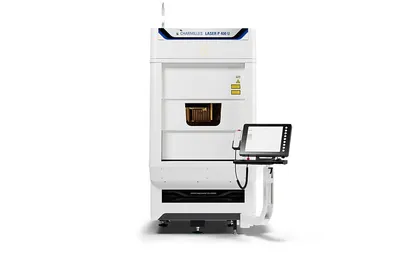
Bodor T Series
Key Specifications
Accuracy
Repeatability
max tube diameter
max tube length
laser type
laser power
How much does the Bodor T Series cost?
Estimated price range
Our best estimate for a cnc laser cutting machine in this class — not a quote from Bodor. Configuration moves it a long way.
Overview
The Bodor T Series is a fiber laser tube cutting machine listed for round tube up to 325 mm in diameter and square tube up to 250 mm, in lengths up to 12,000 mm depending on the model. The listed figures on this page have not been confirmed against a Bodor document. Treat them as a guide and check them for the specific model.
Tube is held in a motorized 4-jaw self-centering rotary chuck, and the supported profiles are round, square, rectangular, oval, D-section and custom shapes. Two limits decide whether a given stock fits. One is section size, 325 mm round or 250 mm square. The other is weight per metre: maximum tube weight is listed at up to 80 kg/m, again model dependent, so a heavy-wall section can sit inside the diameter limit and still be too heavy to run.
Laser power is listed as 1 kW, 2 kW, 3 kW or 6 kW. The wall thickness rows are all for the 6 kW configuration: 16 mm in mild steel, 10 mm in stainless and 10 mm in aluminum. No wall thickness is listed for the three lower powers. Positioning accuracy is listed at ±0.05 mm and repeatability at ±0.03 mm.
The control is described as a Bodor proprietary CNC with BodorCut tube processing software, and the laser source as Raycus, Max Photonics or IPG Photonics depending on configuration. Because the length and weight rows are both marked model dependent, the exact model designation matters: confirm the length capacity before assuming 12,000 mm stock will load.
Full Specifications
| Parameter | Value |
|---|---|
| Max Tube Diameter | 325 mm (round); 250 mm (square) |
| Max Tube Length | Up to 12,000 mm (model dependent) |
| Laser Type | Fiber |
| Laser Power | 1 kW, 2 kW, 3 kW, or 6 kW |
| Max Wall Thickness Mild Steel | 16 mm (6 kW configuration) |
| Max Wall Thickness Stainless | 10 mm (6 kW configuration) |
| Max Wall Thickness Aluminum | 10 mm (6 kW configuration) |
| Supported Profiles | Round, square, rectangular, oval, D-section, and custom profiles |
| Chuck Type | Motorized 4-jaw self-centering rotary chuck |
| Positioning Accuracy | ±0.05 mm |
| Repeatability | ±0.03 mm |
| Max Tube Weight | Up to 80 kg/m (model dependent) |
| CNC Control | Bodor proprietary CNC with BodorCut tube processing software |
| Laser Source | Raycus, Max Photonics, or IPG Photonics (configuration dependent) |
Specifications compiled from manufacturer literature and industry references. Not independently verified against a published spec sheet — confirm with the manufacturer or an authorised dealer before making a purchasing decision.
Strengths & Limitations
Strengths
- Round tube up to 325 mm and square tube up to 250 mm
- Tube lengths up to 12,000 mm on the longest models
- Motorized 4-jaw self-centering rotary chuck for round, square, rectangular, oval and D-section profiles
- 16 mm mild steel wall listed for the 6 kW configuration
- ±0.05 mm positioning accuracy and ±0.03 mm repeatability listed
Limitations
- The listed figures are unconfirmed, and tube length and tube weight are both model dependent
- Stainless and aluminum wall thickness stop at 10 mm even in the 6 kW configuration
- No wall thickness is given for the 1 kW, 2 kW or 3 kW options
- Tube weight is capped at up to 80 kg/m
Best For
Frequently Asked Questions
01
The listed maximum is 325 mm for round tube and 250 mm for square tube. Tube length is listed at up to 12,000 mm and tube weight at up to 80 kg/m, and both of those depend on the model, so check the figures for the exact machine.
02
For the 6 kW configuration the listed maximums are 16 mm in mild steel, 10 mm in stainless and 10 mm in aluminum. Power is also listed at 1 kW, 2 kW and 3 kW, but the table gives no wall thickness for those.
03
Round, square, rectangular, oval, D-section and custom profiles are listed. The tube is gripped by a motorized 4-jaw self-centering rotary chuck, and programs are prepared in BodorCut tube processing software on a Bodor proprietary CNC.
04
The source is listed as Raycus, Max Photonics or IPG Photonics, depending on configuration, at 1 kW, 2 kW, 3 kW or 6 kW. Confirm both the make and the power of the source on any machine under consideration.
More from Bodor
Other CNC Laser Cutting Machines
Ermak Fibermak Momentum Gen-5 SM 4x2
Amada ENSIS 4020 AJe
Yawei HLG-25120
TRUMPF TruLaser 5060 fiber
Ermak Fibermak SL 3x1.5