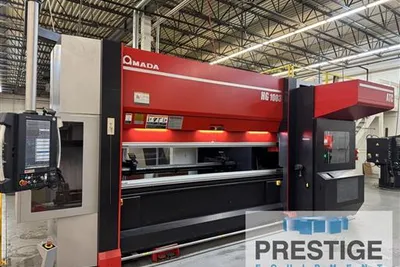
Amada RSF-3013
Key Specifications
press force
bending length
drive system
robot type
robot payload
back gauge axes
Overview
The Amada RSF-3013 is a CNC robotic press brake bending system that integrates an industrial robot with a servo-electric press brake to create a lights-out bending cell. The RSF designation stands for Robot Servo Forming — Amada's line of automated bending systems built around the servo-electric HFE press brake platform paired with a 6-axis industrial robot for fully automated part loading, positioning, bending, and unloading. The 3013 model designation indicates approximately 30 metric tons press force and 1,300 mm bending length — making it a compact, fast automated system for small and medium-sized parts.
The core press brake in the RSF-3013 system is derived from Amada's servo-electric platform, which provides the high-accuracy, high-repeatability bending performance essential for robotic cell operation. When a robot positions sheet metal blanks against a back gauge and presents them to tooling, angle accuracy and stroke repeatability must be consistent to within fractions of a millimeter — servo-electric drive meets that requirement. The robot arm handles parts within its reach envelope, typically flat blanks from a stack loader or feeder, and uses gripper tooling matched to the part geometry.
Automation on the RSF-3013 works through Amada's AMNC control and robot programming software, which coordinate the press brake stroke sequence and robot movements as a unified program. The operator programs the bending sequence, part positions, and robot path offline, then runs the cell unattended. Part changeover — switching from one product to another — requires updating the bend program, reloading the blank stack, and potentially changing gripper tooling. For shops running moderate to high volumes of the same part number, the RSF-3013 delivers a compelling productivity advantage over a standalone press brake with a manual operator.
The system is typically configured with a blank feeder or stack loader that presents flat parts to the robot automatically. Amada offers several feeder options depending on part weight, size, and material type. At the output end, a stacking fixture or conveyor collects finished bent parts. The full cell can run unattended once set up, making overnight and weekend production feasible for appropriate part families.
Cell footprint depends on the robot reach and feeder configuration. A typical RSF-3013 installation occupies roughly 3 x 5 meters of floor space including the robot work envelope, blank feeder, and finished part stacking area. The robot arm requires safety fencing or laser safety scanning to prevent personnel from entering the work envelope during operation.
New RSF-3013 systems typically run $350,000–$600,000 depending on robot payload, feeder type, gripper tooling complexity, and integration services. The wide range reflects the system-integration nature of robotic press brake cells — a basic robot-brake package is at the lower end, while a fully integrated cell with custom gripper tooling, advanced feeders, and Amada commissioning services is at the top. ROI justification requires analyzing labor costs, shift patterns, part volume, and setup frequency — the system pays back fastest on high-volume parts with low changeover frequency. Specs are sourced from Amada published technical data, system integrator documentation, and equipment reseller listings.
Full Specifications
| Parameter | Value |
|---|---|
| Press Force | ~300 kN / 30 metric tons (33 US tons) |
| Bending Length | 1,300 mm (51.2 in) |
| Drive System | AC servo-electric (ball screw) |
| Robot Type | 6-axis industrial robot (Amada-integrated) |
| Robot Payload | Varies by configuration (typically 10–50 kg) |
| Back Gauge Axes | 6-axis servo |
| CNC Control | Amada AMNC with integrated robot controller |
| Programming | Offline robot and bend program via Amada software |
| Cell Configuration | Robot + press brake + blank feeder + stacking output |
| Safety | Safety fencing or laser area scanner |
| Y Axis Accuracy | +/- 0.0001 mm (servo-electric platform) |
| Cell Footprint | ~3,000 x 5,000 mm typical (configuration dependent) |
| E | e |
| Online Order Parts Tooling | Log-in & New Users Registration(opens in new window)Access the Amada Parts Portal for online parts and tooling orders |
| Subscribeview Excerpt | Highlighting AMADA's latest technologies and industry news — all in one convenient email.RegisterView Latest |
Specifications sourced from amada.com — verified 2026-03-28
Strengths & Limitations
Strengths
- Fully automated lights-out bending — robot handles loading, positioning, bending, and stacking without operator intervention once the cell is running
- Servo-electric press brake core delivers +/- 0.0001 mm Y-axis accuracy and consistent repeatability essential for robot-assisted bending
- Eliminates direct labor costs on high-volume repetitive bending operations — the cell runs overnight and weekends with minimal supervision
- Integrated offline programming coordinates robot and press brake in a single program, simplifying changeover and reducing setup errors
- Amada ecosystem integration — same AMNC control family as standalone Amada press brakes for consistent operator training and programming workflow
- Compact cell footprint of approximately 3 x 5 meters makes installation feasible in standard production bays
Limitations
- Complete cell pricing of $350K–$600K requires significant capital investment with ROI dependent on high-volume part families and consistent production demand
- Part changeover requires program updates, gripper tooling changes, and blank feeder adjustment — not suitable for extreme high-mix / low-volume schedules
- Robot gripper tooling must be custom-designed per part family, adding lead time and cost for new products
- System integration complexity requires Amada commissioning support and in-house expertise to maintain — more complicated than a standalone press brake
- Safety fencing or laser scanner requirements add floor space and access constraints around the cell
- At 30 tons / 1,300 mm, the press brake component is limited to small and medium parts — not suitable for larger structural fabrication
Best For
Frequently Asked Questions
01
Complete RSF-3013 system pricing typically runs $350,000–$600,000 depending on robot payload configuration, blank feeder type, gripper tooling complexity, and Amada integration services. This includes the press brake, robot arm, control integration, feeder, safety fencing, and commissioning. The wide range reflects the system-integration nature of the product — a base package is at the lower end; a fully customized turnkey cell with complex gripper tooling and advanced feeders is at the high end.
02
The RSF-3013 works best with part families that are produced in high volumes, have consistent blank sizes that fit standard gripper tooling, require a moderate number of bends (2–8 is typical), and have limited need for repositioning the blank mid-program. Ideal examples include electrical enclosure panels, HVAC brackets, automotive body reinforcements, and electronic chassis components. Complex parts requiring multiple gripper changes within a single part program significantly reduce the cell's throughput advantage.
03
Changeover involves updating the bend program in the AMNC control and robot controller, loading the new blank stack into the feeder, and replacing gripper tooling on the robot arm if the new part family requires different grippers. If the new part uses the same blank size and gripper as the previous run, changeover can be done in minutes. New part families requiring custom gripper tooling require more lead time and setup. Amada designs the system so program recall and tooling exchange are as streamlined as possible, but the RSF series is not optimized for extreme high-mix production.
04
Both are robot-integrated press brake cells from premium press brake manufacturers. Amada's RSF series uses a servo-electric press brake core for higher accuracy; TRUMPF's BendMaster typically pairs with the hydraulic TruBend 5000 series with On-Demand Servo Drive. TRUMPF's BendMaster is available in 60 kg and 150 kg robot payload versions and integrates with the ToolMaster automatic tool changer. Amada's RSF offers the servo-electric accuracy advantage. Both require similar investment levels and ROI analysis. Selection often depends on existing brand relationships and service network.
05
The RSF-3013 robot work envelope must be isolated from personnel during operation. Amada's standard approach uses perimeter safety fencing with interlocked access gates that stop the robot when opened. Alternatively, area laser scanners (safety-rated) can define the work envelope without physical barriers, allowing more flexible floor layout. Both approaches meet ISO 10218 industrial robot safety standards. Regular safety system testing and documented maintenance procedures are required.
Videos

Reality SF Music
Community Discussions
Community discussion — Amada band saw blades.
Community discussion — Automatic bandsaw recommendations - Practical Machinist
Community discussion — Amada bandsaw blades
Troubleshooting and problem-solving — Anyone running a 20+ year old Amada auto bandsaw?
Troubleshooting and problem-solving — Need Help! Manual book and hydraulic diagram Amada ... - CNCzone
Troubleshooting and problem-solving — Experienced operator tip - Amada Vipros issue - CNCzone
Maintenance and service — Need Help! Needed: Amada Alarm Code definitions! - CNCzone
Troubleshooting and problem-solving — Need Help! Amada shearing NS2535 - cnczone.com
Pricing and buying discussion — Vertical band saw recommendations ? : r/Machinists - Reddit
Community discussion — What is the Best Production NC Bandsaw? : r/Machinists - Reddit
Comparison and buying advice — Kennametal question : r/Machinists - Reddit
Community discussion — Bench top bandsaw recommendation : r/Machinists - Reddit
Links to community discussions. Summaries are editorial — visit the original thread for full context.