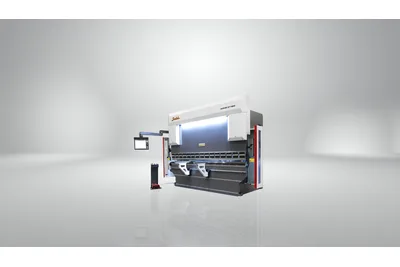
Amada HFE3 170-3
Key Specifications
press force
bending length
distance between columns
open height
stroke
approach speed
Overview
The Amada HFE3 170-3 is a third-generation servo-electric press brake in Amada's HFE series — a platform that has been refined through multiple generations since Amada pioneered the commercial servo-electric press brake concept in the late 1990s. With 170 metric tons (1,700 kN / 187 US tons) of press force and a 3,050 mm (120 in) bending length, the HFE3 brings servo-electric precision and energy efficiency to the mid-to-heavy tonnage class that previously belonged exclusively to hydraulics.
The HFE3's servo-electric drive is the defining characteristic of the machine. Instead of a hydraulic pump and cylinders, an AC servo motor drives a ball screw mechanism that moves the ram with direct mechanical precision. The result is Y-axis positional accuracy of +/- 0.0001 mm (0.000004 in) — significantly tighter than what a hydraulic system can deliver even with linear encoder feedback. That level of precision matters for high-tolerance sheet metal work: electronic enclosures with tight joint tolerances, medical device housings, aerospace brackets where angle deviation translates directly to assembly problems downstream.
The HFE3 third-generation platform refined the servo-electric drive mechanism for higher reliability and improved thermal stability compared to earlier HFE generations. The ball screw drive eliminates hydraulic oil, hydraulic filters, oil coolers, and the associated maintenance tasks. Energy consumption is dramatically lower — the motor only draws power during the actual stroke and during deceleration, regenerating energy back into the drive during the return stroke. Amada's published figures show 50–60% lower energy consumption versus equivalent hydraulic machines.
Ram speed on the HFE3 reaches 150 mm/s approach and return, with a programmable bending speed from 1 to 25 mm/s. The ability to program bending speed allows fine-tuning for different materials: slower speeds on thick stainless reduce springback variability; faster speeds on thin aluminum keep cycle times competitive. The press stroke is 200 mm with an open height of 480 mm (18.9 in).
The standard back gauge on the HFE3 170-3 is a 6-axis servo-driven system (X, X2, R, R2, Z1, Z2) with a depth range of 650 mm and speed up to 900 mm/s. Amada's back gauge design integrates with the AMNC-3i control's bend sequence planning to minimize repositioning steps on complex multi-bend programs. The AMNC-3i is Amada's third-generation touchscreen CNC, running on a 15-inch color display with 3D solid modeling, automatic bend sequence calculation, and tool layout simulation that shows the operator exactly how to set up tooling before the first bend.
Angle correction is handled by Amada's AFH (Angle Finder Head) option, which measures the actual bend angle acoustically through the tooling without touching the part. Like TRUMPF's ACB system and Bystronic's OAM, it eliminates test bends on new material batches by detecting springback characteristics and programming compensating strokes automatically.
New HFE3 170-3 machines typically run $220,000–$340,000 depending on back gauge configuration, angle measurement options, tooling packages, and regional pricing. Used HFE/HFE2 machines in comparable tonnage trade between $80,000 and $180,000 depending on generation, hours, and condition. The HFE3 competes directly with the TRUMPF TruBend 5130 and Bystronic Xpert 150 in this tonnage class. Amada's servo-electric drive is the differentiating factor — the precision advantage is real and measurable, but comes at a higher initial cost than hydraulic alternatives. Specs are sourced from Amada published technical data, dealer listings, and equipment reseller databases.
Full Specifications
| Parameter | Value |
|---|---|
| Press Force | 1,700 kN / 170 metric tons (187 US tons) |
| Bending Length | 3,050 mm (120 in) |
| Distance Between Columns | 2,550 mm (100.4 in) |
| Open Height | 480 mm (18.9 in) |
| Stroke | 200 mm (7.9 in) |
| Approach Speed | 150 mm/s |
| Bending Speed | 1 - 25 mm/s (programmable) |
| Return Speed | 150 mm/s |
| Back Gauge Axes | 6-axis servo (X, X2, R, R2, Z1, Z2) |
| Back Gauge Depth | 650 mm |
| Back Gauge Speed | 900 mm/s |
| Y Axis Accuracy | +/- 0.0001 mm (0.000004 in) |
| CNC Control | Amada AMNC-3i (15" color touchscreen) |
| Drive System | AC servo-electric (ball screw) |
| Machine Weight | ~9,500 kg (20,944 lb) |
| E | e |
| Online Order Parts Tooling | Log-in & New Users Registration(opens in new window)Access the Amada Parts Portal for online parts and tooling orders |
| Subscribeview Excerpt | Highlighting AMADA's latest technologies and industry news — all in one convenient email.RegisterView Latest |
Specifications sourced from amada.com — verified 2026-03-28
Strengths & Limitations
Strengths
- AC servo-electric ball screw drive delivers +/- 0.0001 mm Y-axis accuracy — significantly better than hydraulic press brakes — for tight-tolerance sheet metal work
- No hydraulic oil, filters, or coolers — dramatically reduced maintenance requirements and no oil disposal costs
- 50–60% lower energy consumption than equivalent hydraulic machines, with regenerative deceleration feeding energy back into the drive
- Programmable bending speed from 1–25 mm/s allows fine-tuning for different materials and thickness to optimize accuracy and cycle time
- AMNC-3i control with 3D solid modeling, automatic bend sequence calculation, and tool layout simulation reduces setup time significantly
- 6-axis servo back gauge handles complex multi-step bend sequences and offset flanges without manual repositioning
- Third-generation platform with refined drive reliability and thermal stability compared to earlier HFE generations
Limitations
- New pricing of $220K–$340K is higher than comparable hydraulic press brakes from TRUMPF, Bystronic, or Cincinnati at the same tonnage
- Ball screw drive mechanisms require periodic inspection and eventual replacement — though intervals are long, the cost when service is needed is significant
- Maximum approach speed of 150 mm/s is lower than TRUMPF's On-Demand Servo hydraulic system (220 mm/s), meaning slightly longer cycle times on thick material where most time is dwell, not rapid traverse
- Amada's service network in some regions is thinner than TRUMPF's — parts availability and response time vary
- AMNC-3i control, while capable, has a steeper learning curve than TRUMPF's Touchpoint TruBend for new operators
Best For
Frequently Asked Questions
01
New HFE3 170-3 machines typically run $220,000–$340,000 depending on configuration. Base machines come in at the lower end; adding the AFH angle measurement option, upgrading tooling packages, and configuring additional back gauge axes pushes pricing higher. Used HFE and HFE2 machines in comparable tonnage trade between $80,000 and $180,000 depending on generation and condition.
02
The HFE3 is Amada's third-generation servo-electric press brake platform. The original HFE series established the servo-electric ball screw drive concept. The HFE2 generation improved drive reliability and control integration. The HFE3 further refined the ball screw drive mechanism, improved thermal stability for consistent long-shift accuracy, upgraded to the AMNC-3i control with 3D programming, and enhanced the energy regeneration system. The core servo-electric advantage (high accuracy, low maintenance, low energy) is present across all generations.
03
The HFE3's servo-electric drive delivers +/- 0.0001 mm Y-axis accuracy versus the TruBend 5130's +/- 0.01 mm — a 100x theoretical accuracy advantage, though both machines produce good parts in practice. The HFE3 eliminates hydraulic oil maintenance and uses significantly less energy. The TruBend 5130 offers higher rapid traverse speed (220 mm/s vs 150 mm/s) and TRUMPF's broader automation ecosystem with BendMaster and ToolMaster. Both machines run in the $200K–$340K price range new.
04
The AFH (Angle Finder Head) is Amada's real-time angle measurement system. It uses an acoustic sensor mounted in the tooling to detect the actual bend angle during the stroke without touching the part. The system detects springback characteristics and automatically adjusts subsequent strokes to hit the programmed target angle. This eliminates trial bends when setting up new jobs or switching material lots — functionally similar to TRUMPF's ACB Wireless and Bystronic's OAM systems.
05
Amada reports 50–60% lower energy consumption compared to equivalent hydraulic machines. The servo motor only draws power during the actual stroke and decelerates regeneratively, feeding energy back into the drive on the return stroke. There is no hydraulic pump running continuously. For a machine running two shifts per day, the energy savings can be substantial over the machine's life — Amada's ROI calculations typically show payback on the energy premium within 3–5 years at industrial electricity rates.
Community Discussions
Community discussion — Used Amada Press Brake controller - Practical Machinist
Community discussion — New press brake recommendations - Practical Machinist
Community discussion — Used Amada Press Brake Controller - Practical Machinist
Troubleshooting and problem-solving — Amada CD2005 Controller HFT 100-3 Issues ...
Pricing and buying discussion — Vertical band saw recommendations ? : r/Machinists - Reddit
Community discussion — What is the Best Production NC Bandsaw? : r/Machinists - Reddit
Community discussion — Ream feeds and speeds : r/Machinists - Reddit
Comparison and buying advice — Kennametal question : r/Machinists - Reddit
Links to community discussions. Summaries are editorial — visit the original thread for full context.