Industrial CNC Machine Directory

Amada HFE-M2 130-3

$220,000 - $380,000 Updated 2026-03-17
01

Key Specifications

Pressing Force

130 tonnes (1,300 kN)

Working Length

3,100 mm

Distance Between Uprights

2,550 mm

Throat Depth

415 mm

Open Height

510 mm

Ram Stroke

200 mm

02

Overview

The Amada HFE-M2 130-3 is a servo-electric press brake from Amada's second-generation HFE-M2 series, providing 130 tonnes of bending force across a 3,100 mm working length. The HFE-M2 designation marks Amada's evolution of the original HFE servo-electric platform, incorporating design improvements in drive efficiency, ram rigidity, and control integration that extend the series' applicability to a wider range of production environments.

Like all HFE-series machines, the HFE-M2 130-3 replaces hydraulic oil and pumps with dual servo motors acting through precision ball screws for Y-axis positioning. This configuration eliminates the energy losses associated with continuous hydraulic pump operation, resulting in energy savings of 40–60% compared to conventional hydraulic press brakes running similar production schedules. The servo-electric drive delivers immediate response to ram positioning commands with Y-axis repeatability of ±0.01 mm, enabling consistent multi-bend part programs with minimal scatter between cycles.

Amada equips the HFE-M2 130-3 with the AMNC-3i touchscreen control, providing 3D graphical bend simulation, automatic bend sequence generation, and integrated tool interference checking. The control's connection to Dr. ABE Bend offline programming software allows complex parts to be programmed and verified digitally before the first physical bend, reducing material waste and shortening time-to-first-good-part on new jobs. The back-gauge system is configurable with up to 6 axes including independent Z1/Z2 finger positioning for asymmetric part geometries.

The HFE-M2 series introduces enhanced frame geometry compared to earlier HFE models, with improved cross-section stiffness at the press beam and table interface to reduce deflection under asymmetric loading. An active crowning table responds to load feedback during bending to maintain consistent angular results across the full working length even when bending off-centre or over partial tool sets.

At 130 tonnes and 3,100 mm, the HFE-M2 130-3 occupies a versatile position between compact single-operator machines and large-format structural bending presses. It is well-suited to fabrication shops processing mixed-thickness orders in stainless steel, aluminium, and mild steel where the servo-electric drive's combination of precision and cleanliness provides competitive advantage over shops still running hydraulic equipment.

03

Full Specifications

Parameter Value
Pressing Force 130 tonnes (1,300 kN)
Working Length 3,100 mm
Distance Between Uprights 2,550 mm
Throat Depth 415 mm
Open Height 510 mm
Ram Stroke 200 mm
Approach Speed 200 mm/s
Bending Speed 1–20 mm/s (programmable)
Return Speed 180 mm/s
Back-Gauge Axes 6 axes (X, R, Z1, Z2, X5, optional L)
Y-Axis Positioning Accuracy ±0.01 mm
Drive Type Servo-electric (dual ball screw, 2nd generation)
Control Amada AMNC-3i
Machine Weight Approx. 11,000 kg

Specifications sourced from amada-gmbh.eu — verified 2026-03-28

04

Strengths & Limitations

Strengths

  • Second-generation HFE-M2 platform delivers enhanced frame rigidity and active crowning compared to original HFE series
  • Servo-electric drive provides ±0.01 mm Y-axis repeatability and 40–60% energy savings versus equivalent hydraulic press brakes
  • AMNC-3i control with 3D simulation and Dr. ABE Bend integration reduces programming time and first-part scrap
  • Oil-free operation eliminates contamination risk, making the HFE-M2 suitable for clean-room adjacent and food-grade fabrication environments
  • 6-axis back-gauge configuration handles complex asymmetric part geometries without manual repositioning

Limitations

  • Servo-electric drive system carries a higher purchase price than hydraulic equivalents at 130-tonne capacity
  • Ball screw and servo motor maintenance requires Amada-trained technicians, which may extend downtime in regions with limited dealer coverage
  • 130-tonne force at 3,100 mm limits capability for very heavy plate bending above 12 mm mild steel across full working length
05

Best For

Precision fabricators processing stainless steel and aluminium assemblies requiring consistent angle tolerances across multi-bend programs Job shops with high part variety needing fast setup via AMNC-3i 3D simulation and offline programming integration Food processing and pharmaceutical equipment fabricators requiring oil-free bending environments Shops upgrading from hydraulic press brakes seeking improved precision and energy efficiency within the same force and length class
06

Frequently Asked Questions

01 What is the difference between the HFE 130-3 and the HFE-M2 130-3?

The HFE-M2 is Amada's second-generation servo-electric press brake platform. Compared to the original HFE series, the M2 introduces enhanced press beam rigidity, improved active crowning response, and updated AMNC-3i control integration. The M2 designation reflects mechanical and software refinements rather than a fundamentally different drive architecture, but delivers measurably improved angle consistency and programming capability over the first-generation HFE.

02 Does the HFE-M2 130-3 include automatic angle measurement?

Amada offers an optional Automatic Angle Feedback system for the HFE-M2 series, which uses sensors to measure actual bend angles after each stroke and applies corrections to subsequent hits. This option is recommended for shops bending high-springback materials such as aluminium alloys and high-strength steel, where material variation between batches makes manual springback compensation unreliable.

03 Can the HFE-M2 130-3 be used in a robotic bending cell?

Yes. Amada has developed robotic bending cell configurations using HFE-M2 press brakes in combination with Amada's ASTRO or third-party robotic material handling systems. The AMNC-3i control supports cell integration protocols for automated part loading, bending sequence execution, and unloading, enabling lights-out bending on suitable part families.

04 What is the energy consumption of the HFE-M2 130-3 compared to a hydraulic press brake?

The HFE-M2 130-3's servo-electric drive consumes power only during actual press motion — acceleration, bending, and deceleration — rather than running a hydraulic pump continuously regardless of machine state. On typical production schedules with a 40–60% duty cycle, this results in 40–60% lower energy consumption versus a conventional hydraulic press brake of equivalent capacity.

05 What tooling does the HFE-M2 130-3 use?

The HFE-M2 130-3 uses Amada's standard precision-ground tooling system, compatible across Amada's press brake range. Punches and dies from HG or FBD machines can be used on the HFE-M2 without modification. Amada's quick-change clamping options can be specified to reduce tool change time on high-mix programs.

07

Videos

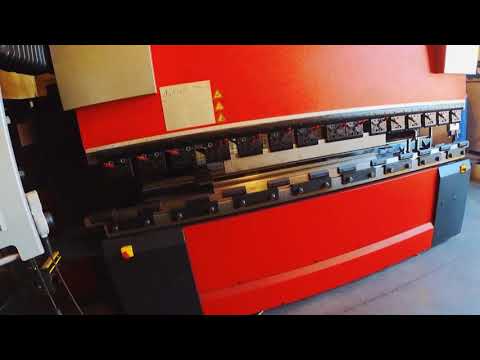
Amada 130 ton x 3000mm CNC Press Brake.  Model HFE M2 1303.  Manufactured 2011

Amada 130 ton x 3000mm CNC Press Brake. Model HFE M2 1303. Manufactured 2011

Electro Motion Used Machinery

Amada HFE Press Brake

Amada HFE Press Brake

HGR

AMADA HFE M2-EVO 1303 Hydraulic press brake / Plegadora AMADA

AMADA HFE M2-EVO 1303 Hydraulic press brake / Plegadora AMADA

Industrialmak Machines

AMADA Press Brake

AMADA Press Brake

Surplex

08

Community Discussions

09

Related Machines