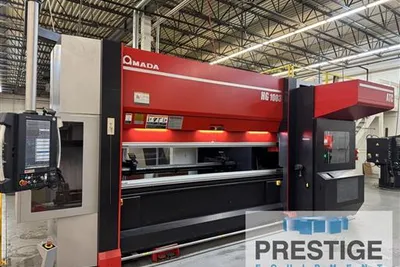
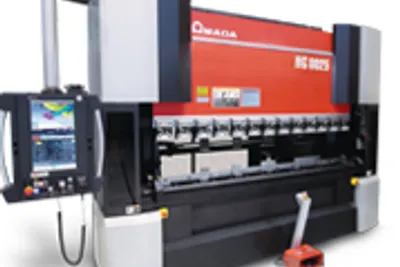
Amada HD-SR 130-3
Key Specifications
press capacity
press beam length
distance between frames
stroke
throat depth
approach speed
Overview
The Amada HD-SR 130-3 is a fully servo-electric press brake -- no hydraulics at all. Where the HG series uses a hybrid servo-hydraulic drive, the HD-SR line replaces the hydraulic circuit entirely with a direct servo-electric drive system. Two servo motors drive ball screws to move the ram, delivering bending force with energy consumed only during active motion. The result is a machine that draws roughly 20% of the power of an equivalent hydraulic press brake and produces no hydraulic heat load on the shop floor.
The HD-SR 130-3 delivers 130 metric tons (143 US tons / 1,274 kN) of press force across a 3,100 mm (122 in) bending length with 2,700 mm (106.3 in) of usable distance between frames. Stroke is 200 mm (7.9 in) and throat depth is 400 mm (15.7 in). The servo-electric drive enables precise independent control of the left and right ram ends, achieving ram parallelism accuracy of ±0.001 mm (±0.00004 in) -- matching the best hydraulic machines without the thermal drift that affects hydraulic oil viscosity over time.
The AMNC 3i control is standard equipment, the same 19-inch multi-touch interface used across Amada's HG and EM series. The HD-SR integrates Amada's AFH angle feedback system as standard, which uses sensors embedded in the die to measure actual bend angle in real time and command correction before the ram returns. Because a servo-electric drive can be commanded to hold at any position with micron-level precision, the angle correction loop is faster and more consistent than on hydraulic machines. The standard backgauge is 6-axis with L-shift.
Bend speeds on the HD-SR 130-3 run at up to 20 mm/sec (47 ipm) pressing speed with a 150 mm/sec (354 ipm) approach and return speed -- slightly slower approach than the hydraulic HG series but adequate for most production work. The servo-electric architecture means no warm-up time, no hydraulic oil changes, no oil cooling, and no oil leak risk. Operating costs over a 10-year horizon are substantially lower than equivalent hydraulic machines when factoring in energy and consumable costs.
New HD-SR 130-3 pricing typically runs $220,000-$310,000 depending on tooling, backgauge configuration, and regional market. The machine is positioned above the entry-level EM series and below the HG-ATC, targeting shops that prioritize energy efficiency and angle accuracy over the ATC's tooling automation. Direct competitors include the Trumpf TruBend 5130 EVO, Salvagnini B3, and Bystronic Xpert 100. The HD-SR's advantages over hydraulic competitors are lower operating cost and freedom from hydraulic system maintenance. Compared to other servo-electric options, the AMNC 3i control ecosystem and Amada's North American service network are key selling points.
Full Specifications
| Parameter | Value |
|---|---|
| Press Capacity | 1,274 kN / 130 metric tons (143 US tons) |
| Press Beam Length | 3,100 mm (122 in) |
| Distance Between Frames | 2,700 mm (106.3 in) |
| Stroke | 200 mm (7.9 in) |
| Throat Depth | 400 mm (15.7 in) |
| Approach Speed | 150 mm/sec (354 ipm) |
| Pressing Speed | 20 mm/sec (47 ipm) |
| Return Speed | 150 mm/sec (354 ipm) |
| Ram Repeatability | ±0.001 mm (±0.00004 in) |
| Back Gauge Axes | 6-axis with L-shift |
| CNC Control | AMNC 3i (19" multi-touch LCD) |
| Drive System | Fully servo-electric (dual servo motors + ball screws) |
| Angle Measurement | AFH angle feedback system (in-die sensors) |
| Crowning | CNC crowning |
| Power Requirement | 200V, ~15 kVA (peak demand) |
| Machine Weight | ~9,500 kg (20,944 lb) |
| E | e |
| Online Order Parts Tooling | Log-in & New Users Registration(opens in new window)Access the Amada Parts Portal for online parts and tooling orders |
| Subscribeview Excerpt | Highlighting AMADA's latest technologies and industry news — all in one convenient email.RegisterView Latest |
Specifications sourced from amada.com — verified 2026-03-28
Strengths & Limitations
Strengths
- Fully servo-electric drive eliminates the hydraulic system entirely -- no hydraulic oil, no oil changes, no cooling system, and no risk of oil leaks that require environmental cleanup
- Energy consumption roughly 80% lower than equivalent hydraulic press brakes -- the servo motors only draw power during active bending motion, not during dwell or approach
- AFH angle feedback system with in-die sensors measures actual bend angle in real time and corrects before return, reducing springback variation across material batches
- Ram parallelism of ±0.001 mm (±0.00004 in) -- equal to the best hydraulic machines -- without thermal drift from hydraulic oil temperature variation across long shifts
- No warm-up time required -- the machine is ready to bend immediately from cold start, useful in shops with intermittent production schedules
- AMNC 3i control with the same intuitive interface as the HG series lowers training burden for operators already familiar with Amada equipment
Limitations
- At 130 metric tons, the HD-SR sits at a moderate tonnage that suits common sheet metal gauges but is not suited to heavy plate work -- shops needing 200+ tons must step up to hydraulic or hybrid machines
- Pressing speed of 20 mm/sec matches hydraulic machines but approach/return speeds are slower than the HG series -- shops doing very high-cycle thin-gauge production may find the HG faster overall
- Higher upfront purchase price than equivalent-tonnage hydraulic press brakes from Amada's EM series or competitive hydraulic alternatives -- the operating cost savings take time to recover
Best For
Frequently Asked Questions
01
The HG series uses a hybrid servo-hydraulic drive -- servo motors control the hydraulic valves and pump, but hydraulic fluid still does the work. The HD-SR replaces the hydraulic system entirely with direct servo-electric drive via ball screws. The HD-SR has lower energy consumption, no hydraulic maintenance, no warm-up time, and no thermal drift from oil temperature -- but the HG ATC configuration is not available for the HD-SR, making the HG the better choice for high-mix shops prioritizing automated tool changes.
02
AFH (Angle Feedback High accuracy) is Amada's in-die bend angle measurement system. Sensors embedded in the die measure the actual bend angle while the ram is still in contact with the material. If the measured angle differs from the programmed target, the control commands a correction before the ram returns. This real-time closed-loop correction compensates for material springback, thickness variation, and hardness variation across a batch -- reducing reliance on trial bends and scrap parts.
03
Amada claims the HD-SR consumes approximately 20% of the power of an equivalent hydraulic press brake. A conventional hydraulic press brake keeps its pump motor running continuously -- typically 15-22 kW -- even during approach, dwell, and backgauge motion. The HD-SR's servo motors only draw power during active bending motion. In a typical production cycle with significant non-bending time, real-world energy savings of 75-85% compared to conventional hydraulic machines are commonly reported by operators.
04
The HD-SR 130-3 uses Amada's standard punch and die tooling system, the same tooling compatible with HG series machines. This allows shops already running HG equipment to share tooling across machines. Amada's precision ground tooling in American, European, and acute styles is compatible, along with third-party tooling manufactured to Amada's standards. The tooling system supports standard V-die widths and punch heights compatible with the machine's 200 mm stroke and open height.
05
Both are servo-electric press brakes in the 130-ton class. The Trumpf TruBend 5130 EVO uses a similar direct-electric drive architecture and competes closely on accuracy and energy efficiency. Key differentiators are the control ecosystem -- AMNC 3i vs Trumpf's Touch Point -- and the service and tooling networks. Amada's US service network is broader for most North American shops, while Trumpf's offline programming integration with TruTops is often preferred in shops already running Trumpf laser cutters. Both machines deliver comparable real-world accuracy; the decision usually comes down to software ecosystem and dealer proximity.
Community Discussions
Troubleshooting and problem-solving — Need Help! OLC-320HIII Oscillator. Error code 130! (Amada ...
Community discussion — Need Help! Amada Lc1212 A2 L16 Fanuc Laser C1500B
Community discussion — AMADA software - CNCzone
Community discussion — Need Help! Amada LC1212 A2 with fanuc series 16L
Community discussion — What is the Best Production NC Bandsaw? : r/Machinists - Reddit
Pricing and buying discussion — Vertical band saw recommendations ? : r/Machinists - Reddit
Pricing and buying discussion — Quiet air compressor recommendations? : r/Machinists - Reddit
Community discussion — What does everyone see as the most trusted CNC ... - Reddit
Links to community discussions. Summaries are editorial — visit the original thread for full context.