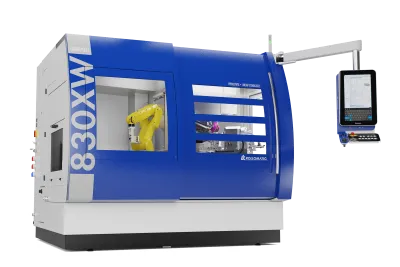
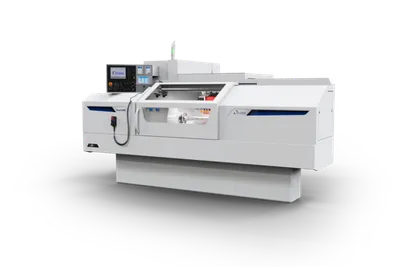
Vollmer QDF 350 H
Key Specifications
Number of CNC Axes
Process Type
Maximum Tool Diameter
Maximum Tool Height
Electrode Material
Pulse Frequency Range
Overview
The Vollmer QDF 350 H is a CNC erosion (EDM) machine engineered specifically for the production and resharpening of PCD (polycrystalline diamond) and PCBN (polycrystalline cubic boron nitride) tipped tools. Unlike conventional abrasive grinding, the QDF 350 H uses electrical discharge machining (EDM) to erode the ultrahard PCD and PCBN cutting edges to precise geometry — a process that is fundamentally different from grinding and is required because conventional grinding wheels cannot efficiently shape PCD or PCBN without extreme wheel wear and heat generation. The QDF 350 H addresses the growing demand for high-quality PCD tooling in aerospace, automotive, and composites machining applications.
The machine's erosion process discharges high-frequency electrical pulses between a rotating copper or graphite electrode and the PCD cutting edge, removing material in controlled increments without mechanical contact or grinding forces. This contactless material removal produces very sharp cutting edges on PCD tools with virtually no subsurface damage, a critical quality factor for PCD insert re-edging and for producing custom PCD form tools with complex geometries. The QDF 350 H can process tools up to 350 mm in diameter, covering a very wide range of PCD saw blades, indexable inserts, form milling cutters, and reamers.
Four CNC axes provide the interpolated motion required to follow complex PCD tip profiles and produce accurate cutting edge geometries on both rotary tools and indexable inserts. Vollmer's dedicated erosion control software manages pulse parameters, gap voltage, and electrode wear compensation automatically, freeing operators from the complex parameter management that manual EDM requires. The machine includes an integrated electrode dressing system that maintains electrode geometry throughout the erosion process.
The QDF 350 H is designed as a standalone production machine with automated part loading options, making it practical for high-volume PCD insert re-edging services and for tool manufacturers producing custom PCD tooling for demanding material machining applications.
Full Specifications
| Parameter | Value |
|---|---|
| Number Of CNC Axes | 4 |
| Process Type | EDM erosion (for PCD/PCBN tools) |
| Maximum Tool Diameter | 350 mm |
| Maximum Tool Height | 180 mm |
| Electrode Material | Copper / graphite |
| Pulse Frequency Range | Application-dependent (kHz range) |
| Positioning Accuracy | ±0.002 mm |
| Repeatability | ±0.001 mm |
| Integrated Electrode Dresser | Yes |
| Dielectric System | Deionized water (integrated) |
| Control System | Vollmer VC 720 |
| Machine Base | Cast iron with vibration isolation |
Specifications compiled from manufacturer literature and industry references. Not independently verified against a published spec sheet — confirm with the manufacturer or an authorised dealer before making a purchasing decision.
Strengths & Limitations
Strengths
- EDM erosion process is the correct technology for PCD/PCBN — enables production of geometries impossible or impractical with conventional grinding
- 350 mm maximum diameter accommodates large PCD saw blades and form milling cutters in addition to smaller inserts
- Contactless material removal produces extremely sharp PCD cutting edges without subsurface stress or micro-cracking
- Integrated electrode dressing eliminates manual electrode management and maintains consistent erosion quality throughout production runs
- VC 720 control automates pulse parameter management, making EDM accessible to operators without deep EDM expertise
Limitations
- EDM process is significantly slower than conventional grinding for carbide substrates — the QDF 350 H is not suitable for carbide-only tool production
- Dielectric system (deionized water) requires regular maintenance including resin bed replacement and water quality monitoring
- 4-axis configuration is more limited than the 5 or 6 axes available on competing universal tool grinders for complex rotary geometries
Best For
Frequently Asked Questions
01
PCD (polycrystalline diamond) is one of the hardest materials on earth and cannot be efficiently shaped by conventional abrasive grinding. Diamond grinding wheels wear extremely rapidly on PCD, generate heat that can damage the PCD layer, and cannot reliably produce the sharp, chipping-free edges that PCD tools require. EDM erosion removes material by spark discharge without mechanical contact, leaving a sharp, stress-free cutting edge at rates that are economically viable.
02
No. The QDF 350 H is an EDM erosion machine, not a grinding machine. It cannot process solid carbide tools or HSS tools. For carbide tool production, Vollmer offers the VGrind 360 and VGrind 360 S. Some facilities use a combination of a QDF for PCD work and a VGrind for carbide work.
03
During EDM erosion, the electrode (copper or graphite) gradually wears as it discharges into the PCD. If the electrode geometry degrades, it will produce inaccurate tool geometry. The integrated electrode dressing system automatically restores the electrode profile to its programmed geometry, compensating for wear and ensuring consistent erosion quality throughout the production run.
04
Primary industries include automotive (PCD tools for aluminum engine and transmission components), aerospace (PCD and PCBN tools for titanium and carbon fiber composites), wood products (large PCD saw blades for MDF, laminate, and solid wood), and general precision machining shops that offer PCD insert regrinding as a service.
05
EDM erosion of PCD is inherently a slow process compared to carbide grinding. Material removal rates depend on PCD grade, pulse parameters, and desired surface quality, but are typically in the range of 0.5–5 mm³/min. This is why the process is reserved for the ultrahard PCD layer rather than the carbide substrate, which is usually pre-ground on a conventional grinder.
Community Discussions
Owner experience and review — new fadal owner. am i setting things up right? - CNCzone
Community discussion — How to setup basic parameter settings for any vfd - cnczone.com
Troubleshooting and problem-solving — Microsoft Word - Tool Setter Calibration.doc - CNCzone
Options and configuration advice — Macro/Parametric Programming - CNCzone
Links to community discussions. Summaries are editorial — visit the original thread for full context.