ANCA FX7
Key Specifications
Spindle Power
machine type
machine structure
wheel packs
tool shank diameter
max tool length
How much does the ANCA FX7 cost?
Estimated price range
Our best estimate for a cnc grinding machine in this class — not a quote from ANCA. Configuration moves it a long way.
Overview
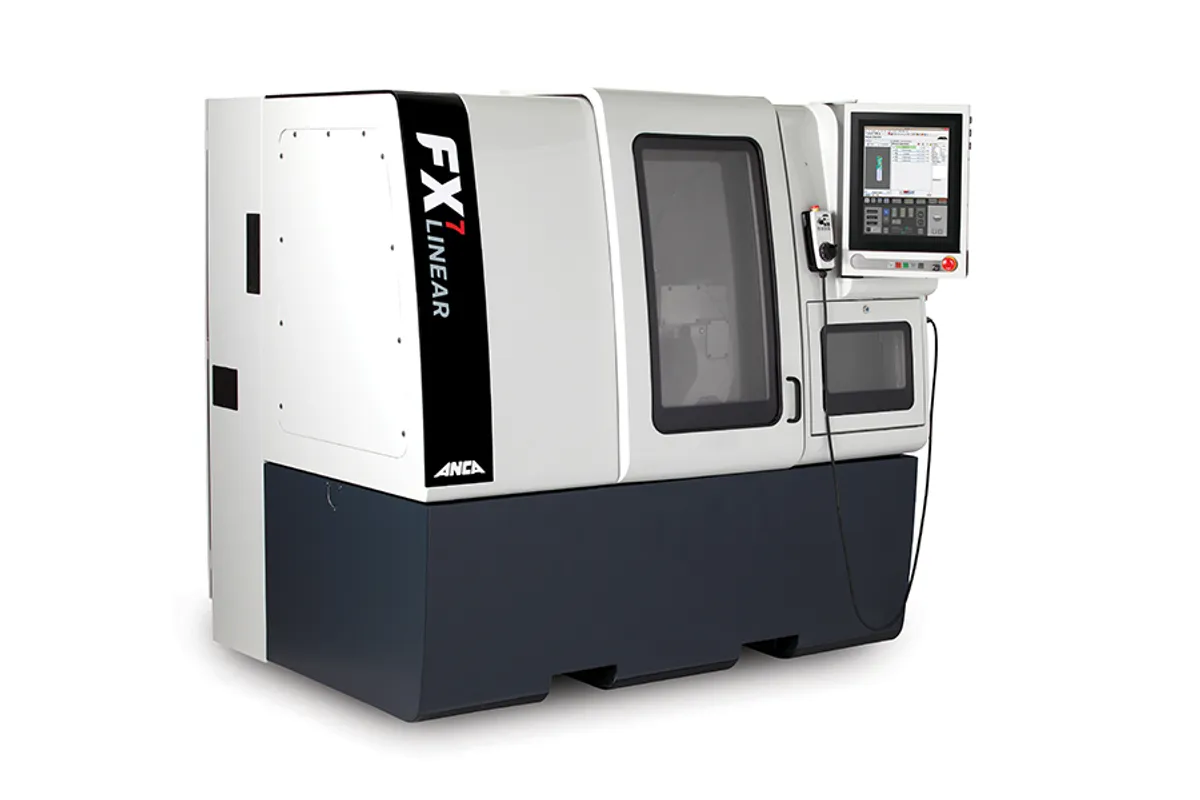
The ANCA FX7 is a CNC tool and cutter grinder in the FX Linear range: a single-column machine with linear motor axes and a spindle rated 19 kW (25.5 HP) peak and 8.2 kW (11 HP) S1. It works the same tool sizes as the FX5, productive up to Ø 12 mm (1/2”) and 200 mm (8”) long, but with more spindle and far more wheel and tool capacity.
The two power figures answer different questions. Peak power is what the spindle can give briefly in a heavy cut. The S1 figure is what it sustains, and at 8.2 kW it is less than half of the 19 kW peak. Size long, continuous fluting passes against the S1 number and treat the peak as headroom. The FX5 by comparison lists a 12 kW (16 HP) peak spindle as standard, with a 19 kW spindle offered as its high-powered alternative.
Wheel capacity is the clearest step up. The table gives 2 wheel packs of up to Ø 203 mm (8”), or 6 packs of the same diameter with the robot wheel changer. Six packs let one setup hold the wheels for several tool types, so a mixed batch can run through without a pack exchange. Loader capacity is listed as 840 x Ø 3 mm, 520 x Ø 6 mm or 221 x Ø 12 mm, which at every diameter is more than twice what the FX5 holds with its optional AR300.
Clamping range and productive range are not the same thing here. The collet chuck range is 3 – 25 mm, so the workholding accepts shanks well above 12 mm, yet the table calls the machine productive up to Ø 12 mm and limits tool length to 200 mm. Read the 25 mm figure as what the chuck can hold, not as the size the machine is meant to grind all day. Regular work at that size belongs on the MX7, which is listed as productive up to Ø 25 mm (1”) with 300 mm (12”) of tool length.
The machine measures 1,930 mm (76”) W x 1,800 mm (70”) D x 1,810 mm (71”) H and runs the ANCA AMC5 G2 High Performance CNC with a high-speed SSD, EtherCAT, an Intel processor and Windows 10.
Full Specifications
| Parameter | Value |
|---|---|
| Machine Type | 5-axis CNC tool and cutter grinder (FX Linear range) |
| Machine Structure | Single column |
| Spindle Motor Power | 19 kW (25.5 HP) peak; 8.2 kW (11 HP) S1 |
| Wheel Packs | 2 x Ø 203 mm (8”) max; 6 x Ø 203 mm (8”) max with robot wheel changer |
| Tool Shank Diameter | Productive up to Ø 12 mm (1/2”) |
| Max Tool Length | 200 mm (8”) |
| Max Tool Capacity with Loader | 840 x Ø 3 mm; 520 x Ø 6 mm; 221 x Ø 12 mm (Fanuc loader) |
| Drive System | Linear motor |
| Machine Dimensions | 1,930 mm (76”) W x 1,800 mm (70”) D x 1,810 mm (71”) H |
| CNC Control | ANCA AMC5 G2 High Performance CNC, high-speed SSD, EtherCAT, Intel processor, Windows 10 |
| Axes | 6 CNC axes (X, Y, Z, A, B, C) |
| Collet Chuck Range | 3 – 25 mm |
| Control System | ANCA proprietary (Windows-based, 6-axis simultaneous) |
Specifications sourced from machines.anca.com — verified 2026-10-03
Strengths & Limitations
Strengths
- 19 kW (25.5 HP) peak and 8.2 kW (11 HP) S1 spindle, against the 12 kW (16 HP) peak standard spindle of the FX5
- Up to 6 wheel packs of Ø 203 mm (8”) with the robot wheel changer
- Loader capacity of 840 x Ø 3 mm, 520 x Ø 6 mm or 221 x Ø 12 mm
- Collet chuck range of 3 – 25 mm for clamping a wide spread of shank sizes
- Linear motor axes in a floor area of 1,930 mm (76”) W x 1,800 mm (70”) D
Limitations
- S1 power is 8.2 kW (11 HP), less than half of the 19 kW (25.5 HP) peak figure
- Six wheel packs need the robot wheel changer; without it the table lists 2 packs
- Productive range ends at Ø 12 mm (1/2”) and 200 mm (8”) of tool length, even though the collet chuck clamps up to 25 mm
- Loader capacity falls from 840 tools at Ø 3 mm to 221 at Ø 12 mm
Best For
Frequently Asked Questions
01
The tool size is the same: both are listed as productive up to Ø 12 mm with a 200 mm tool length. The FX7 has a 19 kW (25.5 HP) peak spindle where the FX5 has 12 kW (16 HP) peak as standard. The FX7 lists up to 6 wheel packs with the robot wheel changer against 2 on the FX5, and its loader holds 840 x Ø 3 mm against 340 x Ø 3 mm on the FX5.
02
The spindle is rated 19 kW (25.5 HP) peak and 8.2 kW (11 HP) S1. S1 is the continuous rating, the power the spindle can hold without a time limit, and peak is what it can deliver for short periods. On long grinding passes the 8.2 kW figure is the one that governs the feed rate you can sustain.
03
Two wheel packs of up to Ø 203 mm (8”) as the base figure, or 6 packs of up to Ø 203 mm (8”) with the robot wheel changer. If the work needs more than two packs per setup, confirm that the robot wheel changer is on the machine being quoted.
04
The table gives a maximum tool length of 200 mm (8”) and calls the machine productive up to Ø 12 mm (1/2”). The collet chuck range is wider, 3 – 25 mm, so larger shanks can be clamped. For production above 12 mm the MX7 is the listed alternative, productive up to Ø 25 mm (1”).
05
The listed capacity is 840 tools at Ø 3 mm, 520 at Ø 6 mm or 221 at Ø 12 mm. Those figures belong to the loader named in the capacity row of the table, so check that the machine on offer has that loader fitted.
Videos

ANCA CNC Machines

MTDCNC

Asset Exchange

Machine Maker
Comparisons
More from ANCA
Other CNC Grinding Machines
Schneeberger Gemini NGM
Jainnher H130 CNC Cylindrical Roll Grinder
Glebar GT-610