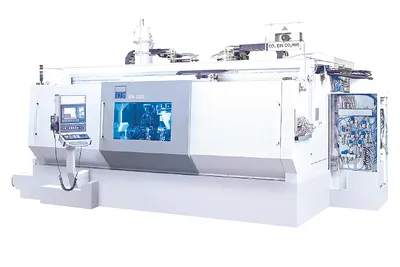
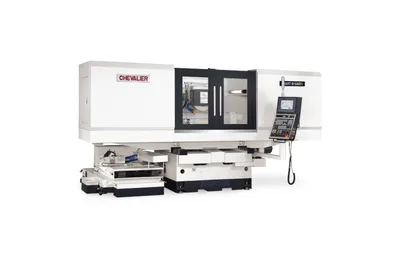
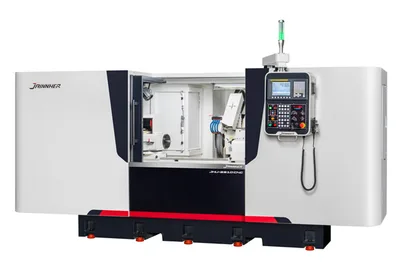
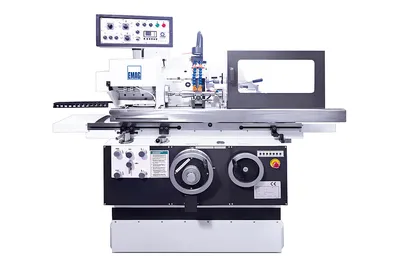
EMAG VSC 250
Key Specifications
Weight
Spindle Power
Max Workpiece ⌀
max workpiece length
chuck diameter
swing diameter
Overview
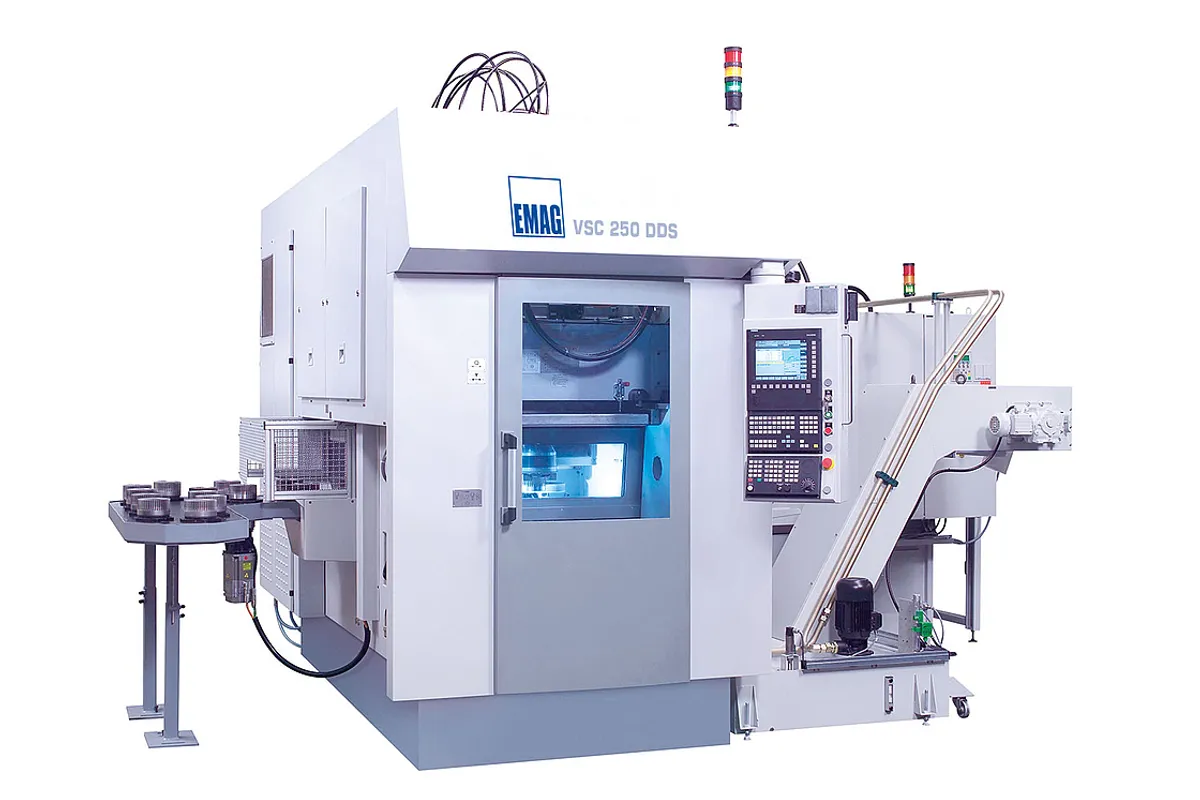
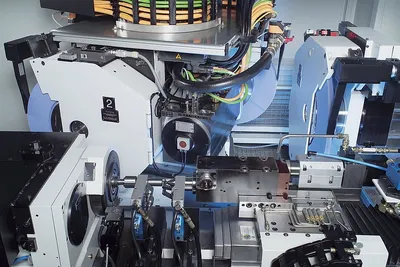
The EMAG VSC 250 is a vertical shaft chuck machine built around an inverted spindle design that EMAG pioneered back in 1992. It's a platform that handles turning, hard turning, and grinding operations on chucked components up to 250 mm diameter — all in a single setup. The inverted spindle picks up the raw workpiece from a conveyor belt, machines it, and drops the finished part back down. No gantry loader, no robot arm, no external automation bolted on as an afterthought. The machine loads itself, and that's a big deal when you're running lights-out or near-lights-out production.
The main spindle runs up to 6,000 RPM with 39 kW of power and 460 Nm of torque — more than enough muscle for hard turning hardened steel gears, bearing rings, and transmission components. In the DS and DDS grinding variants, you've also got a dedicated grinding spindle running up to 45,000 RPM at 18 kW, so you can rough-turn a part and finish-grind it to final tolerance without unclamping. That's where the real cycle time savings come from: eliminating the second setup on a dedicated grinder.
The machine sits on a MINERALIT polymer concrete bed — not cast iron. Polymer concrete damps vibration six to eight times better than gray iron, which translates directly to better surface finishes and longer tool life. The double-wall construction adds thermal stability, so you're not chasing dimensional drift through a production run. X-axis travel is 685 mm with Z at 200 mm, and rapid traverse hits 60 m/min on X and 30 m/min on Z. The 12-position disc turret takes VDI 40 tooling, giving you enough stations for a complete turning operation plus the grinding spindle in a single setup.
Control is Siemens Sinumerik 840D — the industry standard for complex multi-technology machines. The 840D handles the coordination between turning and grinding operations, in-process gauging, and the pick-up automation cycle. It's a control platform that every Siemens-trained operator already knows.
The VSC 250 weighs approximately 6,500 kg in single-spindle configuration and fits a 2.4 x 4.2 m footprint. That's compact for a machine that replaces what traditionally required a turning center plus a separate grinding machine. The DUO variant puts two spindles on one bed for even higher throughput. EMAG's been building these machines for over 30 years, and they're workhorses in automotive powertrain lines across Europe and North America. New VSC 250 machines typically price between $250,000 and $450,000 depending on configuration (turning-only vs. DS/DDS grinding variants). Used machines from the 2000s and 2010s regularly appear in the $40,000-$120,000 range. Specs sourced from EMAG published data, dealer listings, and verified machinery marketplaces.
Full Specifications
| Parameter | Value |
|---|---|
| Max Workpiece Diameter | 250 mm (10 in) |
| Max Workpiece Length | 175 mm (7 in) |
| Chuck Diameter | 315 mm (12.5 in) |
| Swing Diameter | 260 mm (10.2 in) |
| Spindle Speed | 6,000 RPM |
| Spindle Motor Power | 39 kW (52 hp) |
| Spindle Torque | 460 Nm (339 ft-lb) |
| Grinding Spindle Speed | Up to 45,000 RPM (DS/DDS variant) |
| Grinding Spindle Power | 18 kW (24 hp) (DS/DDS variant) |
| X Axis Travel | 685 mm (27 in) |
| Z Axis Travel | 200 mm (7.9 in) |
| Rapid Traverse X | 60 m/min (2,362 IPM) |
| Rapid Traverse Z | 30 m/min (1,181 IPM) |
| Turret | 12-position disc turret, VDI 40 |
| Machine Bed | MINERALIT polymer concrete, double-wall construction |
| Machine Weight | 6,500 kg (14,330 lb) |
| Floor Space Required | 2,400 x 4,200 x 2,750 mm (94 x 165 x 108 in) |
| CNC Control | Siemens Sinumerik 840D |
Strengths & Limitations
Strengths
- Inverted spindle pick-up design eliminates external loaders entirely — the machine loads and unloads itself from a conveyor, slashing non-cutting time and simplifying automation
- Combined turning and grinding in a single clamping (DS/DDS variants) eliminates the second-setup accuracy loss that comes with transferring parts between a lathe and a grinder
- MINERALIT polymer concrete bed provides 6-8x better vibration damping than cast iron, directly improving surface finish quality and tool life on hardened components
- 60 m/min rapid traverse on X-axis and self-loading pick-up cycle keep chip-to-chip times extremely short for high-volume production
- 39 kW spindle with 460 Nm torque handles hard turning of case-hardened gears and bearing rings without strain, reducing reliance on grinding-only finishing
- Compact 2.4 x 4.2 m footprint replaces what traditionally required both a turning center and a separate grinding machine on the shop floor
- Siemens Sinumerik 840D control is the industry standard — finding trained operators and service technicians is straightforward worldwide
Limitations
- 175 mm max workpiece length limits the machine to short, flanged chucked components — it's not suitable for shaft work or parts longer than about 7 inches
- EMAG's service and documentation have drawn criticism from North American owners, with some reporting inadequate manuals and expensive replacement parts (motors, gearboxes)
- The grinding spindle capability (DS/DDS) adds significant cost to the base machine, and the full turning-plus-grinding configuration pushes pricing well above $300K new
- As a highly specialized production machine with pick-up automation, it's not practical for low-volume job shop work — setup changes aren't quick
- Replacement parts can be expensive and lead times from Germany may be long for North American shops not near EMAG's Michigan facility
Best For
Frequently Asked Questions
01
New EMAG VSC 250 machines run $250,000-$450,000 depending on configuration. A base turning-only VSC 250 sits at the lower end, while the DS (turning + grinding) and DDS (turning + dual grinding spindle) variants push toward $400K+. Used VSC 250 machines from the 2000s and 2010s regularly sell in the $40,000-$120,000 range on industrial machinery marketplaces like Surplex, Exapro, and MachineTools.com. The DUO dual-spindle variant commands a premium in both new and used markets.
02
EMAG pioneered the inverted vertical spindle in 1992 with the original VSC. The main spindle faces downward, travels to a conveyor or parts tray, picks up the raw workpiece with its chuck, brings it into the machining zone, machines it, then drops the finished part back onto an outfeed conveyor. This eliminates the need for a separate gantry loader, robot, or any external part-handling equipment. The result is faster load/unload cycles, a smaller machine footprint, and simpler automation — the machine literally loads itself.
03
The base VSC 250 is a vertical turning center — it handles turning, hard turning, drilling, and boring operations. The VSC 250 DS adds a dedicated grinding spindle (up to 45,000 RPM, 18 kW) alongside the turret, so you can hard-turn and finish-grind in a single clamping. The VSC 250 DDS adds a second grinding spindle for even more complex grinding operations or to separate roughing and finishing wheels. Each step up adds capability and cost, but the core platform and pick-up automation remain the same.
04
The VSC 250 runs on the Siemens Sinumerik 840D, which is the go-to control for multi-technology machines that combine turning, grinding, and in-process gauging. It's widely supported, well-documented, and most CNC operators with Siemens experience can get up to speed quickly. EMAG's newer retrofit program also offers upgrades to the Sinumerik One platform for older VSC 250 machines.
05
EMAG's MINERALIT polymer concrete bed provides six to eight times better vibration damping than conventional gray cast iron. Less vibration means better surface finishes, tighter tolerances, and longer tool life — all critical when you're combining hard turning and grinding on the same machine. The polymer concrete also has better thermal stability than cast iron, which helps maintain dimensional accuracy through long production runs without excessive warm-up time.
06
EMAG has a North American headquarters in Farmington Hills, Michigan, and the local distributor team gets positive reviews. However, some owners on machinist forums have noted that the parent company in Germany can be slow to provide documentation and that replacement parts — especially motors and gearboxes — are expensive with long lead times. Shops close to the Michigan facility generally report better service experiences than those in remote locations.
Videos
LHmachine
Surplex
Surplex
Surplex
Surplex
Community Discussions
Community discussion — Recommendations for CNC VMC : r/Machinists - Reddit
Community discussion — What does everyone see as the most trusted CNC ... - Reddit
Pricing and buying discussion — Quiet air compressor recommendations? : r/Machinists - Reddit
Owner experience and review — Best and worst CNC machines and brands you've ever used ...
Links to community discussions. Summaries are editorial — visit the original thread for full context.