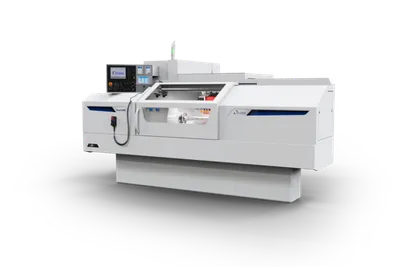
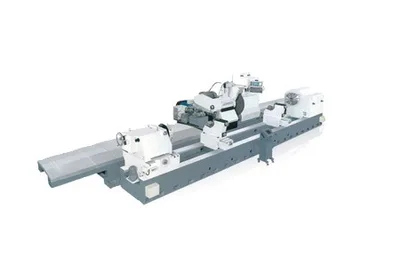
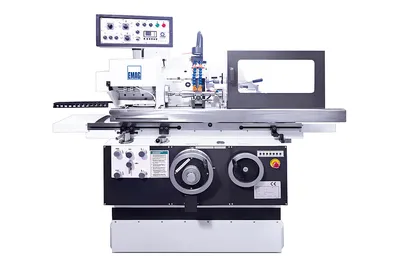
Mägerle MGC
Key Specifications
X Travel
Y Travel
Z Travel
Max Spindle
Table Size
Spindle Power
How much does the Mägerle MGC cost?
Estimated price range
Our best estimate for a cnc grinding machine in this class — not a quote from United Grinding Group. Configuration moves it a long way.
Overview
The Mägerle MGC is a large grinding center built in several sizes: X travel of 1300 mm (51.2 inch), 2100 mm (82.7 inch) or 2600 mm (102.4 inch), and a grinding spindle of 75 kW (100 hp) or 115 kW (154 hp) that runs up to 8000 rpm. Up to 5 axes work simultaneously.
The other axes come in two sizes each. Y travel is 650 mm (25.6 inch) or 900 mm (35.4 inch) and Z travel is 500 mm (19.7 inch) or 750 mm (29.5 inch). Two tables are listed, 760 x 325 mm (29.9 x 12.8 inch) and 1000 x 440 mm (39.4 x 17.3 inch). Both are short next to the X travels, since even the larger table is 1000 mm (39.4 inch) long against the shortest X of 1300 mm (51.2 inch). The table does not say which travels, table and spindle can be ordered together, so that has to be settled in the quotation.
Spindle power is the headline. At 75 kW (100 hp) the smaller drive already has half as much power again as the 50 kW (67.1 hp) of the Magerle MFP 100, and the 115 kW (154 hp) drive more than doubles it. The table gives a maximum tool diameter of 500 mm (19.7 inch) or 600 mm (23.6 inch).
The simultaneous axes are X, Y, Z, a B tilt and a C rotary table, and the rotary table is an option. Achievable form accuracy is stated as < 5 µm of profile form error. Rapid traverse is 20000 mm/min (787 inch/min) in each of X, Y and Z.
Full Specifications
| Parameter | Value |
|---|---|
| Number of CNC Axes | Up to 5 simultaneous (X, Y, Z, B tilt, C rotary table option) |
| Achievable Form Accuracy | < 5 µm (profile form error) |
| X-Axis Travel | 1300 mm (51.2 inch) / 2100 mm (82.7 inch) / 2600 mm (102.4 inch) |
| Y-Axis Travel | 650 mm (25.6 inch) / 900 mm (35.4 inch) |
| Z-Axis Travel | 500 mm (19.7 inch) / 750 mm (29.5 inch) |
| Max Spindle Speed | 8000 /min (8000 rpm) |
| Spindle Motor Power | 75 kW (100 hp) / 115 kW (154 hp) |
| Table Size | 760 x 325 mm (29.9 x 12.8 inch) / 1000 x 440 mm (39.4 x 17.3 inch) |
| Rapid Traverse X | 20000 mm/min (787 inch/min) |
| Rapid Traverse Y | 20000 mm/min (787 inch/min) |
| Rapid Traverse Z | 20000 mm/min (787 inch/min) |
| Max Tool Diameter (full magazine) | 500 mm (19.7 inch) / 600 mm (23.6 inch) |
Specifications sourced from maegerle.com — verified 2026-10-03
Strengths & Limitations
Strengths
- Spindle power of 75 kW (100 hp) or 115 kW (154 hp) at up to 8000 rpm
- X travel in three lengths: 1300 mm (51.2 inch), 2100 mm (82.7 inch) or 2600 mm (102.4 inch)
- Up to 5 simultaneous axes, with a B tilt and an optional C rotary table
- Achievable form accuracy of < 5 µm profile form error
- Rapid traverse of 20000 mm/min (787 inch/min) on X, Y and Z
- Takes tools up to 500 mm (19.7 inch) or 600 mm (23.6 inch) in diameter
Limitations
- The C rotary table is an option, so simultaneous work on all 5 axes is not part of the base machine
- Table sizes stop at 1000 x 440 mm (39.4 x 17.3 inch), far shorter than the longest X travel of 2600 mm (102.4 inch)
- Nothing in the table says which travel, table and spindle variants combine, and it gives no machine weight or footprint
- Spindle speed stops at 8000 rpm, below the 12000 rpm of the Magerle MFP 51
Best For
Frequently Asked Questions
01
X travel is 1300 mm (51.2 inch), 2100 mm (82.7 inch) or 2600 mm (102.4 inch). Y travel is 650 mm (25.6 inch) or 900 mm (35.4 inch), and Z travel is 500 mm (19.7 inch) or 750 mm (29.5 inch). The table size is 760 x 325 mm (29.9 x 12.8 inch) or 1000 x 440 mm (39.4 x 17.3 inch).
02
Two ratings are listed, 75 kW (100 hp) and 115 kW (154 hp), with a maximum spindle speed of 8000 rpm. The maximum tool diameter is 500 mm (19.7 inch) or 600 mm (23.6 inch). Ask which diameter belongs to which spindle, because the table does not pair them.
03
It can be. Mägerle lists up to 5 simultaneous axes: X, Y, Z, a B tilt and a C rotary table. The C rotary table is marked as an option, so a machine ordered without it interpolates the three linear axes and the B tilt.
04
Achievable form accuracy is stated as < 5 µm, measured as profile form error. Rapid traverse is 20000 mm/min (787 inch/min) in X, Y and Z alike, which keeps repositioning short even on the 2600 mm (102.4 inch) X version.
05
The Magerle MFP 100 has 1000 mm (39.4 inch) of X travel, 900 mm (35.4 inch) of Y, 750 mm (29.5 inch) of Z and a 50 kW (67.1 hp) spindle. The MGC starts at 1300 mm (51.2 inch) of X and 75 kW (100 hp), so it is the step up when a part or a cut outgrows the MFP 100.
Videos

UNITED GRINDING North America
UNITED GRINDING North America