JTEKT Toyoda GT27
Key Specifications
Max Workpiece ⌀
max workpiece length
max workpiece weight
wheel head angle
grinding wheel size
work spindle speed
Overview
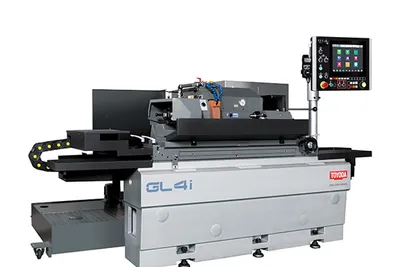
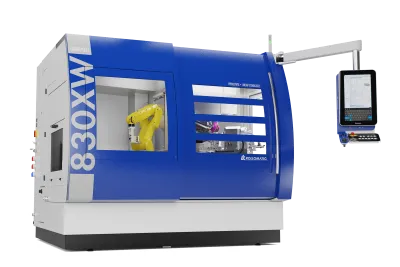
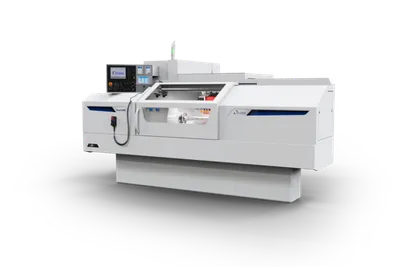
The JTEKT Toyoda GT27 is a CNC angular-wheel cylindrical grinding machine designed for high-productivity OD and shoulder grinding of shafts, pins, and cylindrical workpieces in automotive and precision manufacturing. The angular-wheel approach positions the grinding wheel at an angle to the workpiece, enabling simultaneous grinding of the cylindrical OD and an adjacent shoulder face in a single plunge — a configuration that dramatically reduces cycle times on flanged shafts, stepped pins, and similar workpieces compared to conventional cylindrical grinders requiring sequential operations.
Toyoda's grinding heritage is one of the deepest in the industry — the company produced its first grinding machine in 1941 and has supplied precision grinders to the global automotive industry for over 80 years. The GT27 embodies this lineage with hydrostatic guide technology on the work table, providing virtually frictionless, stick-slip-free motion that translates to surface finishes of Ra 0.1 µm or better and consistent roundness within 0.5 µm under production conditions. The grinding wheel spindle uses precision angular contact bearings with automatic dynamic balancing, maintaining consistent surface quality across long production runs.
The GT27's control system uses Toyoda's proprietary grinding-optimized CNC with automatic wheel dressing compensation, in-process gauging integration, and adaptive feed control that adjusts grinding parameters in real time based on workpiece diameter feedback. This intelligence reduces scrap from wheel wear and workpiece size variation — critical in automotive production where 100% part compliance is mandatory. The machine is designed for full integration with gantry loaders, robots, and in-line gauging systems.
The GT27 competes with the Studer S31, Kellenberger KEL-VITA, and Danobat GCH series in the production cylindrical grinding segment. Pricing for new GT27 machines falls between $350,000 and $600,000 depending on configuration, in-process gauging, and automation options. Specs sourced from JTEKT Toyoda published product data.
Full Specifications
| Parameter | Value |
|---|---|
| Max Workpiece Diameter | 270 mm (10.6 in) |
| Max Workpiece Length | 500 mm (19.7 in) |
| Max Workpiece Weight | 50 kg (110 lb) between centers |
| Wheel Head Angle | Angular (30° standard; configurable) |
| Grinding Wheel Size | ø510 x 100 mm (ø20.1 x 3.9 in) |
| Work Spindle Speed | 50–500 RPM (infinitely variable) |
| Guideway Type | Hydrostatic table guide |
| Table Traverse | 650 mm (25.6 in) |
| In Process Gauging | Optional (Marposs / Renishaw compatible) |
| CNC Control | JTEKT TOYOPUC-Grind |
| Surface Finish Capability | Ra 0.1 µm or better |
| Roundness Capability | 0.5 µm or better |
| Joined | Aug 15, 2011 |
| Messages | 6,918 |
| Likes | 7,861 |
Specifications compiled from manufacturer literature and industry references. Not independently verified against a published spec sheet — confirm with the manufacturer or an authorised dealer before making a purchasing decision.
Strengths & Limitations
Strengths
- Angular wheel geometry enables simultaneous OD and shoulder grinding in a single plunge, cutting cycle times significantly versus sequential conventional grinding
- Hydrostatic table guide delivers frictionless, stick-slip-free motion for consistent surface finish and roundness at production volumes
- Automatic in-process gauging with adaptive feed control eliminates size variation from wheel wear, maintaining 100% part compliance without operator intervention
- Toyoda's 80-year precision grinding heritage provides proven reliability in demanding 24/7 automotive production environments
Limitations
- Angular wheel configuration is optimized for shaft and pin workpieces with OD + shoulder features; it is less versatile than a universal cylindrical grinder for complex geometry
- High machine cost relative to conventional cylindrical grinders makes the GT27 most economical only at sufficient production volume to justify the investment
- Hydrostatic guides require clean, high-quality hydraulic fluid and regular maintenance to maintain their performance advantage
Best For
Frequently Asked Questions
01
An angular-wheel grinder positions the grinding wheel at an angle (typically 30°) to the workpiece axis rather than perpendicular. This allows the wheel to contact both the cylindrical OD and an adjacent shoulder face simultaneously during a plunge-grinding pass. The result is that features requiring two separate operations on a conventional grinder are ground simultaneously, cutting cycle time often in half for flanged and stepped workpieces.
02
In-process gauging uses a Marposs or Renishaw probe to measure the workpiece diameter in real time while grinding. The measurement feeds back to the CNC, which adjusts the feed rate and final sizing stop position to compensate for wheel wear and workpiece size variation. This eliminates the need for frequent manual size checks and prevents oversize or undersize parts from being produced as the wheel wears.
03
The GT27's CNC axes support taper grinding through table swivel or coordinated X/Z interpolation depending on configuration. Contour grinding of complex profiles is possible with full CNC interpolation, though the machine is primarily optimized for high-volume cylindrical plunge grinding rather than complex profile work. For complex contour grinding, Toyoda's GU series or dedicated profile grinders are more appropriate.
04
The GT27 is designed for integration with gantry loaders, 6-axis robots, conveyor systems, and in-line wash and gauging stations. Loading and unloading interfaces follow standard protocols, and Toyoda's applications engineers provide cell integration support. Most automotive production installations run the GT27 fully automated with cycle times under 30 seconds per part.
05
The GT27 is an angular-wheel machine optimized for simultaneous OD and shoulder grinding, while the GP27E is a conventional external cylindrical grinder suited for pure OD grinding and more flexible workpiece geometry. The GT27 is the choice when shoulder and OD features must be ground simultaneously for cycle time; the GP27E is the choice when workpiece geometry varies significantly or shoulder grinding is not required.
Videos

MachineTools.com

MachineryValues Inc
Community Discussions
Community discussion — Fake Mitutoyos? Please help! : r/Machinists - Reddit
Community discussion — I took your advice and bought a Mitutoyo : r/Machinists - Reddit
Pricing and buying discussion — Die grinder recommendations : r/Machinists - Reddit
Owner experience and review — Water jet recommendations? : r/Machinists - Reddit
Links to community discussions. Summaries are editorial — visit the original thread for full context.