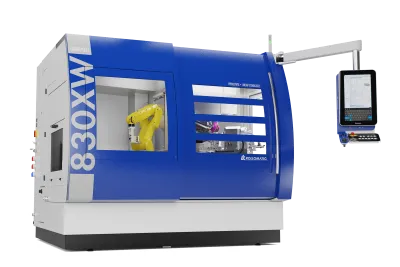
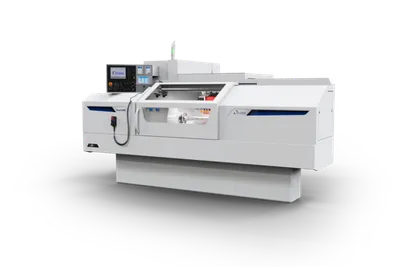
Thielenhaus Strecon E-Plus
Key Specifications
bore diameter range
max bore depth
surface finish achievable
material removal
oscillation frequency
oscillation amplitude
Overview
The Thielenhaus Strecon E-Plus is a precision bore superfinishing system engineered for internal cylindrical surfaces — bearing ring bores, hydraulic valve body bores, fuel injection component bores, and precision guide bores that require surface finishes beyond what internal grinding or honing can achieve. The Strecon system represents a different Thielenhaus product line than the external-surface ZE and KF series — targeting bore superfinishing applications where Ra < 0.05 µm and extreme bore roundness are simultaneously required.
The bore superfinishing process uses an oscillating abrasive tool (stone or film-wrapped mandrel) that rotates and oscillates axially inside the bore, similar to honing but at much lower material removal rates and with higher surface finish targets. The distinguishing feature of the Strecon E-Plus system is the elastic tooling design: the abrasive element is mounted on a compliant elastic holder that conforms to bore geometry deviations rather than imposing the stone form on the bore. This self-conforming behavior allows the Strecon system to superfinish bores that are slightly non-round or tapered without correcting the bore geometry — preserving the geometry control achieved by honing while adding the surface texture improvement of superfinishing.
The E-Plus designation indicates the enhanced version of the Strecon system with full CNC axis control of all process parameters — oscillation amplitude, frequency, tool rotation speed, and axial feed rate — enabling recipe-based process management for production environments. Applications include fuel injector nozzle guide bores (Ra < 0.02 µm), bearing ring inner bore superfinishing after honing, and precision hydraulic spool valve bores requiring Ra 0.025 µm or better for tight spool clearances.
The Strecon E-Plus is priced at $200,000–$450,000 depending on bore size range and automation level, and is used by fuel injection system manufacturers, precision bearing manufacturers, and hydraulic component producers requiring surface finishes finer than honing can reliably produce.
Full Specifications
| Parameter | Value |
|---|---|
| Bore Diameter Range | 5 - 150 mm (0.2 - 5.9 in) |
| Max Bore Depth | 200 mm (7.9 in) |
| Surface Finish Achievable | Ra 0.005 - 0.05 µm (5 - 50 nm) |
| Material Removal | 0.5 - 5 µm (superfinishing-only, not geometry correction) |
| Oscillation Frequency | 15 - 80 Hz |
| Oscillation Amplitude | 0.2 - 3 mm |
| Tool Rotation Speed | 0 - 200 RPM |
| Abrasive Type | Elastic-mounted superfinishing stones or film-wrapped mandrel |
| CNC Control | Thielenhaus CNC (Strecon E-Plus controller) |
| Bore Roundness Achievable | < 0.0005 mm maintained (does not correct existing geometry errors) |
| Machine Weight | ~2,800 kg (6,173 lb) |
| Coolant | Superfinishing oil, sub-micron filtration for fine bore applications |
| Manufacturer | Thielenhaus |
Specifications sourced from machinio.com — verified 2026-03-28
Strengths & Limitations
Strengths
- Achieves Ra 0.005–0.05 µm on internal cylindrical bores — surface finishes finer than production honing (Ra 0.05–0.2 µm) and beyond the capability of internal grinding alone
- Elastic tooling design conforms to the bore without imposing stone geometry — preserving bore roundness achieved by honing while adding superfinished surface texture
- CNC recipe management stores bore-specific process parameters for rapid changeover between different bore sizes and material grades
- Bore superfinishing to Ra < 0.025 µm enables tighter spool valve clearances (0.003–0.008 mm vs. 0.010–0.020 mm for honed bores) for improved hydraulic system efficiency
- Full CNC axis control (oscillation, rotation, feed) enables process monitoring and SPC data export for quality system integration
Limitations
- Strecon E-Plus is a superfinishing system — it does not correct bore geometry errors (roundness, cylindricity, taper) introduced by boring or grinding, requiring the bore to be correctly honed before superfinishing
- Bore diameter range (5–150 mm) limits applicability to small and medium bores — large bore applications (> 150 mm) require the larger Strecon platform
- Sub-micron bore finishing requires rigorous coolant filtration (< 1 µm particle rating) and contamination control to prevent abrasive scratching at final Ra levels
Best For
Frequently Asked Questions
01
Honing uses radially expanding abrasive stones that exert outward pressure against the bore wall during simultaneous rotation and axial stroking. Honing removes 0.01–0.5 mm of material and actively corrects bore geometry — roundness, cylindricity, and taper — while producing the characteristic crosshatch surface finish (Ra 0.05–0.8 µm). Bore superfinishing (as in the Strecon E-Plus) uses a low-pressure abrasive tool that removes only 0.5–5 µm of surface material without correcting bore geometry. The surface finish improvement is the objective — taking a honed bore from Ra 0.05–0.1 µm to Ra 0.005–0.025 µm while maintaining the bore geometry achieved by honing.
02
Common-rail fuel injector guide bores (the bore guiding the needle valve) require Ra 0.010–0.020 µm for consistent needle lift behavior and minimum fuel leakage past the guide. Servo valve spool bores (10–25 mm diameter) in high-performance hydraulic controls require Ra 0.010–0.025 µm with spool-to-bore clearances of 0.003–0.005 mm — clearances that require extremely smooth bores to avoid hydraulic lock. Precision linear bearing bores in metrology equipment and semiconductor wafer handling require Ra < 0.020 µm for consistent bearing drag force and positioning accuracy. All of these are within the Strecon E-Plus operating range.
03
Standard honing stones are rigid — when expanded against the bore, they impose their geometry on the bore, correcting roundness errors. The Thielenhaus Strecon elastic tooling mounts the abrasive element on a compliant elastomeric or spring-element holder that deforms to follow the existing bore surface rather than imposing the tool shape. This means the Strecon tool contacts the entire bore surface — including high spots (out-of-round regions) and low spots equally — without applying the corrective stone pressure that honing uses to cut the high spots preferentially. The result is uniform material removal across the bore surface, preserving the bore roundness achieved by honing while polishing the entire surface to a finer finish.
04
At Ra 0.01–0.02 µm target surface finish, any particle in the coolant larger than the target Ra value can scratch the bore surface and leave a mark deeper than the target finish — negating the superfinishing process. For Ra 0.02 µm work, coolant filtration must remove particles larger than 1–2 µm, requiring absolute-rated cartridge filters (not nominal-rated) at 1 µm absolute rating. The Thielenhaus Strecon E-Plus includes an integrated coolant filtration system designed for sub-micron bore superfinishing. Coolant must also be free of tramp oil and microbial contamination — superfinishing oil (petroleum-based) is preferred over water-soluble coolant to avoid bacterial growth in the fine filtration system.
05
Yes. The Strecon E-Plus is designed for integration into automated production cells in fuel injection and hydraulic component manufacturing. The machine includes a manual load/unload version (E-Plus Standard) and an automated version with robot interface (PROFIBUS, PROFINET, or Ethernet/IP) for automatic workpiece load/unload. In a typical automated cell, a 6-axis robot loads the honed component into the Strecon E-Plus fixture, the machine runs the superfinishing cycle (typically 15–60 seconds per bore), the robot unloads the finished component, and the cell transfers to final cleanliness wash and inspection. Thielenhaus provides complete cell integration engineering for high-volume automotive and hydraulic component production.
Community Discussions
Community discussion — Post Processor Files - CNCzone
Community discussion — HEIDENHAIN -> MillPlus - CNCzone
Community discussion — Mazatrol T-Plus - CNCzone
Troubleshooting and problem-solving — Need Help! Z axis torque alarm - CNCzone
Pricing and buying discussion — Best hex keys/ Allen wrenches : r/Machinists - Reddit
Community discussion — Allen Wrenches : r/Machinists - Reddit
Community discussion — Tried to explain what a thou was to someone - Reddit
Community discussion — r/machining on Reddit: Advice needed on a quality ER32 and ...
Links to community discussions. Summaries are editorial — visit the original thread for full context.