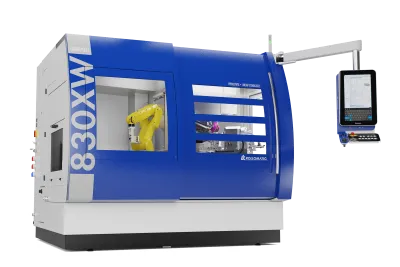
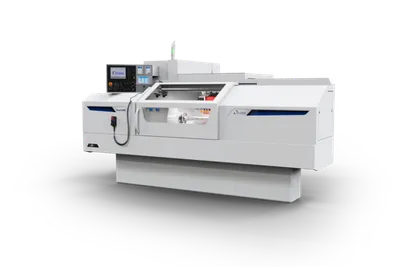
Thielenhaus Powerfinish KF 300
Key Specifications
Max Workpiece ⌀
max workpiece length
superfinishing modes
cam following resolution
abrasive type
oscillation frequency
Overview
The Thielenhaus Powerfinish KF 300 is a CNC superfinishing machine engineered specifically for cam lobe and shaft journal superfinishing — two of the most demanding superfinishing applications in automotive powertrain manufacturing. The KF (Kontour-Finish) designation indicates the machine's primary capability: following and finishing non-circular contoured surfaces such as cam lobe profiles, eccentric journals, and polygon shafts, in addition to standard round journal superfinishing.
Cam lobe superfinishing requires the superfinishing stone to maintain consistent contact pressure against the cam flank as the lobe profile transitions from base circle to ramp to nose and back — a surface that varies continuously in radius and curvature over 360 degrees of rotation. The Thielenhaus KF 300 achieves this through CNC synchronization of the stone pressure axis with the rotary encoder position of the camshaft — the machine's control continuously reads the camshaft angular position and adjusts stone pressure to maintain the target contact force regardless of local profile radius. This produces uniform surface finish across the full cam lobe profile, including the critical nose region where contact stress is highest.
For round journal superfinishing, the KF 300 operates in standard plunge or traverse mode with the cam-following axis locked — delivering the same Ra 0.01–0.08 µm journal surface quality as the standard ZE series. The machine accommodates workpieces up to 300 mm in diameter and 800 mm in length, covering both automotive camshafts (typically 25–40 mm bearing journals, 35–50 mm base circle cam lobes) and transmission selector shafts, balance shafts, and auxiliary shaft applications.
The Powerfinish KF 300 is priced at $350,000–$650,000 depending on the number of superfinishing heads and automation configuration, and is deployed at automotive camshaft OEM manufacturers and Tier 1 camshaft suppliers worldwide — wherever camshaft lobe and journal superfinishing is required in a single machine platform.
Full Specifications
| Parameter | Value |
|---|---|
| Max Workpiece Diameter | 300 mm (11.8 in) |
| Max Workpiece Length | 800 mm (31.5 in) |
| Superfinishing Modes | Plunge, traverse, and CNC cam-following (contour) superfinishing |
| Cam Following Resolution | 0.1 degree angular resolution on cam axis |
| Abrasive Type | Superfinishing stones or abrasive film (film preferred for cam lobes) |
| Oscillation Frequency | 10 - 60 Hz |
| Oscillation Amplitude | 0.5 - 5 mm |
| Stone Pressure Control | Servo-controlled per head, 0.5 - 30 N programmable |
| Surface Finish Achievable | Ra 0.01 - 0.08 µm on cam flanks and journals |
| CNC Control | Thielenhaus CNC with cam-profile database management |
| Machine Weight | ~4,500 kg (9,921 lb) |
| Coolant | Superfinishing oil with fine filtration |
| Manufacturer | Thielenhaus |
Specifications sourced from machinio.com — verified 2026-03-28
Strengths & Limitations
Strengths
- CNC cam-following axis maintains consistent stone pressure across the full cam lobe profile — including ramps and nose — producing uniform Ra 0.01–0.08 µm finish on non-round surfaces
- Single machine platform superfinishes both cam lobes and round bearing journals without fixture changes, simplifying automotive camshaft production cell design
- Servo-controlled stone pressure (programmable per head to 0.1 N resolution) enables fine-tuning of material removal rate across different cam lobe regions for profile accuracy maintenance
- Cam profile database management in the CNC stores digital cam lobe profiles and associated process parameters for rapid changeover between engine families
- Thielenhaus's dedicated cam superfinishing application knowledge — developed over decades in automotive powertrain — provides process qualification support unavailable from generic superfinishing machine builders
Limitations
- Cam-following superfinishing is inherently slower than round journal superfinishing due to the stone pressure modulation required across the cam profile — cycle times are longer than for equivalent-diameter journal finishing
- Abrasive film is preferred over stones for cam lobe superfinishing due to the constantly changing contact geometry, adding film consumption cost versus stone-based journal finishing
- Machine complexity (cam-following servo axis, pressure servo per head) requires more sophisticated maintenance capability than standard plunge superfinishing machines
Best For
Frequently Asked Questions
01
A cam lobe is not a round cylinder — it has a base circle (the minimum radius section), ramps (transition zones where the profile accelerates the follower), and a nose (the maximum lift point). As the cam rotates, the local radius presented to the superfinishing stone changes continuously. On a standard plunge superfinishing machine, the stone pressure is constant — which means the stone digs into low-radius regions (high curvature like the nose) and loses contact on high-radius regions (flat base circle). A cam-following machine like the Thielenhaus KF 300 synchronizes stone pressure with the cam angle, increasing pressure where the profile is convex-curved (nose) and reducing it where it is near-flat (base circle) to maintain constant contact stress and consistent material removal across the full profile.
02
Automotive cam lobes operating against flat-faced or roller followers typically require Ra 0.05–0.15 µm on the cam flank surface, with negative skewness (Rsk < 0) to maximize oil film retention and minimize follower wear. This is significantly smoother than the Ra 0.2–0.4 µm achievable by camshaft grinding alone. The cam nose region — which experiences the highest Hertzian contact stress — is the most critical: a rough nose generates maximum wear and can cause premature follower spalling in high-lift performance engines. Thielenhaus KF 300 achieves Ra 0.05–0.08 µm consistently across the full lobe profile including the nose.
03
Yes. The KF 300's cam profile database management system stores the digital cam profile (as an angular-position-versus-radius table) for each engine family cam lobe type in the CNC. When switching to a different engine family, the operator calls up the appropriate cam profile recipe, which loads the stone pressure modulation curve for that lobe. Physical fixture changes (workpiece holders, tailstocks) may be needed for different shaft diameters and lengths, but the process program changeover itself is a CNC recipe load — typically taking a few minutes. This enables a single KF 300 to service multiple camshaft variants in a flexible manufacturing cell.
04
Abrasive film is generally preferred for cam lobe superfinishing. Film conforms better to the changing cam profile geometry than a rigid stone — the flexible film backing wraps around the cam profile, maintaining consistent contact area across the lobe. Film also provides more consistent results because it indexes to present fresh abrasive continuously (no stone wear variation). The downside is higher consumable cost: film is consumed and discarded, while stones are re-used until worn out. For round journal superfinishing (on the same KF 300 machine), stones are preferred — they self-true against the round journal surface and provide longer consumable life.
05
Cam lobe superfinishing reduces valve train friction and wear in two ways: by reducing the sliding friction coefficient at the cam-follower interface (smooth superfinished surface vs. ground surface) and by improving oil film separation between the cam lobe and follower. Valve train friction accounts for approximately 5–10% of total engine mechanical friction. Superfinishing the cam lobes can reduce valve train friction by 10–25% relative to ground-only surfaces, contributing 0.5–2% to overall fuel economy improvement — significant in the context of modern engine fuel economy regulations (CAFE, EU CO2 targets). Wear life improvements are even larger: superfinished cam lobes can outlast ground-only lobes by 2–5× in high-load applications.
Community Discussions
Pricing and buying discussion — Most economical 300 series stainless to machine ...
Community discussion — Parameters for smooth finish, 3d surfacing ...
Community discussion — Best General Purpose End Mill | Practical ...
Community discussion — Help with 3d toolpath surface finish and ...
Community discussion — need help trumpf laser - CNCzone
Pricing and buying discussion — Trumpf laser problems. Help please - cnczone.com
Community discussion — Need Help! Mystery Spindle Noise (watch video) - CNCzone
Troubleshooting and problem-solving — Need Help! Trumpf Laser Cutting Troubleshooting.... - CNCzone
Links to community discussions. Summaries are editorial — visit the original thread for full context.