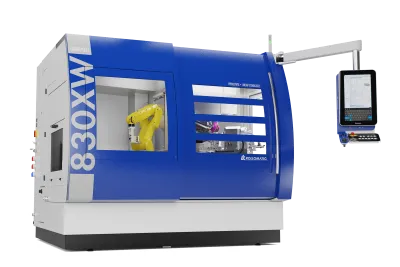
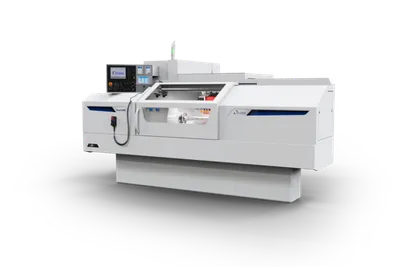
Thielenhaus Microfinish ZE 300
Key Specifications
Max Workpiece ⌀
max workpiece length
superfinishing mode
abrasive type
oscillation frequency
oscillation amplitude
Overview
The Thielenhaus Microfinish ZE 300 is a CNC superfinishing (microfinishing) machine from Thielenhaus Technologies GmbH, a Wuppertal, Germany company that is the world's leading manufacturer of superfinishing equipment. Superfinishing (also called microfinishing or short-stroke honing) is a precision abrasive finishing process that removes the microscopic peaks from precision ground surfaces — bearing races, crankshaft journals, camshaft lobes, gear teeth — producing ultra-smooth surfaces (Ra 0.01-0.1 µm) with improved bearing capacity, reduced friction, and enhanced fatigue life compared to ground-only surfaces.
The ZE 300 handles shafts and cylindrical components up to 300 mm in diameter with a variety of superfinishing modes: plunge superfinishing (for journals and races), traverse superfinishing (for longer cylindrical surfaces), and form superfinishing (for complex profile surfaces like camshaft lobes). The machine uses short-stroke oscillating abrasive film or stone against the rotating workpiece, removing the residual grinding scratches and producing the final micro-geometry required for precision bearing and automotive powertrain components.
Thielenhaus Microfinish machines are installed throughout the automotive powertrain component supply chain — crankshaft journal superfinishing at every major crankshaft manufacturer, camshaft lobe superfinishing at camshaft production facilities, and bearing race superfinishing at precision bearing manufacturers. The superfinishing process after grinding produces surfaces with skewed roughness profile distributions (Ra similar to ground surfaces, but Rsk negative — more bearing area) that enable tighter fits, better sealing, and longer service life compared to ground surfaces alone.
At $300,000-$600,000 depending on configuration and automation, the ZE 300 is the production standard for automotive journal and bearing race superfinishing. Thielenhaus's application knowledge and abrasive tooling supply chain provide the ongoing process support that superfinishing machine operation requires.
Full Specifications
| Parameter | Value |
|---|---|
| Max Workpiece Diameter | 300 mm (11.8 in) |
| Max Workpiece Length | 800 mm (31.5 in) |
| Superfinishing Mode | Plunge, traverse, and form superfinishing |
| Abrasive Type | Superfinishing stones or abrasive film |
| Oscillation Frequency | 10 - 60 Hz |
| Oscillation Amplitude | 0.5 - 5 mm |
| Surface Finish Achievable | Ra 0.01 - 0.1 µm |
| Bearing Ratio Improvement | Rk reduction 50-70% vs ground surface |
| CNC Control | Thielenhaus CNC with recipe management |
| Machine Weight | ~3,500 kg (7,716 lb) |
Specifications sourced from machinio.com — verified 2026-03-28
Strengths & Limitations
Strengths
- Superfinishing achieves Ra 0.01-0.1 µm on bearing journals — 5-10x smoother than precision ground surfaces
- Negative skewness (Rsk) surface texture produced by superfinishing maximizes bearing load capacity and reduces friction
- Handles crankshaft journals, camshaft lobes, bearing races, and gear tooth flanks in a versatile configuration
- Thielenhaus is the global reference for superfinishing — largest installed base in automotive powertrain supply chain
- CNC recipe management enables rapid changeover between different component families without manual process re-setup
Limitations
- Superfinishing is a finishing operation requiring a ground surface of acceptable geometry to start — it cannot correct grinding errors
- Abrasive stones and film are workpiece-specific consumables requiring careful selection and Thielenhaus application engineering support
- Process parameters (contact pressure, oscillation frequency, stone grade) require careful optimization for each component material and geometry
- Thielenhaus North American service coverage is less dense than European automotive belt — important for US facilities
Best For
Frequently Asked Questions
01
Superfinishing (microfinishing) uses a short-stroke oscillating abrasive stone or film against a rotating workpiece to remove the microscopic peaks from a precision ground surface. The stone oscillation is typically 10-60 Hz with 0.5-5mm amplitude. Grinding removes large amounts of material (0.01-5mm) with a high-speed abrasive wheel to produce dimension and geometry. Honing removes smaller amounts (0.01-0.1mm) in a bore with rotating stones to produce final bore size and crosshatch finish. Superfinishing removes only the surface peaks (0.001-0.010mm material removal) from already-precise surfaces to produce the smoothest possible surface for bearing, sealing, or sliding contact.
02
Precision ground crankshaft journals have surface finishes of Ra 0.2-0.4 µm, which meets dimensional specifications but leaves microscopic grinding peaks that initially carry the full bearing load. During engine break-in, these peaks wear against the bearing shells, generating fine metal particles that contaminate engine oil and cause accelerated bearing wear. Superfinishing to Ra 0.05-0.1 µm removes the peaks before engine assembly, so the journal surface is already at its final bearing-contact profile. This eliminates the break-in wear period, reduces oil contamination, and extends bearing life significantly.
03
Superfinishing uses either superfinishing stones (bonded abrasive sticks, similar to honing stones but with softer bond for self-sharpening) or abrasive film (coated abrasive on a flexible film backing, similar to lapping film). Stones are used for journal and raceway superfinishing where the abrasive can maintain consistent pressure against the curved surface. Abrasive film is used for flat surfaces, complex profiles (camshaft lobes), and applications requiring the finest possible finish (Ra < 0.02 µm). Thielenhaus supplies both stone and film systems for the ZE 300.
Community Discussions
Community discussion — Is Microfinish just a smooth surface.....or ...
Community discussion — How do I get a 16 Microfinish in a 440 ...
Community discussion — Understanding and Machining 300 series Stainless ...
Community discussion — American Machine Tool Builders -- Add To ...
Owner experience and review — Opinions on this brand of mills? : r/Machinists - Reddit
Community discussion — what mini mills do you guys recommend? : r/Machinists - Reddit
Community discussion — Good end mills for a beginner? : r/Machinists - Reddit
Community discussion — Accusize : r/Machinists - Reddit
Links to community discussions. Summaries are editorial — visit the original thread for full context.