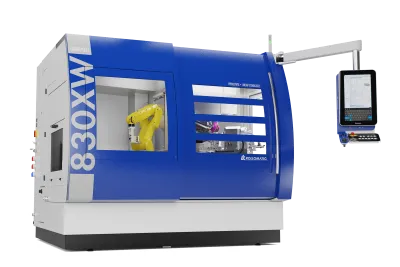
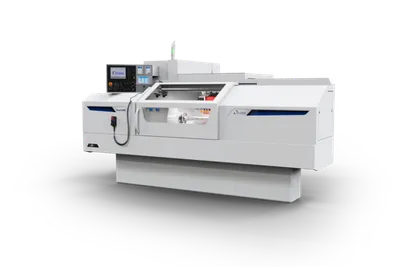
Sunnen AHL-1000
Key Specifications
bore diameter range
max workpiece length
spindle orientation
spindle speed range
stroke rate
surface finish achievable
Overview
The Sunnen AHL-1000 is an automated horizontal honing cell designed for high-volume production bore finishing — combining Sunnen's proven horizontal honing technology with integrated automation (robotic load/unload, automatic stone wear compensation, and statistical process control data output) for lights-out or near-lights-out production honing in automotive, hydraulic, and aerospace component manufacturing.
Horizontal honing is preferred for short, large-diameter bores (length-to-diameter ratio < 2:1) and for high-volume production applications where fixturing multiple bores in a horizontal pallet arrangement enables simultaneous multi-bore honing. The AHL-1000 accommodates bore diameters from 10 mm to 200 mm in workpieces up to 800 mm long, with the horizontal spindle arrangement allowing easy integration with horizontal pallet fixture systems for connecting rod, hydraulic valve body, and transmission case multi-bore honing.
The AHL-1000's automation package includes a 6-axis robot interface (KUKA, FANUC, or ABB), automatic stone wear compensation (the CNC tracks cumulative stone wear and adjusts stone expansion target to maintain constant bore size output without operator intervention), and full SPC data export (bore size, roundness, surface finish Ra from in-process gauging) to the factory MES or SPC software. The machine is designed to run for 4–8 hours between operator attention — loading the raw part magazine, unloading the finished part accumulator, and replenishing coolant and stone consumables.
At $400,000–$700,000 including automation cell integration, the AHL-1000 competes with the Nagel CNC honing systems and the Gehring horizontal honing machines for high-volume automotive bore production. Sunnen's tooling depth and application engineering — developed over a century of honing technology — provide the process reliability that automated production cells demand.
Full Specifications
| Parameter | Value |
|---|---|
| Bore Diameter Range | 10 - 200 mm (0.4 - 7.9 in) |
| Max Workpiece Length | 800 mm (31.5 in) |
| Spindle Orientation | Horizontal |
| Spindle Speed Range | 50 - 800 RPM |
| Stroke Rate | Up to 80 strokes/min |
| Surface Finish Achievable | Ra 0.05 - 1.6 µm |
| Bore Roundness | < 0.001 mm |
| Automation | 6-axis robot interface (KUKA/FANUC/ABB compatible) |
| Stone Wear Compensation | Automatic (CNC tracks cumulative stone wear) |
| Spc Output | Bore size, roundness, Ra — MES/SPC compatible |
| CNC Control | Sunnen SG5 CNC with automation PLC |
| Machine Weight | ~4,800 kg (10,582 lb) |
Specifications compiled from manufacturer literature and industry references. Not independently verified against a published spec sheet — confirm with the manufacturer or an authorised dealer before making a purchasing decision.
Strengths & Limitations
Strengths
- Fully automated robot load/unload with SPC data output enables 4–8 hours of unattended production honing — reducing direct labor content per bore to near zero
- Automatic stone wear compensation continuously adjusts stone expansion target to account for cumulative stone wear, maintaining consistent bore size output without operator gauge checks
- Horizontal spindle orientation with pallet fixture capability enables simultaneous multi-bore honing of connecting rods, valve body castings, and other multi-bore components in one cycle
- Sunnen's century of honing application knowledge provides the stone specification, process parameter, and troubleshooting depth that automated production cells require to achieve cycle time and quality targets
- SPC data output (bore size, roundness, Ra) on every part enables real-time process monitoring, automatic out-of-tolerance alerts, and full production quality traceability
Limitations
- Automation cell integration requires significant upfront engineering — robot programming, fixture design, parts presentation, and MES interface — adding $50,000–$150,000 to base machine cost and 3–6 months to installation schedule
- Horizontal configuration is less suited for deep bores (L/D > 3:1) than vertical honing — long bores require careful stone guide support to avoid bore taper from spindle deflection
- High-volume automated honing generates large coolant volumes — coolant system maintenance (filtration, tramp oil removal, microbial control) requires disciplined daily/weekly attention to avoid quality issues
Best For
Frequently Asked Questions
01
In manual honing, the operator periodically measures the bore size and adjusts the stone expansion setting to compensate for stone wear (the abrasive surface of honing stones gradually wears down, reducing the effective cutting diameter). In automated production, stopping the machine for operator measurement defeats the purpose of automation. The AHL-1000's stone wear compensation system tracks the cumulative stone wear indirectly — by measuring the final bore size on each part via the in-process gauging system and calculating the stone wear rate from the trend. The CNC automatically adjusts the stone expansion setting upward as stones wear, maintaining consistent bore size output without operator intervention. When stones are worn beyond the compensation range, the CNC alerts the operator for a stone change.
02
Connecting rod multi-bore honing uses a horizontal fixture pallet that holds multiple connecting rods simultaneously — typically 4–8 rods in a row. The honing spindle traverses horizontally along the pallet, dwelling at each bore position to complete the honing stroke sequence. Alternatively, the pallet can be indexed to present each bore to a fixed honing spindle. For connecting rods, big-end and small-end bores require different stone mandrel sizes — the AHL-1000 can accommodate this with a quick-change mandrel system or by running big-end and small-end honing as sequential automated operations within the same cell. Cycle times for automotive connecting rod honing are typically 15–30 seconds per bore with automated load/unload.
03
The Sunnen AHL-1000 provides standard discrete I/O and fieldbus (PROFIBUS, PROFINET, DeviceNet, or EtherNet/IP) communication interfaces for robot integration. This is compatible with all major 6-axis industrial robot brands including KUKA, FANUC, ABB, Yaskawa (Motoman), and Stäubli. Sunnen does not supply a specific robot as part of the standard machine — the customer selects and installs the robot based on their facility's existing robot standards, reach requirements, and payload needs. Sunnen provides the robot interface specification document and works with the system integrator or customer's automation engineering team to develop the robot program and cell layout.
04
The AHL-1000's SPC output system exports bore diameter (from in-process PBG gauging), bore roundness (from multi-point gauge measurements at multiple bore depths), and optionally surface finish Ra (from an integrated post-process surface profilometer if installed). Data is exported per-part with date/time stamp and part serial number (if scanned) to a factory MES, SCADA, or standalone SPC software (such as InfinityQS or Minitab) via OPC-UA, Ethernet, or USB. Control charts (Xbar-R, I-MR) for bore diameter show process stability in real time. Out-of-tolerance conditions automatically halt the cell and alert the operator — preventing a systemic bore size shift from producing a batch of scrap parts before detection.
05
Gehring (Germany) and Nagel (Germany) are the principal European competitors in automated production honing. Gehring specializes in engine cylinder bore honing with their ConturHoning technology and strong OEM automotive relationships in Europe. Nagel offers a broad range of CNC honing machines with strong automotive Tier 1 penetration. Sunnen's AHL-1000 competes primarily on tooling system integration depth (Sunnen supplies both machine and tooling from one source), North American service network, and total cost of ownership. European manufacturers often specify Gehring or Nagel for European plants and Sunnen for North American plants. Asian automotive manufacturers choose based on local service capability — Sunnen has offices in Japan and Korea.
Videos

Adv. Faiz Syed
Community Discussions
Community discussion — Clean & Refurb of Small Sunnen Hone - Practical Machinist
Community discussion — Sunnenhone help please | Practical ...
Troubleshooting and problem-solving — Sunnen bore gauge setting fixture. Accuracy of it and problems?
Community discussion — Sunnen cf 1000 setting fixture - Practical Machinist
Links to community discussions. Summaries are editorial — visit the original thread for full context.