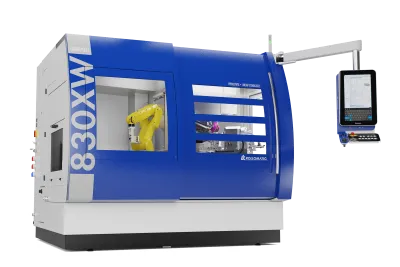
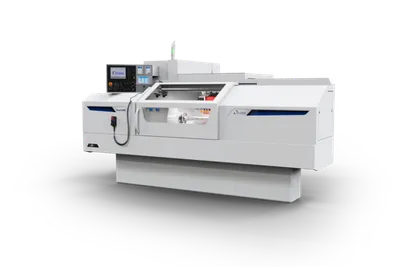
Schneeberger COMPACT T
Key Specifications
grinding axes
max tool diameter
max tool length
max grinding wheel diameter
grinding spindle speed
spindle type
Overview
The Schneeberger COMPACT T is a CNC tool grinding machine designed for shops that need the accuracy of a full Schneeberger tool grinder in a more compact footprint and at a lower entry price. The COMPACT T handles the core tool grinding applications — end mills, drills, reamers, and general HSS and carbide cutting tools — without the full 5-axis simultaneous capability of the TITAN or the insert-specific focus of the NORMA.
The COMPACT T is a 4- or 5-axis CNC tool grinder depending on configuration, supporting simultaneous linear axes with indexed rotary positioning for the standard cutting tool geometries that make up the majority of toolroom and tool reconditioning work. The machine grinds primary and secondary reliefs, rake faces, gash profiles, web thinning, and pointing on standard end mills, drills, reamers, and step tools. For tool reconditioning operations — resharpening worn cutting tools to restore geometry and edge quality — the COMPACT T is an efficient and accurate platform.
The machine's structural design prioritizes rigidity within the compact envelope. The base is cast iron with precision-ground surfaces, and the grinding spindle is a belt-driven or direct-drive type with a speed range appropriate for both CBN and conventional wheel operation. Wheel diameter up to 200 mm provides adequate grinding arc length for most tool diameters. The wheelhead swivel accommodates relief angle variations and approach angles for different tool geometries without major machine reconfiguration.
Control is a Schneeberger CNC with tool grinding software that includes libraries for standard cutting tool types. An operator selects the tool type, enters the geometry parameters (diameter, helix angle, number of flutes, relief angles), and the software generates the grinding program. This conversational approach significantly reduces programming time compared to manual CNC programming for tool grinding.
Pricing for the COMPACT T falls in the $200,000-$350,000 range — entry-level for the Schneeberger line and accessible for toolrooms, reconditioning shops, and precision job shops that want Swiss-quality tool grinding at a mid-tier investment level.
Full Specifications
| Parameter | Value |
|---|---|
| Grinding Axes | 4 or 5-axis (X, Y, Z linear + A rotary; C optional) |
| Max Tool Diameter | Up to 200 mm (7.9 in) |
| Max Tool Length | Up to 400 mm (15.7 in) with standard setup |
| Max Grinding Wheel Diameter | 200 mm (7.9 in) |
| Grinding Spindle Speed | Up to 8,000 RPM |
| Spindle Type | Belt-driven or direct-drive (configuration-dependent) |
| Machine Base | Cast iron with precision-ground surfaces |
| CNC Control | Schneeberger CNC with tool grinding software |
| Software Libraries | End mills, drills, reamers, step tools, form tools |
| Coolant | Flood coolant with filtration |
| Collet System | Precision collet chuck, ER and custom options |
Specifications compiled from manufacturer literature and industry references. Not independently verified against a published spec sheet — confirm with the manufacturer or an authorised dealer before making a purchasing decision.
Strengths & Limitations
Strengths
- Compact footprint allows installation in toolroom environments where floor space is limited — smaller footprint than full 5-axis production grinders
- Conversational tool grinding software with standard geometry libraries dramatically reduces programming time for common cutting tool types
- Schneeberger's Swiss precision heritage in a mid-range price bracket — surface finish and geometry accuracy consistent with the premium brand's standards
- Handles the full range of reconditioning applications — resharpening end mills, drills, reamers — making it the core machine for tool reconditioning service centers
- Accessible entry price of $200,000-$350,000 versus $400,000+ for the TITAN or NORMA allows smaller shops to access Schneeberger quality
- 4- or 5-axis configuration flexibility lets shops choose the appropriate capability level for their specific tool range
Limitations
- Less capable than the TITAN for complex 5-axis simultaneous tool geometries — shops grinding complex custom profiles or form tools will need a more capable machine
- Smaller wheel diameter (200 mm) limits the machine on very large diameter tools — for tools above 150 mm diameter, wheel arc length becomes a limitation
- Tool length capacity up to 400 mm restricts very long tools — shops handling long reamers or boring bars may need a longer-capacity machine
- Belt-driven spindle (on some configurations) introduces more vibration potential than a direct-drive motorized spindle — relevant for the finest surface finish requirements
Best For
Frequently Asked Questions
01
The COMPACT T is designed for standard cutting tool grinding and reconditioning — end mills, drills, reamers, and similar tools with standard geometries. The TITAN is a full 5-axis simultaneous machine designed for complex, high-precision tool geometries including complex form tools, multi-step profiles, and demanding applications where all five axes must move simultaneously with high accuracy. The COMPACT T handles the mainstream of tool grinding work at a lower price; the TITAN is the choice when tool complexity or precision requirements exceed the COMPACT T's capability.
02
Yes, with diamond grinding wheels. The COMPACT T fully supports carbide tool grinding using resin and metal bond diamond wheels for roughing and finishing. Carbide end mill grinding — flute grinding, relief grinding, and end geometry — is a core application. The machine requires a coolant system with fine filtration (10 micron or better) for carbide grinding to prevent carbide fines from recirculating and damaging the wheel or workpiece surface. Flood coolant is standard; through-spindle coolant is not typically available on the COMPACT T.
03
For a standard tool type already in the software library — end mill, drill, reamer — setup involves selecting the tool type, entering geometry parameters, and running a simulation to verify the program. This takes 15-45 minutes for an experienced operator. For a custom tool geometry not in the library, programming from scratch is a 2-4 hour process that requires knowledge of the software's toolpath tools. Tool grinding software knowledge and training are essential investments when purchasing the COMPACT T — Schneeberger offers training courses at their facility and at customer sites.
04
For HSS tools, standard aluminum oxide wheels (46-60 grit for roughing, 80-120 grit for finishing) or CBN wheels (for higher speed and longer wheel life) are typical. For carbide tools, resin bond diamond wheels (80-120 grit for roughing, 150-200 grit for finishing) are the standard choice. A basic wheel stock for mixed HSS and carbide reconditioning might include: one roughing aluminum oxide wheel, one finishing aluminum oxide wheel, one resin bond diamond roughing wheel, and one resin bond diamond finishing wheel. This covers the majority of standard reconditioning work without excessive wheel inventory.
Videos

SCHNEEBERGER Group

SCHNEEBERGER Group

SCHNEEBERGER Group

SCHNEEBERGER Group
SCHNEEBERGER Group
Community Discussions
Community discussion — Schneeberger Orion T&C Grinder - Practical Machinist
Community discussion — The usefulness of a tool and cutter ...
Community discussion — T-nut sizing & milling down too-large T-nuts ...
Community discussion — T&C grinder standard specs - Practical Machinist
Links to community discussions. Summaries are editorial — visit the original thread for full context.