Industrial CNC Machine Directory

Salvagnini P4X Panel Bender

$400,000 - $900,000 Updated 2026-03-17
01

Key Specifications

panel size max

3,020 x 1,530 mm (119 x 60 in)

panel size min

150 x 150 mm (5.9 x 5.9 in)

sheet thickness steel

0.5-3.0 mm

sheet thickness aluminum

0.5-4.0 mm

bending length

3,020 mm (119 in)

bend force

Variable (servo-controlled)

02

Overview

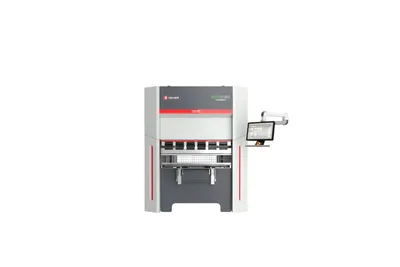
The Salvagnini P4X is a CNC automatic panel bending machine from Salvagnini Group S.p.A., headquartered in Sarego, Italy. While technically a panel bender rather than a traditional turret punch press, the Salvagnini P4X is categorized within the sheet metal fabrication equipment class and competes in the same fabrication line as punch presses for sheet metal parts processing.

The P4X processes flat punched or laser-cut blanks into fully-formed box and panel components using a sequence of positive and negative bending operations programmed automatically from part geometry. A panel bender differs from a traditional press brake: where a press brake requires an operator to manually position and reposition the part for each bend, the P4X automatically positions the blank, indexes through the bend sequence, and produces a completed panel without operator repositioning between bends.

The P4X handles panels from 150 x 150 mm to 3,020 x 1,530 mm, in sheet thicknesses from 0.5-3.0 mm (mild steel and stainless) and 0.5-4.0 mm aluminum. Bending length up to 3,020 mm enables full-width panel bending for enclosure sides, HVAC panels, and large electrical cabinet components. The automatic blank repositioner manipulates blanks without operator contact during the bending sequence.

The P4X competes with the Trumpf TruBend Cell series, the Bystronic BySmart Fiber combination system, and the Prima Power Combo systems for automated panel bending. Salvagnini differentiators are the dedicated panel bender architecture (the P4X is purpose-built for bending only, not a press brake with automation), blanking speed, and the Salvagnini MAC3.0 software for automatic part programming from DXF files. Pricing typically runs $400,000-$900,000.

03

Full Specifications

Parameter Value
Panel Size Max 3,020 x 1,530 mm (119 x 60 in)
Panel Size Min 150 x 150 mm (5.9 x 5.9 in)
Sheet Thickness Steel 0.5-3.0 mm
Sheet Thickness Aluminum 0.5-4.0 mm
Bending Length 3,020 mm (119 in)
Bend Force Variable (servo-controlled)
Bending Speed Up to 180 bends/min
Blank Repositioning Automatic (no operator intervention between bends)
CNC Control Salvagnini MAC3.0 automatic programming
Machine Weight 18,000 kg (39,683 lb)
Electrical 400 VAC 3-phase 50 Hz
Model P4-3220
Maximum Length Of Incoming Sheet 3850
Maximum Width Of Incoming Sheet 1524
Maximum Diagonal That Can Be Rotated 4000
Maximum Bending Force 660
Maximum Clamping Force 1060
Maximum Bending Length 3200
Maximum Bending Height 203
Minimum Thickness 0.5
Maximum Thickness And Bending Angle Steel Uts 410 N Mm2 3.2 (±90°)2.5 (±130°)2.1 (±135°)
Maximum Thickness And Bending Angle Stainless Steel Uts 660 N Mm2 2.5 (±90°)2.1 (±125°)1.6 (±130°)
Maximum Thickness And Bending Angle Aluminium Uts 265 N Mm2 4.0 (±120°)3.5 (±130°)3.0 (±135°)

Specifications sourced from salvagninigroup.com — verified 2026-03-28

04

Strengths & Limitations

Strengths

  • Automatic blank repositioning eliminates operator handling between bends - one operator manages multiple machines simultaneously
  • MAC3.0 automatic programming generates bend sequences directly from DXF part geometry, reducing programming to minutes
  • 180 bends/minute bending speed dramatically outperforms manual press brake on multi-bend parts with many bends
  • Consistent bend angle accuracy without operator skill variation - statistical quality consistency across full production shift
  • Enables 24-hour lights-out bending with automated blank handling systems

Limitations

  • Sheet thickness limited to 3.0 mm steel maximum - heavy gauge and structural plate fabrication requires press brake
  • High capital cost at $400K-$900K requires sustained high-volume enclosure or panel production to justify investment
  • Dedicated panel bending only - cannot replace punch press or laser for cutting operations; requires upstream cutting cell
05

Best For

Electrical enclosure manufacturers producing 4-6 side boxes, cable trays, and mounting panels in 0.8-2.5 mm steel at high volumes HVAC ductwork manufacturers bending duct sections, transitions, and air handling components in galvanized and aluminum Contract fabricators with high-volume panel bending workload (500+ boxes/shift) where press brake labor cost is the production constraint Automotive component tier suppliers bending steel enclosures, battery box covers, and structural panels at production volumes
06

Frequently Asked Questions

01 What is the difference between a panel bender and a press brake?

A press brake uses a top punch and bottom die with the part held manually or by a backgauge system. For each bend, the operator positions the part, actuates the press, then repositions for the next bend. On a 6-bend box, this requires 6 operator positioning steps plus 6 press actuations - skilled operator cycle: 2-3 minutes per box. A panel bender like the P4X uses a different mechanism: an automatic blank repositioner positions the flat blank on the machine table, and bending blades (upper and lower) fold the panel edges without the operator touching the part between bends. For the same 6-bend box: the P4X repositions automatically between all 6 bends with no operator touch - cycle time: 20-45 seconds per box. At high volume (500 boxes/shift), the P4X produces in one shift what would take 4-6 press brake operators.

02 What is MAC3.0 automatic programming?

MAC3.0 is Salvagnini's automatic part programming system that generates the complete bending sequence from DXF part geometry without manual programming. Workflow: import the DXF flat pattern; MAC3.0 analyzes the geometry, determines the bend lines, calculates the bend sequence to avoid collisions and minimize blank repositioning moves, and generates the CNC program. For standard box and panel geometries, programming takes 5-15 minutes. For complex parts, MAC3.0 may require operator review and adjustment of the proposed bend sequence. MAC3.0 includes material-specific bend parameter libraries for common steel, stainless, and aluminum alloys with springback compensation values for each material/thickness combination.

03 What types of panels can the P4X not produce?

P4X limitations: (1) Thickness above 3.0 mm steel or 4.0 mm aluminum - heavy gauge requires press brake; (2) Parts with flanges taller than approximately 250 mm - the panel bender blade geometry limits maximum flange height; (3) Parts requiring complex progressive die-type operations (embossing, drawing, coining) - P4X is bending only; (4) Tubular or round cross-section forming - P4X is for flat blank bending to angular shapes; (5) Parts with very tight inside radius (less than 0.5x material thickness) - panel bender achieves larger radii than air bending on a press brake with specialty tooling. For parts outside these limits, press brake or dedicated forming equipment is required.

04 How does the P4X integrate with upstream laser or punch cutting?

The P4X receives flat blanks from the upstream cutting operation (laser, punch, or plasma). Integration levels: (1) Manual feed - operator stacks cut blanks on an input conveyor and the P4X picks from the stack; (2) Automated conveyor link - the Salvagnini or third-party automated conveyor transfers blanks from the laser or punch press output directly to the P4X input; (3) Full FMS (Flexible Manufacturing System) - Salvagnini S4Xe FMS integrates laser cutting, punch press, panel bender, and storage in a single automated cell with parts routing via overhead crane or conveyor. For shops with high mixed-product volume, the FMS integration eliminates batch transfers between operations and enables single-piece flow from raw sheet to finished bent panel.

05 What is the typical production rate for the P4X on a standard electrical enclosure?

Standard 4-side electrical enclosure (400 x 300 x 200 mm, 1.5 mm mild steel, 8 bends): P4X cycle time approximately 30-45 seconds including blank repositioning. Output: 80-120 enclosures/hour from one machine with one operator. Press brake comparison on same part: 90-120 seconds per part with experienced operator = 30-40 parts/hour. P4X throughput advantage: 2.5-3x for this geometry. For a 6-side enclosure requiring a separate top and bottom bending: add a second pass or a second P4X in line. At 120 enclosures/hour x 2 shifts x 250 days: 480,000 enclosures per year from one P4X - a throughput level requiring 3-4 press brake operators to match.

07

Videos

Salvagnini panel bending: streamline sheet metal working with P4 panel bender capabilities

Salvagnini panel bending: streamline sheet metal working with P4 panel bender capabilities

Salvagnini

Salvagnini panel bender: hemming, radius, safe & inner bends—all in one with P2-1620

Salvagnini panel bender: hemming, radius, safe & inner bends—all in one with P2-1620

Salvagnini

SALVAGNINI P4X 2116 Automatic Panel Bending Machine (2010) id11239 -For Sale -

SALVAGNINI P4X 2116 Automatic Panel Bending Machine (2010) id11239 -For Sale -

Vanto Machines

Forming with Salvagnini panel bender

Forming with Salvagnini panel bender

Atlas Manufacturing

08

Community Discussions

Practical Machinist

Salvagnini press brake CNC tooling adjustment

Community discussion — Salvagnini press brake CNC tooling adjustment

Practical Machinist

OT- Any Trumpf / Salvagnini users - Practical Machinist

Community discussion — OT- Any Trumpf / Salvagnini users - Practical Machinist

Practical Machinist

CNC Machining | Salvagnini programs - Practical MachinistCNC Programming Service - Practical MachinistCareer Opportunities Wanted | Sheet Metal Programmer ...

Maintenance and service — Salvagnini programs - Practical MachinistCNC Programming Service - Practical MachinistCareer Opportunities Wanted | Sheet Metal Programmer ...

Practical Machinist

General | Need help indentifying metal.

Troubleshooting and problem-solving — Need help indentifying metal.

CNCZone

Radius bend - salvagnini - CNCzone

Community discussion — Radius bend - salvagnini - CNCzone

CNCZone

Salvagnini or Trumpf programmers - CNCzone

Community discussion — Salvagnini or Trumpf programmers - CNCzone

CNCZone

Search Results - CNCzone.com- Largest Forums for CNC ...

Community discussion — Search Results - CNCzone.com- Largest Forums for CNC ...

CNCZone

Need Help! Mr - cnczone.com

Pricing and buying discussion — Need Help! Mr - cnczone.com

Reddit

experience with Xometry? : r/Machinists - Reddit

Owner experience and review — experience with Xometry? : r/Machinists - Reddit

Reddit

Need Help with Vevor Lathe Decision : r/Machinists - Reddit

Troubleshooting and problem-solving — Need Help with Vevor Lathe Decision : r/Machinists - Reddit

Reddit

Tool box recommendations : r/Machinists - Reddit

Community discussion — Tool box recommendations : r/Machinists - Reddit

Reddit

benchtop lathe/mill recommendations? : r/Machinists - Reddit

Options and configuration advice — benchtop lathe/mill recommendations? : r/Machinists - Reddit

Links to community discussions. Summaries are editorial — visit the original thread for full context.

09

Related Machines