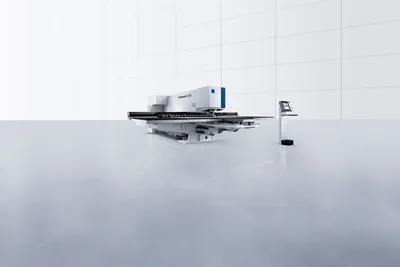
Salvagnini Combi P4+L3
Key Specifications
laser type
cutting area
cutting thickness steel
cutting thickness aluminum
panel bender width
bending thickness steel
Overview
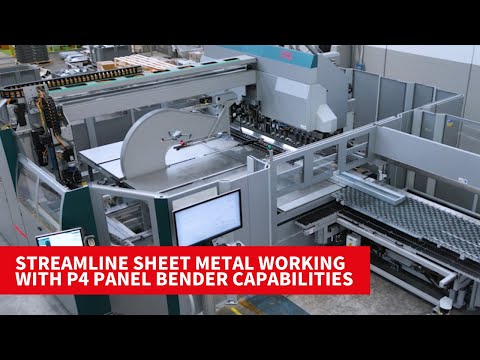
The Salvagnini Combi P4+L3 is an integrated combination system that pairs the Salvagnini P4lean automatic panel bender with the Salvagnini L3 fiber laser cutting cell in a single automated manufacturing system. Produced by Salvagnini Group S.p.A. of Sarego, Italy, the Combi P4+L3 enables complete sheet metal fabrication from raw flat sheet to finished bent panel without operator intervention between the cutting and bending operations — a concept Salvagnini calls the 'complete cell' approach to automated sheet metal production.
The L3 component is Salvagnini's fiber laser cutting system, available in power levels from 3 kW to 10 kW, capable of cutting mild steel up to 25 mm, stainless up to 20 mm, and aluminum up to 15 mm depending on laser power selected. The L3 uses an automatic sheet loader and part sorter that feeds raw sheets from a pallet stack, cuts the programmed part nest, and transfers finished blanks to the P4lean panel bender via an automated conveyor or Salvagnini S4 automated warehouse interface. The transition from cut blank to bent panel is fully automated — no operator blank transfer is required.
The P4lean panel bender within the Combi system processes blanks from 200 x 200 mm up to 3,000 x 1,500 mm in sheet thicknesses from 0.5 mm to 3.0 mm steel. Bending speed up to 180 bends/minute is maintained. The integrated system shares a single Salvagnini MAC3.0 software environment: the operator programs a part order in MAC3.0, and the software simultaneously generates the laser cutting nest and the panel bender bend sequence — a single programming step produces the complete part program for both operations.
For shops with high mixed-product volume and dedicated sheet metal fabrication capacity, the Combi P4+L3 represents a significant density improvement over separate standalone laser and panel bender installations. System footprint is larger than either machine independently, but the elimination of manual inter-operation blank transfer, reduced work-in-process queue between cutting and bending, and single-operator management of both processes delivers throughput and labor efficiency gains that justify the combined system investment for appropriate production volumes.
The Combi P4+L3 competes with the Trumpf TruBend Cell 5000 + TruLaser combination, Bystronic combination cells, and the Prima Power Combi Genius laser punch. Pricing for the complete Combi P4+L3 system with automated blank handling ranges from $1,200,000 to $2,500,000 depending on laser power, automation level, and warehouse integration. Return on investment is typically calculated against 3-4 press brake operators plus a laser operator, all replaced by a single system operator.
Full Specifications
| Parameter | Value |
|---|---|
| Laser Type | Fiber laser (3 kW, 6 kW, or 10 kW options) |
| Cutting Area | 3,000 x 1,500 mm (118 x 59 in) |
| Cutting Thickness Steel | Up to 25 mm (10 kW config) |
| Cutting Thickness Aluminum | Up to 15 mm (10 kW config) |
| Panel Bender Width | 3,000 mm (118 in) |
| Bending Thickness Steel | 0.5-3.0 mm |
| Bending Speed | Up to 180 bends/min |
| Blank Transfer | Automated (conveyor or S4 warehouse link) |
| CNC Control | Salvagnini MAC3.0 (unified cutting + bending programming) |
| Combined Footprint | Approx. 12,000 x 8,000 mm (varies by config) |
| Electrical | 400 VAC 3-phase 50 Hz |
Specifications compiled from manufacturer literature and industry references. Not independently verified against a published spec sheet — confirm with the manufacturer or an authorised dealer before making a purchasing decision.
Strengths & Limitations
Strengths
- Single MAC3.0 programming environment generates laser cutting nest and bending sequence simultaneously — one program step for the complete part
- Fully automated blank transfer from laser output to panel bender input eliminates manual handling and inter-operation queue time
- One operator manages the complete cutting-to-bending process, replacing 3-5 separate machine operators in an equivalent standalone cell
- Integrated production tracking and order management via Salvagnini WMS enables lights-out operation for programmed part batches
- Fiber laser cutting combined with panel bending covers 80-95% of typical sheet metal fabrication work in a single system for thin-gauge steel, stainless, and aluminum
Limitations
- Capital cost of $1.2M-$2.5M is one of the highest investments in sheet metal fabrication equipment — requires documented high-volume production to justify
- Panel bender thickness limit (3.0 mm steel) means the system cannot process heavy-gauge structural work — shops with mixed light and heavy gauge need additional press brake capacity
- System downtime risk is higher than standalone machines: if either the laser or the panel bender is in maintenance, the entire integrated line is affected
Best For
Frequently Asked Questions
01
MAC3.0 accepts a 3D part model or a DXF flat pattern as input. From the part geometry, MAC3.0 automatically: (1) unfolds the 3D model to produce the flat blank shape if a 3D model is provided; (2) generates the laser cutting nest — packing the flat blank shape and any part features (holes, cutouts, slots) onto the raw sheet format most efficiently; (3) calculates the bending sequence for the panel bender, including blank repositioning path, bending blade positions, and springback compensation values; (4) produces a single production order that is sent to both machines. The operator confirms the production order and releases it — both the laser and the panel bender begin executing their respective portions of the program. This single-step programming reduces part setup time from 30-60 minutes (programming laser and press brake separately) to 5-15 minutes for a new part.
02
The L3 laser component within the Combi system includes an automatic part sorter that identifies cut parts versus skeleton scrap. Finished blank parts are transferred to the panel bender conveyor. The cutting skeleton (the remaining sheet material after part removal) is automatically moved to a scrap container or skeleton pallet by the L3's material handling system. Small offcut parts that are programmed as production parts (not scrap) can be sorted to a secondary output bin for manual routing to additional operations. The skeleton handling is automatic — the operator does not need to manually clear scrap between cycles, which is critical for unmanned overnight runs.
03
Yes. While the Combi P4+L3 is designed as an integrated system, both the L3 laser and the P4lean panel bender can be operated as standalone machines when the combined workflow is not required. The operator can run the laser only (for cutting flat parts that do not need bending), run the panel bender only (feeding pre-cut blanks manually from an external source), or run both in integrated mode. This independence is important for maintenance scheduling — a service event on the panel bender does not prevent the laser from running flat-cutting orders, and vice versa. However, for peak overall equipment effectiveness (OEE), the integrated mode is preferred.
04
The L3 laser cuts mild steel (CR and HR), stainless steel (304, 316, duplex), aluminum (5xxx and 6xxx series), galvanized steel, and copper. The P4lean panel bender processes mild steel and stainless (0.5-3.0 mm) and aluminum (0.5-4.0 mm). In practice, the Combi P4+L3 handles virtually all thin-gauge sheet metal used in enclosure, HVAC, and light structural fabrication. Materials that the laser can cut but the panel bender cannot subsequently bend (e.g., thick stainless above 3.0 mm, copper sheet for electrical bus components) would be cut by the laser and routed to a standalone press brake for bending — a workflow the MAC3.0 system can accommodate by flagging those parts for manual transfer.
05
The S4Xe FMS (Flexible Manufacturing System) is Salvagnini's most comprehensive automated sheet metal system, incorporating the S4 automated tower warehouse for raw sheet and blank storage, the L3 or L5 laser cutter, the P4lean panel bender, and a fully automated part routing system that sequences orders across all machines without operator intervention. The Combi P4+L3 is a simpler two-machine combination — laser plus panel bender — with automated blank transfer but without the full tower warehouse integration of the S4Xe. The Combi P4+L3 is appropriate for shops with a dedicated part mix running large batches. The S4Xe FMS is appropriate for shops running high-mix, low-volume work where automated sequencing of many different part orders across multiple machines delivers the greatest efficiency gain.
Videos
Salvagnini

Salvagnini

Salvagnini

Salvagnini

Italian Machinery Association (IMA)
Community Discussions
Community discussion — OT- Any Trumpf / Salvagnini users - Practical Machinist
Community discussion — Salvagnini programs - Practical MachinistSalvagnini press brake CNC tooling adjustmentGeneral | Question for you Salvagnini types. | Practical ...CNC Machining | CNC Turret Punches - Practical MachinistGeneral | I am in Sandiego any machinerey dealers to see ...
Community discussion — Salvagnini press brake CNC tooling adjustment
Community discussion — Question for you Salvagnini types. | Practical ...
Community discussion — Search Results - CNCzone.com- Largest Forums for CNC ...
Troubleshooting and problem-solving — Problem with Salvagnini L3 - CNCzone
Community discussion — Salvagnini or Trumpf programmers - CNCzone
Community discussion — Radius bend - salvagnini - CNCzone
Options and configuration advice — benchtop lathe/mill recommendations? : r/Machinists - Reddit
Pricing and buying discussion — Cheap Combination Mill/Lathe. Great value entry level setup ...
Community discussion — Belzona or alternatives. : r/Machinists - Reddit
Options and configuration advice — Tool box recommendations? : r/Machinists - Reddit
Links to community discussions. Summaries are editorial — visit the original thread for full context.
Related Machines
Trumpf TruMatic 3000
Trumpf TruMatic 7000
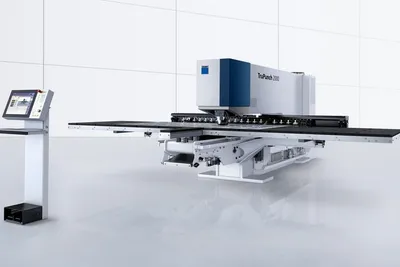
Trumpf TruPunch 2000
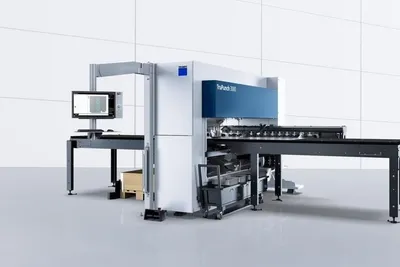
Trumpf TruPunch 3000