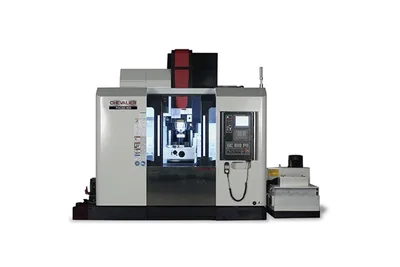
Rollomatic NaNO6
Key Specifications
X Travel
Y Travel
Z Travel
Max Spindle
Rapid Traverse
Spindle Power
How much does the Rollomatic NaNO6 cost?
Estimated price range
Our best estimate for a cnc grinding machine in this class — not a quote from Rollomatic. Configuration moves it a long way.
Overview
The Rollomatic NaNO6 is a six-axis grinder for micro tools: its grinding range runs from Ø 0.03 to 2.0 mm, on shanks of 1.0 to 6.35 mm (0.040 to 0.250 in). Grinding length is 30 mm (1.180 in) and overall tool length 100 mm (4 in).
Everything about the machine is scaled to that range. Travels are 146 mm (5.8 in) in X and Z and 99 mm (3.9 in) in Y, with 15 m/min (590 in/min) rapids. The spindle is 1.5 kW and runs from 2000 to 12000 rpm, carrying a pack of 4 wheels of 125 mm (5 in) diameter, with a maximum wheel peripheral speed of 66 m/s. A tool of 2.0 mm or less gives up very little material, so the small motor is no handicap. What counts is how finely the axes can be placed.
On that point Rollomatic publishes resolution and accuracy separately. Linear axis resolution is 0.00005 mm. Stated to ISO 230-2, positioning accuracy is 0.0025 mm and repeatability 0.0010 mm. Of the rotary axes, A has a 119° stroke at 8000°/min and B a 200° stroke at 10800°/min, both resolving 0.00005°, while C turns the tool at up to 1000 rpm with 0.0001° resolution.
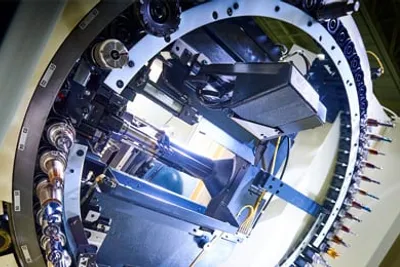
The robot holds 1000 tools with shanks of 1.0 to 6.35 mm and lengths up to 101.6 mm (4 in), and it moves at 60 m/min. Tools are clamped in W10 collets.
The NaNO6 weighs 2900 kg (6400 lbs), measures 1970x1460x2060 mm (78x57x81 in) and has a total power of 10 kW.
Full Specifications
| Parameter | Value |
|---|---|
| Grinding Range | Ø0.03– 2.0 mm (.001"– .080") |
| Shank Diameter | 1.0 – 6.35 mm (0.040"– 0.250") |
| Grinding Length | 30 mm (1.180") |
| Overall Tool Length | 100 mm (4") |
| CNC Control | FANUC30iMB |
| X-Axis Travel | 146 mm (5.8") |
| Y-Axis Travel | 99 mm (3.9") |
| Z-Axis Travel | 146 mm (5.8") |
| Rapid Traverse Rate | 15 m/min (590"/min) |
| Linear Axis Resolution | 0.00005 mm |
| A Axis Stroke | 119° |
| A Axis Fast Rotation | 8000°/min |
| A Axis Resolution | 0.00005° |
| B Axis Stroke | 200° |
| B Axis Fast Rotation | 10800°/min |
| B Axis Resolution | 0.00005° |
| C Axis Fast Rotation | 1000 rpm |
| C Axis Resolution | 0.0001° |
| Spindle Motor Power | 1.5 kW |
| Max Spindle Speed | 2000 -12000 rpm |
| Number of Wheels per Pack | 4 |
| Grinding Wheel Diameter | 125 mm (5") |
| Collet Type | W10 |
| Robot Number of Tools | 1000 |
| Robot Shank Diameter | 1.0 – 6.35 mm (.040" – .250") |
| Robot Max Tool Length | 101.6 mm (4") |
| Robot Speed | 60 m/min (2300"/min) |
| Positioning Accuracy Iso 230 2 | 0.0025mm |
| Repeatability Iso 230 2 | 0.0010mm |
| Max Wheel Peripheral Speed | 66 m/s |
| Floor Space Required | 1970x1460x2060mm (78"x57"x81") |
| Machine Weight | 2900 kg (6400 lbs) |
| Total Power | 10 kW |
Specifications sourced from rollomatic.ch — verified 2026-10-03
Strengths & Limitations
Strengths
- Grinding range from Ø 0.03 to 2.0 mm for micro tools
- Positioning accuracy of 0.0025 mm and repeatability of 0.0010 mm, both stated to ISO 230-2
- Linear axis resolution of 0.00005 mm, with the A and B axes resolving 0.00005°
- Robot for 1000 tools, moving at 60 m/min
- Compact at 1970x1460x2060 mm (78x57x81 in) and 2900 kg (6400 lbs)
- Spindle range of 2000 to 12000 rpm with a wheel peripheral speed of up to 66 m/s
Limitations
- Nothing above Ø 2.0 mm can be ground, and shanks stop at 6.35 mm (0.250 in)
- Grinding length is limited to 30 mm (1.180 in) and overall tool length to 100 mm (4 in)
- The 1.5 kW spindle suits micro tools only and is not sized for heavier stock removal
- W10 is the only collet type in the table
Best For
Frequently Asked Questions
01
Rollomatic lists a grinding range of Ø 0.03 to 2.0 mm on shank diameters of 1.0 to 6.35 mm (0.040 to 0.250 in). Grinding length is 30 mm (1.180 in) and overall tool length is 100 mm (4 in).
02
To ISO 230-2, positioning accuracy is 0.0025 mm and repeatability is 0.0010 mm. Linear axis resolution is 0.00005 mm. The A and B axes resolve 0.00005° and the C axis 0.0001°.
03
A 1.5 kW spindle with a speed range of 2000 to 12000 rpm. It carries 4 wheels per pack at a wheel diameter of 125 mm (5 in), and the maximum wheel peripheral speed is 66 m/s.
04
The robot holds 1000 tools. It takes shank diameters of 1.0 to 6.35 mm (0.040 to 0.250 in) and tool lengths up to 101.6 mm (4 in), and its speed is listed as 60 m/min.
05
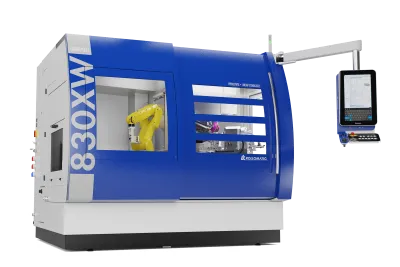
They sit at opposite ends of the size range. The NaNO6 has 146 mm (5.8 in) of X and Z travel, 99 mm (3.9 in) of Y, a 1.5 kW spindle and a weight of 2900 kg (6400 lbs). The GrindSmart 830XW has 320 mm (12.6 in) of X, 200 mm (7.87 in) of Y and 400 mm (15.7 in) of Z, an 11 kW (15 HP) spindle and weighs 6200 kg.
More from Rollomatic
Rollomatic GrindSmart 628XW
Rollomatic LaserSmart 510
Rollomatic GrindSmart 629XW
Rollomatic ShapeSmart NP5